Analyst warns China’s spent rocket stages continue to worsen
▼ Summary
– China’s annual orbital rocket launches grew from fewer than 20 a decade ago to a record 93 in the last year, making it the second-most productive space power.
– China’s launch growth is expected to continue from both state-owned enterprises and private companies, mirroring trends in the US and SpaceX.
– China appears to be ignoring long-established norms for safely disposing of rocket upper stages after launches.
– For the last 20 years, most countries have adopted responsible disposal of upper stages because uncontrolled multi-ton metal in low-Earth orbit creates long-term problems.
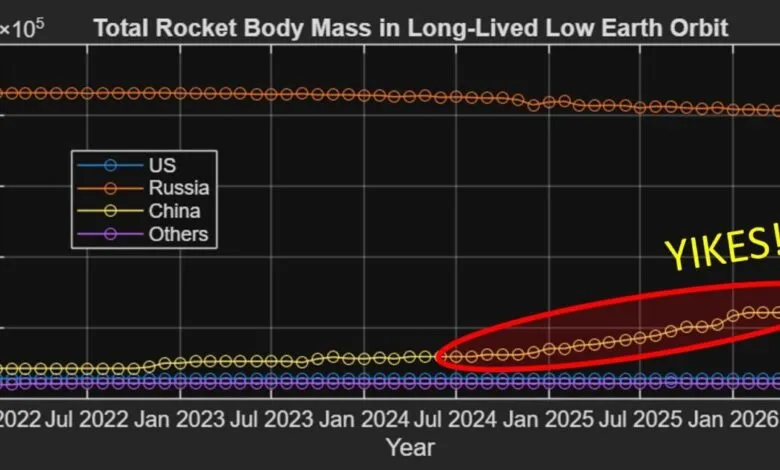
– Russia is the biggest offender with about 800 metric tons of rocket bodies in long-lived orbits, while the US has about 57 metric tons, with both totals holding steady or slowly declining.
Just over a decade ago, China had never launched more than 20 orbital rockets in a single year. That benchmark is now a distant memory. Starting in 2022, the nation launched 64 rockets, and last year it shattered that record with a remarkable 93 launches, cementing its position as the world’s second most prolific space power.
Growth shows no signs of slowing, driven by both state-owned enterprises and an expanding roster of private launch companies. There is nothing inherently wrong with this surge; China’s ascent mirrors that of the United States, particularly the rapid cadence achieved by SpaceX.
Yet a troubling pattern has emerged. China appears to be disregarding long-established norms for disposing of rocket upper stages , the sections that separate from the first stage and propel payloads into orbit.
The shift toward responsible disposal
In the early days of spaceflight, the Soviet Union, the United States, and other spacefaring nations gave little thought to these discarded “rocket bodies.” They were simply left in various orbits, where they would remain for decades before slowly decaying under Earth’s gravity.
Over the last 20 years, however, most countries and their private operators have adopted a more responsible approach. The reason is clear: large, multi-ton chunks of metal spinning uncontrollably in low-Earth orbit pose a growing hazard.
Russia remains the biggest offender, with roughly 800 metric tons of rocket bodies lingering in long-lived orbits between 600 km and 2,000 km above Earth, according to data from the European Space Agency’s Space Debris Office and Jonathan McDowell’s General Catalog of Artificial Space Objects. The United States, by contrast, accounts for about 57 metric tons in these altitudes. Crucially, those figures are either stable or, in Russia’s case, slowly declining as stages naturally fall out of orbit. China’s trajectory, however, is moving in the opposite direction.
(Source: Ars Technica)