China Recovers First Reusable Rocket, Demonstrates New Recovery Method
▼ Summary
– China’s state-owned rocket developer recovered a reusable orbital-class booster for the first time on Friday in the South China Sea.
– The Long March 10B rocket launched from Wenchang on Hainan Island, powered by seven kerosene-fueled engines.
– About 10 minutes after liftoff, the booster descended into a four-legged frame with tensioned cables on an offshore ship.
– The rocket’s upper stage deployed a payload called CX-26 into orbit, and Chinese officials declared the flight a “complete success.”
– CASC and CALT became the third enterprise to achieve controlled rocket recovery, after SpaceX and Blue Origin.
China’s primary state-run rocket manufacturer, the organization behind the Long March family, achieved a significant breakthrough on Friday by successfully recovering a reusable orbital-class booster for the very first time. The recovery took place in the South China Sea, marking a major step forward for the nation’s space ambitions.
The landmark mission launched a Long March 10B rocket from the Wenchang Commercial Space Launch Site on Hainan Island, China’s southernmost province. Lifting off at 12:15 am EDT (04:15 UTC), or 12:15 pm local time at the coastal spaceport, the rocket stood approximately 209 feet (63.6 meters) tall and was powered by seven kerosene-fueled engines.
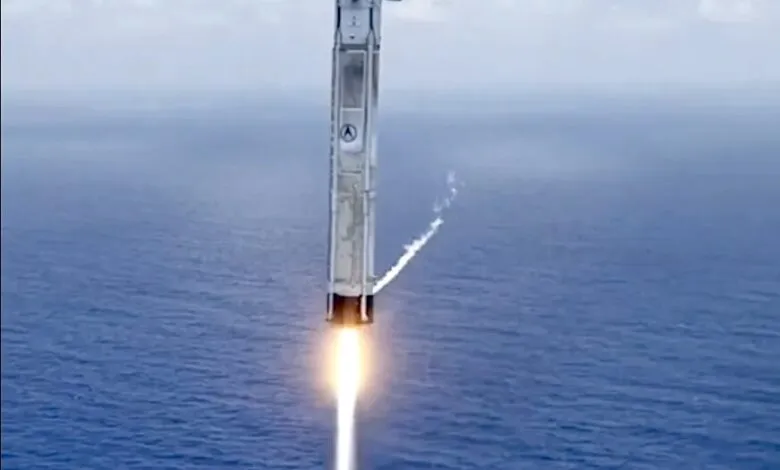
Roughly ten minutes after liftoff, the Long March 10B booster descended from space and navigated itself into a specialized four-legged recovery frame mounted on an offshore vessel. The ship was equipped with tensioned cables stretched in a grid pattern, which effectively caught the rocket as its landing engines shut down. This left the smoldering booster suspended in midair. Meanwhile, the rocket’s upper stage continued its journey into orbit, successfully deploying a payload identified only as CX-26. Chinese officials have described the flight as a “complete success.”
Mao Ning, a spokesperson for the Chinese Foreign Ministry, celebrated the achievement on X, writing: “A historic day in China’s space program! China’s Long March 10B has successfully completed its maiden flight,and recovered its first stage via a sea-based net. This marks the country’s first-ever controlled rocket recovery. A major leap toward reusable launch capabilities.”
With this landing, the China Aerospace Science and Technology Corporation (CASC) and its subsidiary, the China Academy of Launch Vehicle Technology (CALT) , have become the third enterprise globally to accomplish such a feat. SpaceX first achieved this with its Falcon 9 rocket in 2015, followed by the Starship/Super Heavy booster in 2024. Blue Origin also joined the ranks last November, landing its New Glenn booster on an offshore platform.
While both SpaceX and Blue Origin rely on propulsive landings to return their Falcon 9 and New Glenn boosters to offshore platforms or onshore pads, SpaceX introduced a novel technique with Starship. That method involves catching the rocket’s reusable booster back at the launch pad using mechanical arms attached to the launch tower. China’s approach, however, employed a sea-based net system, demonstrating an alternative recovery method that could prove valuable for future missions.
(Source: Ars Technica)