Toyota Highlander EV: 320-Mile Range, 3-Row Electric SUV
▼ Summary
– Toyota has unveiled the 2027 Highlander, its first three-row electric SUV for the US market and its first American-assembled EV, targeting a popular vehicle segment.
– The launch occurs as Toyota’s hybrid-focused strategy appears validated amid slowing global EV sales, and under a new CEO who oversaw navigating industry challenges.
– The Highlander EV features two trims, battery options up to 95.8kWh offering up to 320 miles of range, and a comprehensive infotainment system with a large touchscreen.
– It includes practical family features like seating for seven, a fold-flat third row, a Tesla NACS charging port for fast charging, and vehicle-to-load power capabilities.
– Toyota will announce pricing later this year, building on recent EV sales momentum, as the Highlander represents a critical opportunity to compete in the electric SUV market.
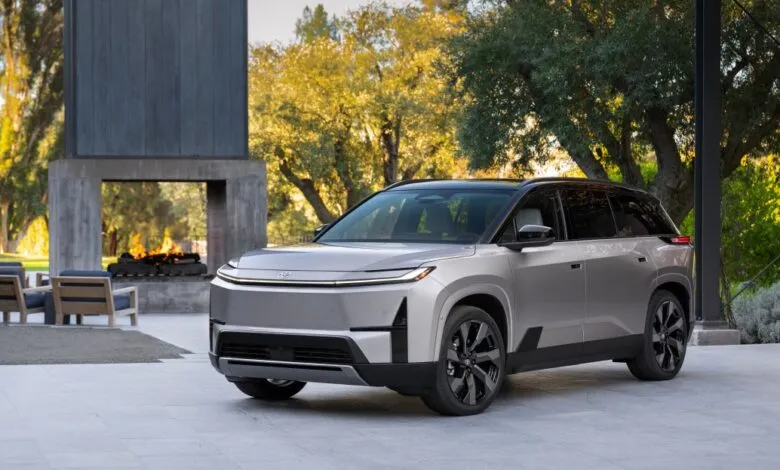
Toyota has officially revealed the 2027 Highlander, a completely reimagined midsize SUV that serves as the brand’s inaugural three-row electric vehicle for the U.S. market and its first American-assembled EV. This strategic move leverages a trusted nameplate to enter one of the country’s most competitive and popular vehicle segments. The launch arrives during a pivotal period for the automaker, as its measured approach to electrification appears increasingly prudent amidst shifting market dynamics and significant financial pressures on competitors.
The decision to produce the Highlander EV at Toyota’s Kentucky plant is a direct response to complex global challenges, including potential tariffs and the intense competition from Chinese manufacturers. By choosing a familiar model name over the more cryptic “bZ” branding, Toyota aims to connect immediately with a broad customer base already comfortable with the Highlander legacy. This vehicle represents a critical test of the company’s ability to translate its hybrid success into the pure electric arena.
The new Highlander will be offered in just two trims: XLE and Limited. The XLE can be configured with front-wheel drive or all-wheel drive, while the Limited comes standard with AWD. Powertrain options center on two battery packs: a 77kWh unit and a larger 95.8kWh pack. Models equipped with all-wheel drive and the larger battery are projected to achieve an estimated 320 miles of range, supported by 338 horsepower and 323 lb-ft of torque. Front-wheel-drive versions will offer 221 horsepower and 198 lb-ft of torque.
Inside, the cabin features an updated infotainment system with a 14-inch central touchscreen and a 12.3-inch digital gauge cluster. The interface includes a customizable home screen, enhanced “Hey Toyota” voice commands, and integrated streaming apps like Spotify. A fixed panoramic glass roof, noted as the largest ever in a Toyota, stretches overhead. The vehicle seats seven passengers, with a third row that folds flat to provide over 45 cubic feet of cargo space. Convenience touches abound, including wireless charging pads, numerous USB-C ports across all rows, rear climate controls, and a hands-free power liftgate.
Charging flexibility is a key focus. The Highlander EV will come standard with a NACS port for seamless access to the expansive Tesla Supercharger network. Using DC fast charging, the battery can replenish from 10 to 80 percent in roughly 30 minutes under ideal conditions. Battery preconditioning to optimize charge speed is standard and can be activated manually or via an optional Drive Connect subscription. The SUV also introduces Toyota’s first vehicle-to-load (V2L) system, allowing it to power external devices and even serve as a backup power source for a home during an outage with the proper accessories.
In terms of dimensions, the electric Highlander is positioned to compete directly with rivals. It measures 198.8 inches long, 78.3 inches wide, and 67.3 inches tall, with a 120.1-inch wheelbase. This places it in close company with vehicles like the Rivian R1S, Kia EV9, and Hyundai Ioniq 9. Pricing details will be announced closer to its production date later this year. Toyota’s recent momentum in electrification, highlighted by the stronger-than-expected sales of its revamped bZ model, suggests the Highlander EV could be the catalyst the company needs to solidify its presence in the electric vehicle marketplace.
(Source: The Verge)