Wildfire Evacuates NASA’s Deep Space Network in Spain
▼ Summary
– A fast-moving wildfire forced an evacuation and temporarily suspended operations at NASA’s Madrid Deep Space Communications Complex in Spain.
– The Madrid station is part of NASA’s Deep Space Network, which provides global coverage for over 40 missions including Artemis and the James Webb Space Telescope.
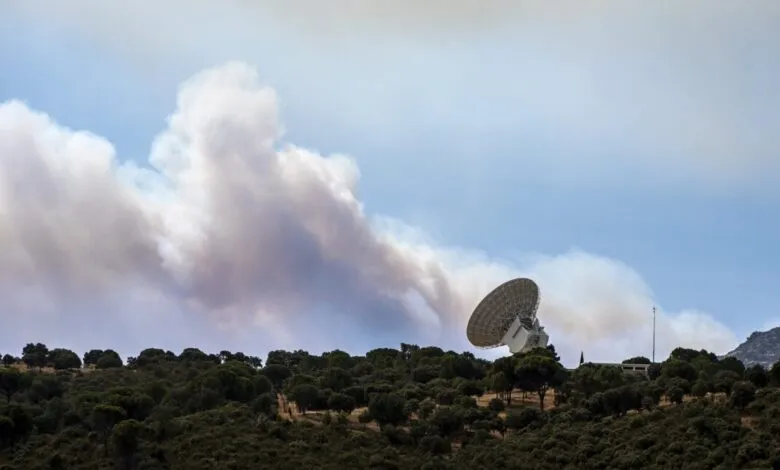
– The complex features a 230-foot radio dish and smaller antennas; flames and smoke were seen rising over the antenna array.
– NASA has transitioned mission support to the Goldstone complex in California to ensure uninterrupted spacecraft communications.
– NASA officials are monitoring the fires with local authorities and the US Embassy, with damage assessments planned once it is safe.
A fast-moving wildfire tore through the hills west of Madrid on Friday, forcing the evacuation of NASA’s Madrid Deep Space Communications Complex and temporarily halting operations at one of the agency’s most critical tracking stations. The blaze, part of a series of wildfires sweeping across Spain, prompted NASA to suspend activities at the facility located nearly 40 miles from central Madrid.
The Madrid complex is a cornerstone of NASA’s Deep Space Network, which works in tandem with stations in California and Australia to maintain constant communication with spacecraft as Earth rotates. This global system supports over 40 missions, from lunar expeditions under the Artemis program to the James Webb Space Telescope and the twin Voyager spacecraft at the edge of the Solar System. The network is essential for tracking probes and relaying data from the Moon to deep space.
A NASA spokesperson confirmed the evacuation Friday “due to ongoing wildfires in the region.” Images and video from the scene showed flames and thick smoke rising near the facility’s antenna array, which includes a massive 230-foot-diameter radio dish and several smaller 112-foot antennas. The spokesperson added, “Any potential damage will be assessed when it is safe to do so.”
Managed by NASA’s Space Communications and Navigation division and the Jet Propulsion Laboratory, the network’s operations are being coordinated with local authorities and the US Embassy. In a swift response, NASA shifted mission support to the Goldstone Deep Space Communications Complex in California. “The agency has seamlessly transitioned support for mission operations to Goldstone, ensuring continuity of service and uninterrupted support for spacecraft communications,” the spokesperson stated.
The Deep Space Network typically operates on a “follow the Sun” model, where control centers at each site in Australia, California, and Spain can remotely manage the entire network during local daytime hours. Antennas at all three locations run continuously, making the Madrid station’s temporary closure a significant but manageable disruption. High demand for the network’s limited capacity underscores the urgency of restoring full operations once the wildfire threat subsides.
(Source: Ars Technica)