Warner Bros. vs. Paramount: A New Takeover Threat?
▼ Summary
– The proposed Paramount-Warner Bros. Discovery merger is a highly leveraged deal, with Paramount borrowing tens of billions and relying heavily on funding from Larry Ellison’s personal fortune.
– A central strategic question is whether the combined entity can become a daily-use streaming platform like Netflix or YouTube, as both Paramount+ and HBO Max currently suffer from low engagement and high subscriber churn.
– The transaction includes declining linear TV assets like CNN, which are seen as necessary for their cash flow to service the deal’s massive debt, despite being in secular decline.
– A key rationale for the Ellison family is the belief that technology, particularly a migration to Oracle Cloud and AI, can reduce content production costs and create a competitive advantage where previous Warner acquirers failed.
– Industry analysts are skeptical the merger can overcome fundamental challenges, including an oversupply of content, powerful existing platforms, and the difficulty of marketing a new service in a saturated market.
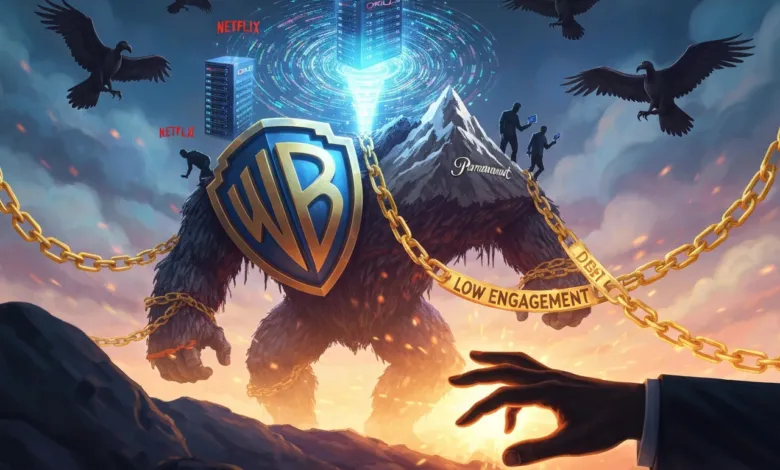
The potential merger between Paramount and Warner Bros. Discovery represents a seismic shift for the media landscape, driven by a massive debt-fueled acquisition and a bold gamble on artificial intelligence. David Ellison’s Paramount, backed by his father Larry Ellison’s fortune, outbid Netflix to secure the deal, committing to a price that demands tens of billions in borrowed money. This move defies a troubling history: previous acquirers of Warner Bros., from AOL to AT&T, have often been left struggling under crippling debt. The central question isn’t just why anyone would attempt this now, but whether the Ellisons’ strategy can finally break the curse.
Industry observers are deeply skeptical. The core assets being acquired, including legendary film studios and valuable intellectual property, are shadowed by significant challenges. Linear television networks, which still generate cash, are in irreversible decline. Meanwhile, the streaming services involved, Paramount+ and Max, struggle with user engagement compared to giants like Netflix and YouTube. The fundamental hurdle is transforming these platforms into daily destinations for viewers, rather than places they visit only for specific weekly shows. Achieving this requires not just more content, but a technological overhaul and marketing spend so vast it could overwhelm any cost savings from efficiency gains.
A significant portion of the Ellisons’ thesis appears to hinge on technology and AI. The plan involves migrating the combined company’s entire streaming infrastructure to Oracle Cloud, Larry Ellison’s primary business. This promises lower costs and better performance, but it’s an unproven move in high-scale streaming. Furthermore, there is a belief that AI can drastically reduce the cost of producing film and television content. However, this efficiency argument overlooks a parallel threat: AI is also empowering a tidal wave of user-generated content on platforms like YouTube and TikTok, potentially devaluing traditional studio IP by flooding the market with high-quality, low-cost alternatives.
Financially, the deal’s structure is daunting. The transaction is leveraged at approximately seven times debt to EBITDA, a heavy burden that necessitates the cash flow from those declining linear TV assets to service. The inclusion of these “terrible assets,” as some analysts describe them, was likely a mathematical necessity to make the debt load workable, and a tactical move since other bidders like Netflix wanted no part of them. The involvement of sovereign wealth funds, potentially from the Middle East, adds another layer of geopolitical complexity, especially for a news division like CNN and global blockbuster franchises that must navigate international sensitivities.
Looking ahead, the path is fraught with execution risk. Beyond regulatory scrutiny, the combined entity faces the enormous task of integrating two different corporate cultures, technology stacks, and content libraries. Layoffs, particularly in overlapping areas like cable news, are expected to be severe. The ultimate success metric is growth—can the new company create a streaming service so compelling and full of must-see content that it achieves daily engagement and reduces subscriber churn? This is the same challenge that has eluded other major players, including Disney.
The media industry’s distribution model has fundamentally fractured. While Netflix remains a powerful buyer, other platforms like YouTube, Instagram, and TikTok capture immense audience attention while paying creators little to nothing. In this environment, the strategy of simply owning more classic IP may not be enough; the winners will be those who can consistently produce new, captivating content that cuts through the noise. For the Ellisons, the gamble is that their capital, technology, and tolerance for risk can accelerate a turnaround where others have failed. The coming years will test whether this is a visionary consolidation or the latest, most expensive chapter in Warner’s notorious history.
(Source: The Verge)