Razer’s AI Assistant: A Holographic Desk Buddy That Helps, Not Judges
▼ Summary
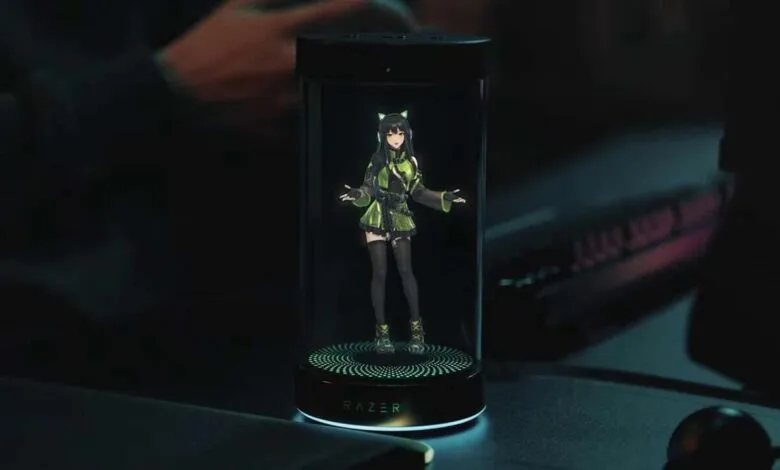
– Razer’s Project Ava, revealed at CES 2026, is an AI-powered desktop companion that interacts as a 3D hologram with multiple animated personalities.
– The device uses human-like vision and audio-sensing to converse, assist with work tasks, motivate self-care, and deliver real-time hype for gaming.
– It features several distinct character personalities, rendered in real-time on a holographic display with high-fidelity motion and expressions for user engagement.
– Project Ava currently uses the Grok AI engine but will be compatible with other platforms, and its physical design includes advanced mics, a camera, and RGB lighting.
– The device is designed for Windows PCs via a USB-C connection, with a planned launch in late 2026 and no pricing yet announced.
Among the wave of new technology unveiled at CES 2026, Razer’s Project Ava stands out as a uniquely ambitious vision for an AI-powered desktop companion. This device is not just another smart speaker; it’s designed to be a holographic partner with a distinct personality, capable of interacting with users through a 3D display. Razer describes it as a dynamic personality that can assist with daily tasks, from work consultations to personal motivation, all while appearing as a real-time animated character.
The system leverages advanced human-like vision and audio-sensing technologies to achieve full contextual awareness of its environment. This allows for natural, two-way conversations where Ava can discuss work projects, offer reminders for self-care routines, or even act as a gaming co-pilot by delivering real-time commentary and hype. For gamers, the assistant can fulfill multiple supportive roles, adapting its interactions to enhance the experience.
Users will have a selection of animated personalities to choose from, each with a unique visual style and presumed demeanor. The default character blends iconic sci-fi elements, reminiscent of HAL 9000 and the original Xbox startup screen. Other options include Kira, designed with an anime aesthetic; Zane, positioned as a gaming wingman; and Sao, who appears ready for a professional office setting. These holograms are rendered on a 5.5-inch display, featuring sophisticated animations like high-fidelity motion, realistic eye-tracking, and expressive facial features to create a more engaging presence.
Under the hood, Project Ava currently utilizes the Grok AI engine from xAI, a platform that has sparked its share of debate in the tech community. Razer has indicated plans to ensure future compatibility with other leading AI platforms, offering users flexibility. The physical hardware incorporates signature Razer elements, including dual Far-Field microphone arrays for clear audio pickup, an HD camera with an ambient light sensor, and customizable RGB lighting.
This is a product built for the Windows ecosystem, requiring a direct USB-C connection to a user’s PC to handle the high-bandwidth data necessary for its holographic functions. Razer is targeting a commercial launch in the latter half of 2026, though specific pricing details remain under wraps. The reveal of Project Ava was part of a broader showcase of cutting-edge gaming and interface technology at the event, which also featured innovations like high-refresh-rate XR glasses from Asus, novel brain-computer interface concepts, and premium controllers from accessory makers.
(Source: GameSpot)