Is Top-of-Funnel Content Still Worth It in 2027?
▼ Summary
– Organic search clicks have dropped by 42% since the expansion of AI Overviews in Google Search, as large language models increasingly answer queries directly within the platform.
– Publishers are flooding search results with top-of-funnel content at scale, which increases competition for clicks while the total number of available clicks decreases.
– An analysis of 30 major digital publishers from August 2026 compared to the previous year shows significant traffic declines in finance, healthcare, legal, and consumer tech sectors.
– These declines align with Google’s Your Money or Your Life categories where AI Overviews provide authoritative answers without requiring user clicks through to publisher sites.
– While B2B tech TOFU content saw some improvement, the overall trend suggests that traditional informational content may no longer justify its production costs due to reduced visibility and engagement.
Top-of-funnel content strategy has faced significant headwinds in recent years, prompting marketers to question its viability. Organic search clicks have dropped by 42% since the expansion of AI Overviews in Google Search. Simultaneously, large language models (LLMs) now provide comprehensive answers directly within the search results. This shift has created a paradox: while AI tools allow publishers to generate vast quantities of top-of-funnel articles, the total pool of available clicks is shrinking. Consequently, competition for visibility has intensified even as user engagement declines.
To determine if this content type still drives meaningful traffic, an analysis was conducted comparing organic traffic estimates from August 2026 against the same period in 2025. The study examined thirty major digital publishers across nine distinct industries, using third-party data to identify broader trends rather than precise metrics. The sample included prominent domains such as aws.amazon.com and ibm.com in Cloud/DevOps; howtogeek.com and pcmag.com in consumer tech; crowdstrike.com and paloaltonetworks.com in cybersecurity; qualtrics.com and mailchimp.com in Data/CX SaaS; investopedia.com and nerdwallet.com in fintech; mayoclinic.org and healthline.com in healthcare; bamboohr.com and gusto.com in HR; legalzoom.com and nolo.com in legal services; and hubspot.com and salesforce.com in marketing software.
Industry-Specific Traffic Shifts
The performance of top-of-funnel pages varied drastically depending on the sector. Pages were categorized as top-of-funnel based on their ranking for informational keywords like “what is” or “how to,” or by including “guide” in their URL structure. The data revealed that every domain in finance, healthcare, legal, and consumer tech experienced a decline in traffic over the past year. This trend aligns with Google’s Your Money or Your Life (YMYL) guidelines, where the search engine prioritizes providing immediate, authoritative answers via AI Overviews, reducing the need for users to click through to external sites.
Even outliers like Legalzoom.com, which saw a sharp 90% year-over-year decline, attributed their losses to shifting search patterns rather than internal site issues. However, not all sectors suffered. Domains in cybersecurity and marketing/sales software improved during this window. Cloud infrastructure also posted positive results, suggesting that certain B2B technology niches remain resilient despite the broader market contraction.
Comparing Funnel Stages
A critical question arises regarding whether these declines are specific to top-of-funnel efforts or indicative of a broader funnel issue. By comparing top-of-funnel metrics against middle-of-funnel markers,such as service comparisons ranking for “vs.” and “best”,researchers found remarkably similar trends. In this sample of thirty top publishers, both top-of-funnel and middle-of-funnel content moved in the same direction. This suggests that the stage of the buyer’s journey may be less important than the industry itself when predicting content performance.
Key Takeaways for Content Strategy
The data yields four primary insights for modern content marketers. First, success in 2026 and beyond is heavily dependent on industry vertical. Second, top-of-funnel content remains a viable strategy for B2B technology sectors. Buyers researching platform migrations or security vendors often require deeper expertise than what AI summaries provide. Furthermore, B2B topics evolve rapidly, potentially outpacing LLM training data, which can encourage users to click through to authoritative sources for the latest information.
Third, for YMYL brands, shifting budget from top-of-funnel to middle-of-funnel may not mitigate the negative impact of AI Overviews. Since both funnel stages perform similarly within these industries, cutting educational content will not necessarily protect overall traffic. Fourth, the decline in YMYL traffic likely extends beyond major publishers. Research indicates that Google’s AI summaries rely heavily on a small set of established authorities, leaving smaller competitors with fewer opportunities to capture visibility.
Adapting TOFU Strategies for 2027
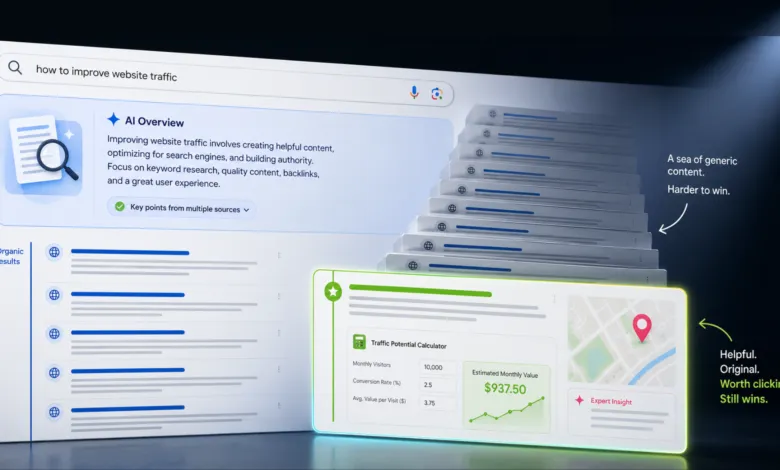
While past performance does not guarantee future results, certain strategic adjustments show promise for maintaining visibility. One effective approach involves local search optimization. LLMs currently lack reliable location awareness, and AI Overviews appear less frequently for local queries. Therefore, creating helpful, non-programmatic content tailored to specific geographic areas can drive consistent traffic. Additionally, interactive tools such as specialized calculators and screeners perform well. Unlike generic how-to guides, which LLMs can easily reproduce, ungated tools offer unique utility that AI summaries cannot replicate, making them highly citable assets.
Another crucial element is leveraging Subject Matter Expertise (SME). AI-generated content tends to be generic and lacks nuanced perspective. Articles informed by human experts who possess firsthand experience, formed opinions, and deep technical knowledge stand out against algorithmic summaries. This expertise often leads to original data and insights, increasing the likelihood of citation by AI systems.
Finally, publishers must address the challenge of scaled AI content generation. While some organizations treat automated content production as a standard practice, several factors suggest this approach is becoming unsustainable. Improvements in AI writing quality have slowed, and studies indicate that AI-generated text requires significant human oversight to perform adequately. Moreover, detection technologies are improving, and Google has begun cracking down on scaled spam content. Rather than relying on fully automated outputs, marketers should focus on creating high-quality, expert-driven content that genuinely deserves to be published.
(Source: Search Engine Land)