Google Ads Tests Enhanced Matching for Customer Match
▼ Summary
– Google Ads is testing a new Enhanced matching option in Customer Match settings that expands audience reach by matching consented advertiser data with consented publisher data.
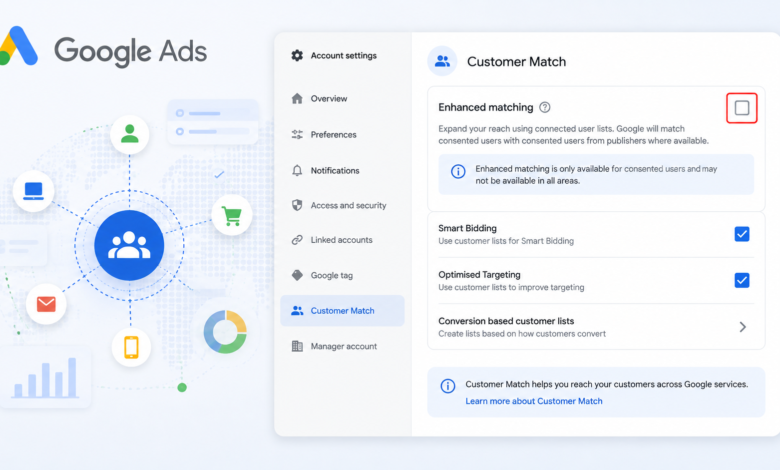
– The feature is opt-in, appearing unchecked under Account settings alongside existing Customer Match controls.
– Enhanced matching works with existing tools like Smart Bidding, Optimized Targeting, and conversion-based lists, potentially extending reach without new customer lists.
– Google emphasizes consent-based matching between users, aligning with its privacy framework, but has not disclosed incremental reach, participating publishers, or technical differences from standard Customer Match.
– Availability appears limited, suggesting a gradual rollout or testing phase, with the setting first spotted by Joey Bidner on LinkedIn.
Google Ads is quietly testing a new capability designed to stretch the reach of first-party customer audiences by tapping into consented user data from external publishers. The feature, labeled Enhanced matching, has begun surfacing within Customer Match settings in select advertiser accounts.
When activated, the tool reportedly allows Google to cross-reference connected customer lists with consented users from participating publishers, effectively widening the audience pool beyond Google’s own ecosystem. The toggle appears under Account settings, sitting alongside existing Customer Match controls, and has been observed in an unchecked, opt-in state so far.
This addition complements a suite of options already available to advertisers using Customer Match data, including Smart Bidding, Optimized Targeting, and conversion-based customer lists. The core promise here is straightforward: the same first-party data could yield greater audience scale without the need to build new lists from scratch.
Why does this matter? Traditionally, Customer Match has enabled advertisers to reconnect with known customers across Google properties using their own CRM or app data. Enhanced matching, however, introduces a layer of publisher-derived consent signals into the equation. That could extend the utility of existing lists, giving advertisers more mileage from the same underlying data assets while keeping Customer Match as the strategic hub.
The emphasis on consent is telling. Google frames the feature specifically as matching consented users with other consented users from publishers, which suggests the expansion is engineered to fit within its evolving privacy and data-sharing boundaries. It also signals a broader industry direction: advertising systems increasingly blend advertiser first-party data with privacy-conscious signals drawn from platforms and publishers alike.
That said, transparency remains thin. Google has not publicly detailed how much incremental reach Enhanced matching might deliver, which publishers are involved, or how the underlying matching mechanics differ from current Customer Match functionality. Availability also appears limited for now, hinting that the feature could still be in a phased rollout or behind-the-scenes testing.
The practical takeaway is that Enhanced matching could make Customer Match audiences more scalable, potentially broadening reach while preserving the targeting framework advertisers already rely on. The new setting was first spotted by Joey Bidner, who shared a screenshot on LinkedIn, sparking early industry attention.
(Source: Search Engine Land)