The Cost of Reckless AI: Accountability for Your Output
▼ Summary
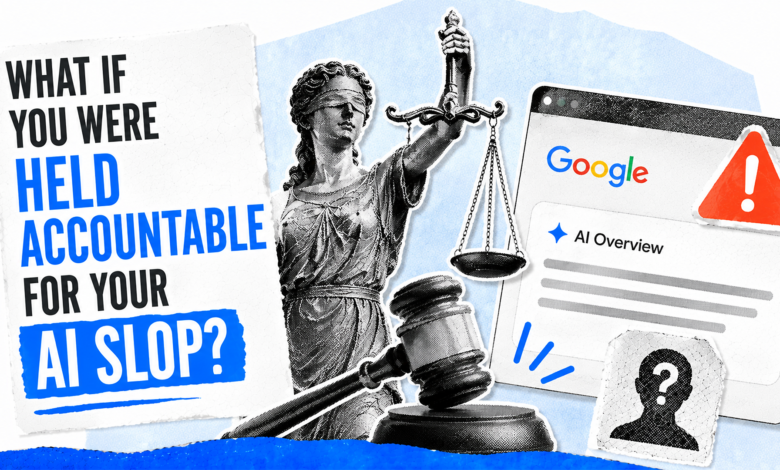
– A German court ruled that Google is responsible for AI Overviews content, rejecting Google’s defense that users should fact-check the results themselves.
– The court’s decision weakens the “disclaimer” defense, stating that merely warning users about AI errors does not remove liability when those errors cause harm.
– Businesses that adopt AI for tasks like content creation and customer service must now consider who is accountable when AI-generated outputs are wrong.
– The article notes irony in AI vendors marketing their systems as reliable while simultaneously using disclaimers to avoid responsibility for errors.
– The ruling could expand accountability beyond AI, challenging the internet’s culture of anonymity and lack of consequences for harmful content.
A German court has quietly reshaped the legal landscape for AI-generated content, ruling that Google is responsible for what its AI Overviews produce. The court rejected Google’s claim that users should fact-check the results themselves, instead treating those outputs as the company’s own content. This decision marks a pivotal shift in AI accountability, one that businesses and individuals can no longer ignore.
For years, the standard defense for AI platforms has been a simple disclaimer: “AI can make mistakes. Verify important information.” Users accepted this as the price of convenience. But the German ruling chips away at that shield. The court essentially stated that a warning does not erase liability when errors cause real harm. If an AI system generates claims not found in its source material, those claims belong to the creator of the system, not the user. This moves the debate beyond AI usefulness and squarely into legal responsibility for AI errors.
The implications for businesses are profound. Many companies are rapidly adopting AI for everything from content creation and customer service to product descriptions, legal reviews, hiring, and internal communications. The focus has been on efficiency: faster content, cheaper support, automated processes. Those are valid goals. But the German decision introduces a tougher question: Who pays when the output is wrong? Consider an AI-written support response giving bad advice, an article damaging a competitor’s reputation, or a report with fabricated data influencing a major decision. The “AI wrote it” excuse is losing its power. As AI is marketed as a trusted, reliable source, it becomes harder to argue that no one should be held accountable for its statements.
There is a clear irony here. AI vendors already know this. They plaster disclaimers and usage policies everywhere, yet simultaneously market their systems as smarter, faster, and more reliable. You cannot tell users to trust the answer while simultaneously arguing that no one should trust it. Those positions are on a collision course. Google’s current “solution” is to offer an opt-out from AI features. Germany may simply be the first court willing to force a change.
For SEO professionals, this ruling could ultimately be beneficial. The conversation is currently focused on whether AI companies should be responsible for their systems’ outputs. But accountability for online content could expand far beyond AI. The internet has long enabled distance between actions and consequences: anonymous accounts, fake profiles, throwaway emails, and now AI-generated content. This ruling introduces a powerful idea: “I didn’t write it” may no longer be a sufficient defense.
Consider a real email sent to Russell and Nina Westbrook, wishing them dead in a car crash. That is not free speech; it is hate speech. The internet, combined with AI, demands greater confidence in content accuracy and stronger accountability for content creators. You do not get to claim the productivity gains when AI is right and blame the algorithm when it is wrong. The cost of reckless AI is becoming clear.
(Source: Search Engine Land)