Top 10 Most Insightful Quotes from the MarTech Conference 2026
▼ Summary
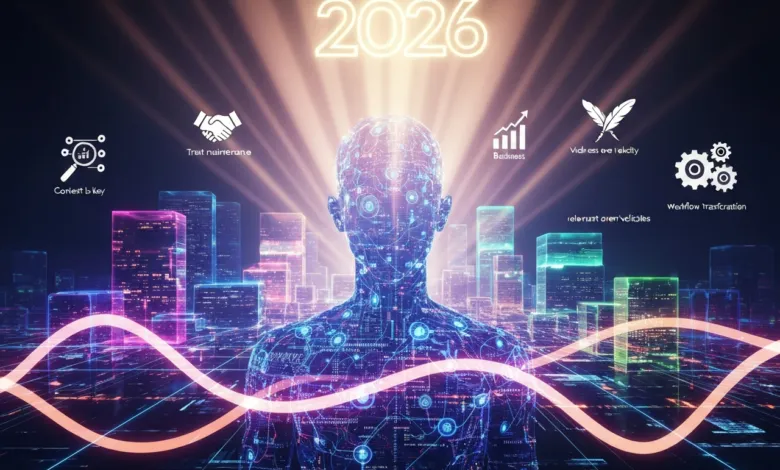
– Alec Haase argued that customer data value exchange is an ongoing relationship, not a one-time consent event, reframing personalization as trust maintenance.
– Sean Nowlin stated that the true outcome of marketing is growing individual businesses, not personalization itself, which is merely a tactic.
– Melanie Deziel emphasized that authentic storytelling requires tension and stakes, warning that AI-generated content risks flattening narratives into press releases.
– Jordache Johnson urged marketers to prioritize vividness over velocity in content, as AI accelerates production but can sacrifice emotional resonance and originality.
– Greg Boone noted that AI forces organizations to restructure workflows around outcomes rather than departmental silos, exposing inefficiencies and driving operational transformation.
The May 2026 MarTech Conference delivered seven live panel discussions packed with actionable insights for marketing and marketing operations professionals. With event transcripts spanning nearly 150 pages, we sifted through every session to extract the most thought-provoking quotes that define the current state of marketing technology and strategy.
“The value exchange isn’t really a one-time thing at the point of collection. It’s always on.” Alec Haase, general manager of AI products at Hightouch, made this point during a session on winning attention without losing trust. He challenged the common belief that obtaining customer consent is the finish line, arguing instead that it marks the start of an ongoing relationship. Brands must continuously prove the worth of collected data through relevant experiences, rewards, and utility, reframing personalization as a trust-maintenance discipline rather than a compliance checkbox.
“The outcome we’re aiming for isn’t personalization, the outcome is growing our individual businesses.” Sean Nowlin, founder and CEO of SpotlightIQ, cut through the hype around one-to-one marketing during the same panel. As the discussion questioned whether hyper-personalization has become overhyped, Nowlin grounded the conversation in practical business outcomes. He reminded attendees that personalization is a tactic, not the objective itself, and that sophisticated-looking campaigns often fail to improve actual customer journeys.
“A sanitized case study with no conflict, that isn’t a story. That is a press release.” Melanie Deziel, creative systems architect, delivered this sharp observation during a session on reclaiming the power of storytelling. She warned that AI-generated content risks flattening brand narratives into predictable corporate language. Authentic storytelling requires tension, stakes, and vulnerability , elements many marketing teams strip away in pursuit of polish. Her comment reinforced that emotional truth remains essential even in AI-assisted content environments.
“Stop worshiping velocity over vividness.” Jordache Johnson, AI transformation strategist at Never Tech Behind, captured a recurring tension at the conference during the same storytelling session. He argued that while AI accelerates content production, it often sacrifices originality and emotional resonance. The temptation to prioritize output volume over quality is strong, but memorable storytelling depends on clarity, humanity, and emotional texture , qualities that demand intention, not just scale.
“AI does not care about your process or org chart. It prioritizes outcomes.” Greg Boone, CEO of Walk West, made this blunt statement during a panel on aligning creative and technical teams. He discussed how AI adoption exposes inefficiencies and silos that organizations have tolerated for years. Boone argued that AI forces a fundamental rethinking of workflows around results rather than departmental ownership, underscoring the need for operational transformation over simple tool adoption.
“We’re now in that phase of moving from personal productivity gains to marketing team productivity gains through improving our workflows.” Peter Isaacson, CMO at Invoca, shared this insight during the same session. He described the current AI maturity stage in enterprise marketing, where early experimentation with individual task automation is giving way to broader operational integration. The real opportunity, he argued, lies in redesigning collaborative workflows, approvals, and systems around AI-enabled efficiency.
“With AI, context is the new data.” Jessica Kao, director and B2B GTM transformation advisor at Adobe, offered one of the clearest conceptual reframes of the event during a discussion on the marketing operations stack. As organizations rapidly add AI tools without clear governance strategies, success increasingly depends on preserving and transmitting meaningful context between systems, workflows, and prompts. Raw data collection alone is no longer enough.
“Consent isn’t intent , it’s trust.” Owen Jennings, senior director of product at OneTrust, made this distinction during a session on activating first-party data in a cookieless future. He argued that brands often misinterpret permission as a signal of customer readiness or buying intent. When users share data, they grant conditional trust, not immediate purchase interest. The real drivers of long-term relationships are education, transparency, and relevance.
“If you’re not on that initial shortlist, the odds of you winning that deal are really quite low.” Megan Heuer, executive consultant at Inflexion Group, highlighted the critical importance of brand awareness during a session on translating marketing insight into business impact. She explained that AI-assisted research processes narrow vendor options earlier than ever, making upper-funnel marketing strategically vital despite pressure for direct attribution.
“Not everybody has this endless bucket of money or the money tree.” Correy Honza, VP of strategy at Access Marketing Company, grounded the AI conversation in practical execution during a session on first-party data activation. He emphasized that smaller organizations can adopt realistic AI-driven strategies through scrappy, MVP-style experimentation with widely accessible tools like ChatGPT and Claude, rather than waiting for enterprise-scale budgets.
(Source: MarTech)