Martech 2026: AI Resets the Industry
▼ Summary
– The martech landscape grew only 0.7% in 2026, but this masks a renewal process where nearly 1,500 tools were added and over 1,300 disappeared.
– AI is becoming the value layer on top of SaaS infrastructure, shifting differentiation from rule-based workflows to context-based, adaptive decision-making.
– Most of martech is in a “renewal” state, with high inflow of new AI-native tools and high outflow of first-generation solutions, particularly in content, collaboration, and personalization.
– To succeed, companies should focus on three to five high-value use cases, engineering value first by identifying the most valuable customer, their key purchase, and the margin.
– Building for context is strategic: SaaS provides structure and consistency, while AI interprets and adapts, requiring aligned stacks rather than feature-rich ones.
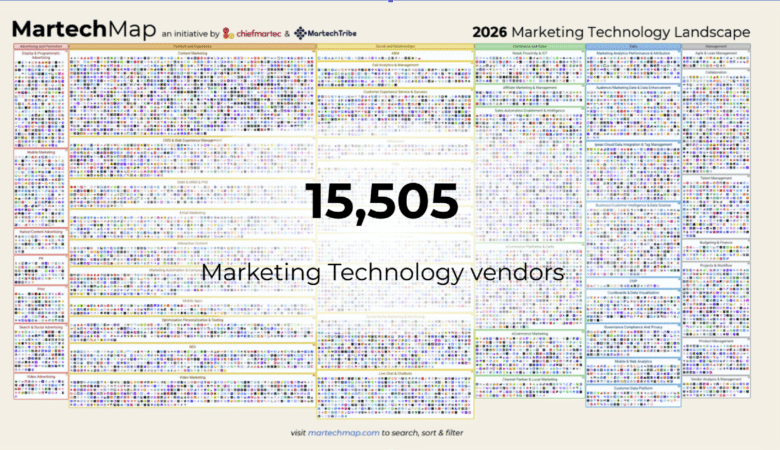
In 2026, the marketing technology landscape grew by a mere 0.7%, climbing from 15,384 to 15,505 solutions. On the surface, this looks like a market that has hit a ceiling. But that aggregate figure masks a dynamic churn beneath it: nearly 1,500 new tools entered the scene, while over 1,300 vanished. This is not a sign of stagnation. It is a signal of renewal.
For years, the martech landscape has been a tool not for the final count, but for observing the subtle, deep shifts in the industry. It provides a unique perspective. Today, that perspective reveals a clear truth: the idea of “Peak Martech” is a myth. The industry is entering its Darwinian phase. The landscape is renewing itself, and value is growing.
This transformation has direct consequences for your technology stack. The era of simply accumulating tools is ending, replaced by an era of replacing them. The driving force is a structural change in how value is created. SaaS platforms are no longer the primary source of competitive differentiation. They are becoming infrastructure: systems of record, workflow engines, and integration layers that provide stability. The real value is moving on top of that foundation. AI is becoming the value layer.
Where SaaS operates on rules and predefined logic, AI operates on language, context, and probability. It doesn’t just execute workflows; it interprets, decides, and adapts. Think of it like adding sound to silent movies. The foundation remains the same, but the experience and the value are fundamentally transformed. The role of the stack is no longer about assembling the right tools. It is about enabling the right outcomes. The landscape is not flat. It is being rewired.
If the landscape is being rewired, the most visible impact will be in how companies create customer value, especially in personalization. For years, personalization has been defined by rules: segments, workflows, and triggers. If a customer fits a profile, they receive a predefined experience. This worked in a world where customer journeys were predictable and channels were controllable. That world is disappearing.
Retrieving structured data, like a customer’s age or city, does not make sense with probabilistic AI. This is where SaaS remains essential as infrastructure. But as AI becomes the value layer, personalization is no longer about configuring journeys. It is about continuously interpreting context and deciding how to respond in real time. The shift is subtle but profound: moving from designing experiences in advance to generating them dynamically, powered by a solid SaaS and data foundation. This is not an incremental improvement. It is a paradigm shift.
The old SaaS era was rule-based, deterministic, and used segments. The new AI era is context-based, probabilistic, and focuses on individuals in real time. It moves from predefined workflows to adaptive decisioning, from campaign-driven to continuous interaction, and from static journeys to dynamic experiences.
If this shift is real, it should show up in the data. And it does. The martech landscape is no longer dominated by pure growth. Instead, it is spread across four distinct states: Growth, Renewal, Stability, and Decay. In this model, inflow signals opportunity, while outflow signals pressure. Together, they form a market thermometer that reflects vendor interpretation of demand.
What stands out is not where growth happens, but where it doesn’t. Growth is happening in categories like CMS, ecommerce, and iPaaS, but these are not new categories. They are being reshaped. CMS is evolving into machine-readable infrastructure for AI agents. eCommerce is adapting to AI-driven discovery. iPaaS is becoming the orchestration layer. Growth occurs where AI changes the job to be done.
Renewal is where the real action is. Content, collaboration, and personalization are renewing. This is the dominant pattern today: high inflow meets high outflow. New ideas enter rapidly, while first-generation solutions exit just as quickly. The market is actively discovering what the new need really is. Content is the clearest example. The GenAI boom triggered an explosion of tools, followed by rapid consolidation as core capabilities became commoditized. The same dynamic is now playing out in personalization and collaboration. Most of martech now sits in renewal. It is being rewritten. The market is not expanding; it is replacing first-generation solutions with AI-native ones. Renewal is not instability. It is creative destruction.
Stability characterizes mature, foundational systems like CRM, customer service, and customer intelligence. They remain essential, but their role is shifting toward foundational infrastructure rather than innovation. Decay is visible in categories like chat, video, and email. These are shrinking, not disappearing, but their role is changing. Functionality is being absorbed into broader platforms and AI-driven workflows. AI is upgrading chat and video. Email is moving from a system you optimize to a channel AI decides to use.
The winners in this next phase of martech will not be the companies with the most tools. They will be the ones with a stack that allows AI to create the most value. If martech is being rewired, the response is not to add more tools. It is time to rethink how the stack creates value. Here are two steps to take.
First, build for value. The role of SaaS is changing. It is no longer where differentiation lives. It is the foundation that unlocks value. The goal is not to cover every use case with a tool. It is to identify the three to five use cases that deliver the most value and focus on them first. This means learning to engineer value first, rather than tools. Value engineering starts by answering three key business questions before addressing technology: Who is your most valuable customer? What do they buy most? Where is the margin? Only once these are clear does automation start to make sense. The objective is not to implement tools, but to create an environment where AI can operate effectively within a clear value model.
Second, build for context. In a world of AI-driven execution, fragmentation becomes the biggest constraint. 90.3% of marketing organizations now use AI agents in some capacity, yet only 23.3% have deployed them in full production. The shift is not just about integration. It is about how SaaS and AI work together. SaaS provides structure: data, workflows, and consistency. AI creates value on top: interpreting context, making decisions, and adapting in real time. Value emerges at the intersection of these two layers. The best stacks are not the most feature-rich. They are the most aligned, focused on a small number of high-impact use cases where SaaS enables, and AI amplifies. Integration is no longer just technical. It is a strategic asset. It is about context engineering: creating the conditions for the stack to operate effectively, not by adding more tools, but by ensuring that data, workflows, and decision-making are aligned around a common set of use cases.
(Source: MarTech)