Beyond Neuralink: The Future of Brain Tech
▼ Summary
– Brad Smith, a Neuralink BCI user with ALS, independently connected a webcam to his mind-controlled computer system to track his son’s soccer games despite Neuralink’s initial confusion.
– Smith’s Neuralink BCI replaced his eye-tracking software, allowing him to control a cursor with his thoughts for communication and web browsing, though he had to master the new interface over several days.
– BCI users like Smith and Nathan Copeland combine their implants with everyday technology and custom hardware to adapt to daily tasks, demonstrating that BCIs are tools requiring supplementary solutions.
– Smith collaborated with Insta360 to customize the webcam’s controls for faster movement, and Neuralink later assisted with mounting it to his wheelchair to improve usability for future users.
– Smith and other advocates emphasize that BCIs restore agency and enable creativity for people with disabilities, with potential future applications including controlling wheelchairs and smart home devices.
Brain-computer interface technology is advancing rapidly, offering new possibilities for individuals with mobility challenges to interact with the world in innovative ways. Brad Smith, who lives with ALS, discovered this firsthand when he decided to connect a webcam to the computer he operates using his Neuralink implant. His creative approach initially puzzled the Neuralink team, but it highlights how users often find unexpected applications for emerging technologies.
Six months after receiving his Neuralink BCI in November 2024, Smith became the company’s third recipient and first ALS patient. The device replaced his previous eye-tracking system, enabling him to control his laptop cursor through thought alone. While this allowed faster communication and web browsing, Smith envisioned more, like tracking his son on the soccer field. He settled on an Insta360 Link 2 webcam, a consumer product not designed for medical use, to expand his capabilities.
Nathan Copeland, another long-term BCI user with a device from Blackrock Neurotech, understands such improvisation well. Over the past decade, he has used his BCI for everything from operating a robotic arm to meeting public figures, yet his daily routine still involves combining various technologies. He uses voice commands for smart home controls and custom-built controllers for gaming, illustrating that BCIs serve as tools that require supplementary hardware and software to be fully effective.
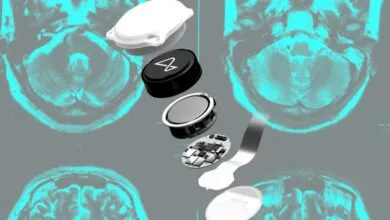
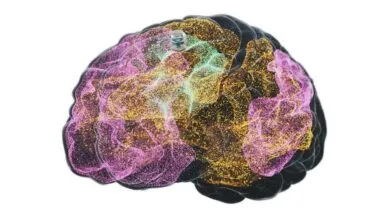
BCIs function by detecting electrical signals from neurons in the brain. When a user thinks about movement, neurons communicate through voltage changes, which electrodes pick up and translate into commands, like moving a cursor on a screen. For Smith, this replaced his Eyegaze system, which relied on an infrared camera to track eye movements but was fatiguing and unusable outdoors. He adapted to thought-based control within days, comparing it to the unconscious use of a mouse.
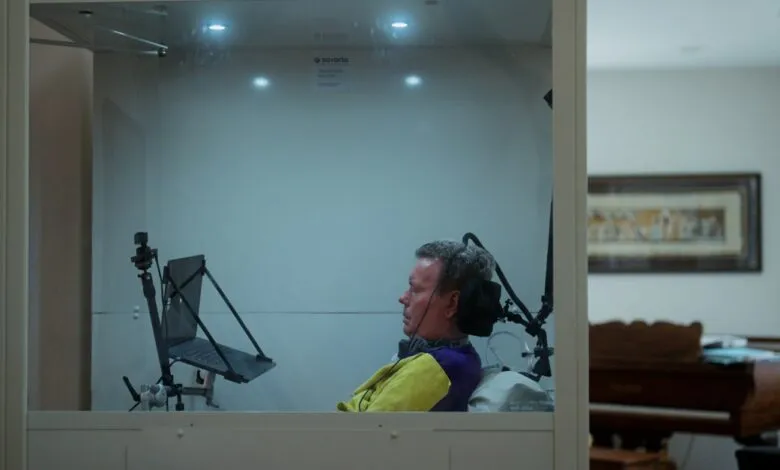
Smith demonstrated his setup by controlling the webcam through his BCI, panning, zooming, and sharing footage during video calls. Neuralink eventually supported his initiative, purchasing the camera and helping mount it to his wheelchair. Though not used constantly, the camera accompanies him outdoors and helps him observe family interactions and facial expressions from his seat.
Using Proloquo4Text for communication, Smith composes responses letter by letter, sometimes aided by word prediction. A single reply might take over a minute, but the technology lets him stay connected. His cursor moves rapidly, occasionally jittering, leading him to “park” it in a screen corner when not in use.
In May, Smith collaborated with Insta360 to customize the Link 2’s controls, tripling its rotation speed and adding fine-adjustment options. This partnership improved his ability to direct the camera precisely, enhancing his independence.
Before his BCI, Smith relied on simple, affordable adaptations, a dog bell instead of a nurse call button, a microphone to amplify his fading voice, and a runner’s armband to position his phone within reach. Now, he programs common phrases and quotes into his speech software, keeping pace with conversations.
Smith sees disability as a catalyst for creativity, a sentiment echoed by Ian Burkhart, a former BCI research participant. Burkhart, paralyzed from the chest down after an accident, leads the BCI Pioneers Coalition and believes user-driven innovations like Smith’s are vital. He advocates for involving users early in the design process to develop more integrated solutions.
Looking forward, Smith envisions BCIs merging with everyday gadgets, from smart home devices to robotic arms, and even controlling his wheelchair through thought. He emphasizes that this technology does more than restore function, it reaffirms dignity and agency for people whose bodies no longer cooperate. For Smith and others, brain-computer interfaces represent not just technical progress, but a path toward re-engagement and hope.
(Source: The Verge)