AI promised to win hearts – it hasn’t
▼ Summary
– Public concern about AI has risen sharply, with 52% of Americans more concerned than excited about its daily use, up from 37% in 2021.
– Tech companies face a PR crisis over AI data center plans, offering perks like job guarantees and teacher bonuses to appease local communities.
– Consumer backlash against AI is stronger than for earlier technologies like the iPhone or internet, driven by perceived costs like job loss and unwanted features.
– Young people are increasingly adopting retro tech and analog hobbies, signaling a rejection of AI and algorithm-driven products.
– Industry leaders like Airbnb’s Brian Chesky and Anthropic’s Dario Amodei acknowledge the backlash is a trust crisis, attributing it to a failure to deliver practical benefits for ordinary people.
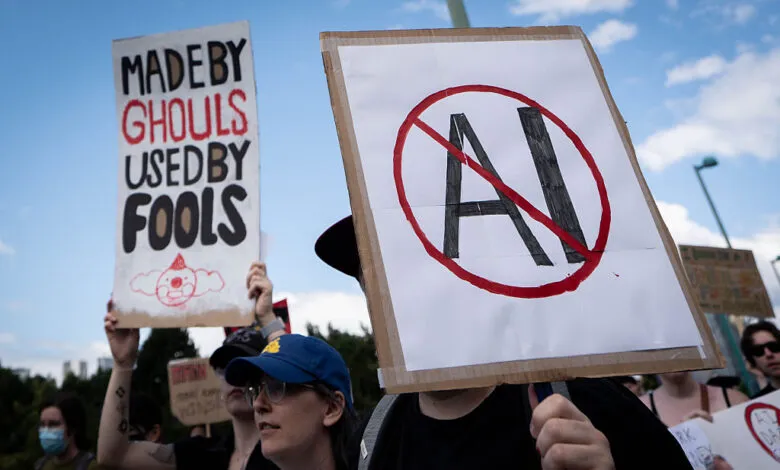
Despite remarkable technical breakthroughs, the public’s perception of artificial intelligence is souring rather than improving. On Wednesday, Axios reported that the National Republican Senatorial Committee sent a memo to leading AI firms, warning that data center expansion is jeopardizing the party’s prospects in a crucial Ohio race. Around the same time, Pew Research published findings showing American apprehension about AI is on the rise: 52% now say they are “more concerned than excited” about AI’s growing role in everyday life, a jump from 37% in 2021.
A separate CNBC survey targeting 18- to 34-year-olds revealed that, when presented with the names of nine prominent AI industry figures, most respondents expressed distrust in those leaders’ ability to “act responsibly” with the technology. An Economist/YouGov poll from May found that more than 70% of Americans believe AI is progressing too rapidly. The pattern is consistent across multiple data points.
That growing dissatisfaction is now hitting corporate finances. The Wall Street Journal reported this week that tech companies are wrestling with a public relations crisis over their proposed AI data center projects nationwide. In response, they are sweetening local agreements with job guarantees, investments in clean water infrastructure, and other community perks. One notable example included $50,000 bonuses for teachers in a Louisiana parish.
The common thread running through these stories is simple: consumers don’t perceive how AI improves their lives, yet they’re being asked to shoulder the costs. For an industry that has attracted hundreds of billions in funding on the premise of AI’s inevitability, this erosion of public goodwill is transforming into a genuine business challenge, not merely a communications headache. Even the industry’s own leadership is beginning to acknowledge the shift.
Today, many consumers understand AI through narrower lenses, such as chatbots or AI-driven search experiences like the revamped Google. They watch AI features being injected into everyday products, from email platforms to televisions, often without explicit consent. They see AI as a tool enabling academic dishonesty, even at the college level, which raises uncomfortable questions about the value of higher education. They hear about AI systems training on vast amounts of others’ intellectual property to generate art, videos, music, and writing, domains that have historically belonged to human creators.
Given all this, it’s unsurprising that AI is meeting more consumer resistance than earlier transformative technologies, including the iPhone, the personal computer, or even the internet itself, when they were at comparable adoption stages.
Still, some remain baffled by the public’s reaction. They assumed that widespread adoption would naturally lead to acceptance, and that AI’s integration into nearly every tech product would eventually generate positive sentiment.
Instead, consumer behavior is heading the opposite direction. Young people, in particular, are gravitating toward retro technology: dumbphones, point-and-shoot cameras, tape decks, and CD players are enjoying renewed popularity. AI-free, algorithm-free classic iPods are fetching premium prices on eBay. So-called “grandma hobbies” like quilting, knitting, jigsaw puzzles, card games, and Mahjong are experiencing a cultural resurgence. In-person gatherings, such as run clubs, are increasingly preferred over online dating.
Some in Silicon Valley might attribute this to a messaging failure, suggesting executives need to explain AI more effectively so people can grasp its advantages.
But the truth may be that consumers understand AI well enough and simply don’t find the trade-offs worthwhile. When the promised upside isn’t higher-paying automated jobs with shorter workweeks, but rather the threat of displacement, combined with AI features that feel underwhelming, like summarized web pages or talkative TVs, skepticism only deepens.
There are industry figures waking up to this reality.
On a recent podcast, Airbnb CEO Brian Chesky acknowledged that the AI backlash is genuine and largely stems from the industry’s failure to ship products that resonate with “regular people.”
“I think part of it’s a narrative issue that we’re not talking about AI correctly,” Chesky said. “But part of it is we need to actually be developing more products that just regular people can use and say, ‘I love AI because AI allows me to have a doctor on demand and I can’t have that. I can’t afford that.’ And so I think we need more regular things.”
Even Anthropic CEO Dario Amodei, one of the industry’s most visible leaders, conceded in a post on X this week that negative public perception of AI is a “big problem” that fundamentally amounts to a “crisis of trust.” He observed that people don’t trust companies, governments, or the tech sector, as they “suspect that we are cooking up some new way to screw them over.”
His proposed solution was straightforward: deliver on AI’s promises, such as curing cancer.
“I think by far the most accurate criticism of AI companies, including Anthropic, is that we haven’t yet delivered on our big promises to benefit the world. That is totally on us,” he noted.
(Source: TechCrunch)