Open-Source Platform for Self-Improving AI Agents
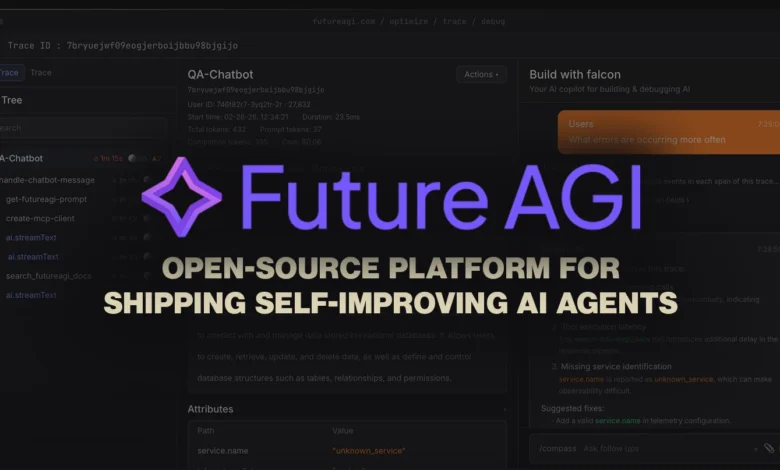
▼ Summary
– Future AGI is an open-source, self-hostable platform for tracing, evaluating, simulating, and guardrailing LLM agents, licensed under Apache 2.0.
– Self-hosted instances send a one-time registration to Future AGI on first boot, including instance ID, version, deployment type, and admin emails, before any sign-in; opting out requires setting FUTURE_AGI_TELEMETRY_DISABLED=1 in .env before first start.
– Disabling telemetry stops heartbeats and withholds emails, but leaves a single census ping with instance ID, version, and deployment type; the article advises turning off networking at the edge for full silence.
– The installer runs ClickHouse, PostgreSQL, Redis, RabbitMQ, and Temporal behind a dashboard at localhost:3000, with traces stored in ClickHouse, and instrumentation supports 50+ agent frameworks via OpenTelemetry.
– The Agent Command Center is an OpenAI-compatible proxy for 100+ providers, with routing, caching, virtual keys, MCP, and A2A, plus 18 built-in scanners for PII, jailbreak, and prompt injection, maintaining P99 latency under 21 ms inline.
Future AGI has launched as a fully open-source platform designed for tracing, evaluating, simulating, and guardrailing LLM agents. Released under the Apache 2.0 license, the system is self-hostable, giving teams complete control over their infrastructure. On first boot, a self-hosted instance registers with Future AGI, transmitting a single payload that includes an instance ID, version string, deployment type, and the email addresses and domains of active admin users.
That registration occurs exactly once, before any user signs into the dashboard. Operators who prefer to keep all data local can set a single environment variable, FUTUREAGITELEMETRY_DISABLED=1 , in the .env file prior to the initial start. Miss that window, and the admin list has already been sent over the network. Future AGI explicitly lists air-gapped and on-prem deployments as supported configurations that operate without any phone-home traffic.
Even with telemetry enabled, the system limits data sharing to a single census ping containing the instance ID, version, and deployment type, with email addresses withheld. Once that initial ping is sent, periodic heartbeats cease. The platform’s telemetry documentation closes with a straightforward recommendation for operators: “turn networking off at the edge if you need full silence.”
Behind the dashboard at localhost:3000, the installer orchestrates a stack of ClickHouse, PostgreSQL, Redis, RabbitMQ, and Temporal. Spans are routed into ClickHouse, while prompt text, model output, and tool calls pass through the tracer before landing in that store. For security, the platform’s defender inherits the access controls already configured on the database, along with the trace data.
Instrumentation covers more than 50 agent frameworks, including LangChain, LlamaIndex, CrewAI, and DSPy, all through OpenTelemetry. This broad compatibility means teams can adopt the platform without reworking their existing agent stacks.
At the heart of the architecture sits the Agent Command Center, an OpenAI-compatible proxy that fronts over 100 providers. It handles routing strategies, semantic caching, virtual keys, MCP, and A2A. Every provider credential in a deployment terminates at this gateway, centralizing access management.
For protection, the platform ships 18 built-in scanners targeting PII, jailbreak attempts, and prompt injection. Vendor adapters extend coverage to Lakera, Presidio, and Llama Guard. These scanners run inline within the gateway or as standalone components through the SDK. On the project’s benchmark harness, inline scanning maintains P99 latency at or under 21 ms, a figure that should satisfy performance-sensitive deployments.
Future AGI is available at no cost on GitHub, and the project encourages community involvement.
For those tracking the open-source security ecosystem, the Help Net Security ad-free monthly newsletter covers essential tools like this one. Subscribe to stay current on the latest developments.
(Source: Help Net Security)