FCC bans foreign robots, inverters citing China security risks
▼ Summary
– The US FCC added advanced robots and connected power inverters to its Covered List, effectively blocking new imports of these devices from needing FCC authorization to enter the US market.
– The ban applies to foreign-made robots and inverters “regardless of the nationality of origin,” avoiding directly naming China while targeting its supply chains.
– Manufacturers can apply for “Conditional Approval” to bypass the block, with the Department of War vetting robots and Homeland Security vetting inverters.
– The security rationale is that both devices are networked and could be remotely commandeered or used for surveillance, with grid inverters at risk of being turned off and robots of being taken over.
– The block only affects new device models seeking authorization, not existing ones, and is an import gate that grows over time, but US reliance on Chinese supply chains poses a challenge for domestic replacement.
The United States is tightening its grip on imported technology, this time targeting advanced robots and power inverters over fears they could be weaponized by foreign adversaries. While the official announcement never explicitly names China, the implications are unmistakable.
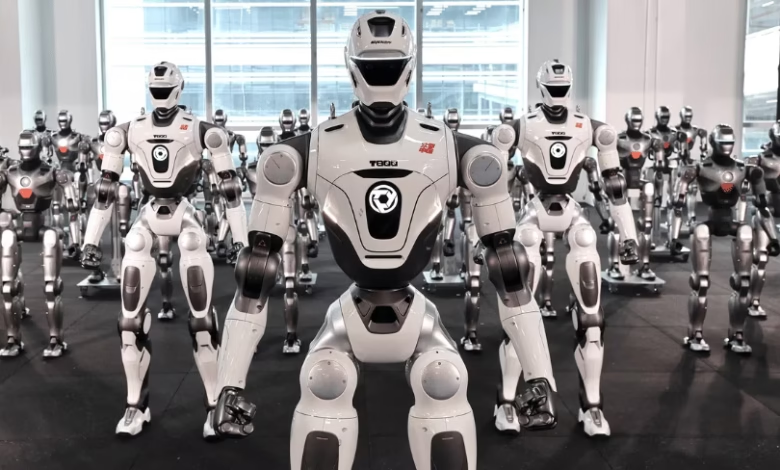
The Federal Communications Commission has added two new categories to its Covered List, as first detailed by CNBC. The first encompasses “advanced robotic devices” , mobile machines like humanoid and quadruped robots. The second covers connected power inverters, the critical boxes that link solar panels, batteries, and data-center equipment to the electrical grid.
Being placed on the Covered List is effectively a commercial death sentence for new imports. Any device on the list cannot receive FCC authorization, a prerequisite for nearly all electronics sold in the U. S. It is the same regulatory tool the agency previously used to restrict DJI drones and Huawei networking gear.
The language of the ban is notably careful. The FCC document restricts foreign-produced robots and inverters “regardless of the nationality of origin.” The political subtext clearly points to Beijing, but the letter of the law applies to all manufacturers equally. This deliberate ambiguity allows Washington to name China as the threat while compelling every foreign producer to choose: build in America, or submit to a rigorous security review. An administration official told CNBC the goal is to protect the U. S. AI buildout and encourage reshoring. “Economic security is national security,” the official stated.
There is an escape hatch. A manufacturer can apply for “Conditional Approval” and continue selling if it passes a security check. The Department of Defense oversees robots, while the Department of Homeland Security handles inverters. In theory, any company , including Chinese ones , can walk through this door. In practice, it places the Pentagon in charge of vetting which robots reach American consumers.
The pairing of robots and inverters may seem odd at first, but the security rationale is consistent. Both devices are networked and remotely controllable. Grid inverters communicate with their manufacturers for monitoring and firmware updates. The interagency determination warns that this same channel could allow a foreign firm to “turn off the inverters or use them to collect and exfiltrate data.” As more solar and battery capacity comes online, the number of remote-controllable boxes grows.
Robots present a similar risk on legs. The determination notes that networked machines “collect data that could be leveraged by malign actors to surveil Americans,” or allow an attacker to “remotely commandeer the robots.” Unitree, a Chinese firm whose humanoids and quadrupeds have moved from lab demos to a pending public listing, is the emblematic example. The Pentagon has already flagged the company.
What does this actually change? Less than the headlines suggest, at least in the short term. The block applies only to new device models seeking authorization. It does not affect robots or inverters already purchased, models already approved, or anything the federal government buys and uses. This is an import gate, not a recall. Its impact will grow over time as newer models are frozen out while older, approved ones remain on sale. The FCC used the same staged approach on drones and consumer routers. The Cybersecurity and Infrastructure Security Agency now advises companies to screen suppliers against the list.
The harder question is whether the U. S. can fill the gap. China dominates both supply chains. The same rare-earth and battery chokeholds that complicated the drone ban apply here. Blocking imports is quick. Building a domestic industry to replace them is slow, and so is hardening a grid whose weak points attackers are already probing. For now, Washington has drawn the line where it is easiest: at the border, on the next generation of machines. Whether the factories follow is the test that matters. A listing will not settle it.
(Source: The Next Web)