NASA Funds Hardware for ‘Skyfall’ Mars Helicopter Mission
▼ Summary
– NASA selected Firefly Aerospace to design and manufacture the aeroshell for the nuclear-powered Skyfall Mars mission, awarding a $13 million subcontract.
– The Skyfall mission, managed by JPL, is scheduled for 2028 and will carry three helicopters similar to Ingenuity.
– The aeroshell includes the heatshield and backshell to protect the descent stage during atmospheric entry, but Firefly is not responsible for landing.
– Skyfall will release its helicopters mid-descent for immediate flight to map resources, a maneuver NASA calls the “SkyFall Maneuver.”
– The mission aims to scout for water ice on Mars to help identify potential landing sites for future crewed missions.
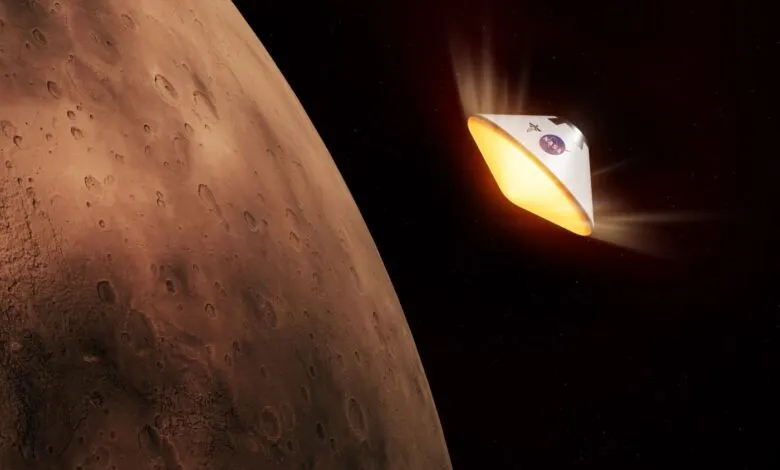
NASA has taken another concrete step toward its ambitious nuclear-powered Mars mission, awarding a $13 million subcontract to Firefly Aerospace to build the critical protective shell for the Skyfall spacecraft. The aeroshell, designed to shield the descent stage during its high-speed plunge through the Martian atmosphere, marks a major milestone in a project that aims to deploy three helicopters on the Red Planet.
Scheduled for launch in 2028, Skyfall will be NASA’s first-ever interplanetary probe powered by nuclear energy. The mission, managed by the Jet Propulsion Laboratory (JPL) in California, will send three rotorcraft modeled after the successful Ingenuity drone that accompanied the Perseverance rover. Firefly’s contract represents its first project to be developed at its newly expanded Texas facility, Gloworks, and will leverage engineering expertise gained from its Blue Ghost lunar lander, as well as its Alpha and Eclipse rocket programs.
“We’ve proved our ability to execute off-Earth missions at a fraction of the cost and timeline through our successful Blue Ghost lunar mission,” said Ray Allensworth, Firefly’s vice president of spacecraft. “Now we’re applying these lessons learned and utilizing our proven technologies to continue accelerating and lowering costs for future missions to the moon, Mars, and beyond.”
Blue Ghost launched in January 2025 and touched down on the moon about two months later, becoming only the second commercial lander ever to achieve a soft lunar landing. For this Mars contract, however, Firefly is aiming higher in more ways than one. The aeroshell design will include the Skyfall capsule’s heatshield and backshell, providing the thermal protection needed to withstand the Martian atmosphere and the aerodynamic properties required for a precise descent from space.
Unlike Blue Ghost, this mission does not involve an actual landing. Instead of setting the trio of helicopters down on the Martian surface, Skyfall will release them mid-descent, allowing them to take immediate flight through the Martian sky to begin their resource mapping mission. NASA has dubbed this approach the “SkyFall Maneuver.”
The primary goal of Skyfall is to demonstrate the effectiveness of the helicopters’ onboard prospecting instruments. NASA plans to use the collected data to scout for water ice on Mars’ surface, helping to identify potential landing sites for future crewed missions. Once Firefly completes aeroshell development at Gloworks, work will shift to the company’s Rocket Ranch in Briggs, Texas, for manufacturing and testing before the component is transported to JPL for final spacecraft integration.
(Source: Space.com)