Wizz Air to Install Starlink Wi-Fi on Planes by 2027
▼ Summary
– Wizz Air will offer Starlink satellite internet across its entire Airbus A320-family fleet from 2027, becoming the first European budget airline to adopt the technology.
– The airline did not disclose financial terms, as the high cost of Starlink installation has made rivals like Ryanair and EasyJet hesitate.
– Starlink’s low-Earth-orbit network provides low-latency, fast connectivity, allowing passengers to download a three-hour HD film in about three minutes.
– Wizz Air has not yet decided if the service will be free, paid, or tied to a loyalty scheme, while US carriers like United Airlines offer it free to members.
– The deal highlights Europe’s dependence on US technology, as no European system matches Starlink’s capabilities.
Low-cost airlines and reliable in-flight internet have historically been a poor match. Europe’s budget carriers have long pointed to the math: the investment simply hasn’t made sense. Wizz Air is now betting that equation is about to shift.
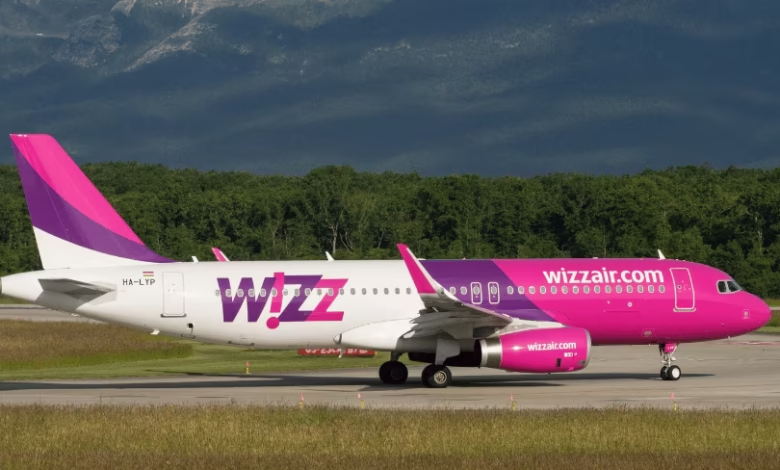
The Hungarian ultra-low-cost carrier announced on Monday that it will equip its entire fleet with Starlink, Elon Musk’s satellite internet service, starting in 2027. This makes Wizz the first European budget airline to commit to the technology. The airline plans to install the system on its entire Airbus A320-family fleet, which includes more than 200 aircraft, as well as future deliveries. Financial details were not disclosed.
That silence is revealing, because the economics are precisely what have kept rivals on the sidelines. Both Ryanair and EasyJet have cited the cost of integrating Starlink into their low-fare models. Ryanair’s Michael O’Leary has estimated the annual expense for his airline could reach $250 million, partly because the rooftop antenna adds weight and drag, increasing fuel consumption. EasyJet stated in January that the financials were “not right yet.” By moving first, Wizz Air is taking a gamble its biggest competitors have so far avoided.
The core advantage is speed.
Traditional in-flight Wi-Fi, relying on older satellites or ground towers, has long suffered from slow speeds, inconsistent coverage, and high prices. Starlink’s low-Earth-orbit network promises low-latency connectivity robust enough for streaming. Wizz claims passengers will be able to download a three-hour HD film in roughly three minutes.
Whether passengers will have to pay for this access remains unclear. The airline has not specified if the service will be free, paid, or linked to a loyalty program. In contrast, United Airlines is installing Starlink on more than 1,000 aircraft and offering it at no cost to loyalty members. Wizz’s chief commercial officer, Ian Malin, offered only a general statement: “Ultra-low-cost travel has always been about making opportunities accessible to more people.”
Wizz Air joins a growing list of carriers partnering with Starlink, which has already secured deals with American, Southwest, United, and Alaska in the US, as well as long-haul operators Singapore Airlines and Emirates. The timing is notable: SpaceX, Starlink’s parent company, is set to go public this week in one of the largest listings in history, and a steady stream of airline agreements strengthens its narrative. With over 7,000 satellites in orbit, Starlink dominates a market that competitors like Amazon’s Project Kuiper and Europe’s own struggling satellite initiatives are racing to challenge.
For Europe, there is an uncomfortable undercurrent.
A European airline wiring its fleet to a US-controlled network operated by Elon Musk comes at a time when the continent is increasingly concerned about its reliance on American technology, from semiconductors to artificial intelligence. No European system currently offers a comparable solution, and Wizz, which reports full-year results on Thursday, clearly believes the connectivity benefit outweighs both the political and financial costs.
For passengers, the promise is straightforward: by 2027, a Wizz Air flight could offer internet that is actually usable. Whether it arrives free of charge or as the airline’s next upsell is the detail still missing. On a carrier that charges for nearly everything, few would bet on free.
(Source: The Next Web)