After 4 Years of Daily Use, Starlink Speeds Took an Unexpected Turn
▼ Summary
– The author, a PCMag reviewer in rural Idaho, relies on Starlink for high-speed internet, having used it for years and tested its evolution from 2022 to 2026.
– Starlink’s service has expanded with new hardware (Dish V4, Starlink Mini) and tiered plans (Residential Max, 200, 100), moving from a single flat-rate model.
– Download speeds have increased 78.6% since 2022 (from 89Mbps to 160Mbps average), but 2026 data shows a ceiling, with average speeds of 145-170Mbps, below the advertised 400Mbps for the top tier.
– Upload speeds have nearly quadrupled since 2022, and latency has dropped to a 2026 average of 21.5ms, with 67% of pings under 20ms, rivaling broadband consistency.
– The value proposition now centers on service priority over raw speed, as network congestion grows, and competition from Amazon’s Leo (Kuiper) is expected soon.
After four years of daily Starlink use, I’ve seen the satellite internet service transform from a promising experiment into a mature network. But my latest testing reveals a surprising shift: download speeds may be hitting a ceiling while upload speeds and latency reach new highs. As SpaceX prepares for a highly anticipated IPO, the value proposition is changing, and users must now navigate a tiered system where priority matters more than raw speed.
I live in farm country Idaho, where ground-based internet options are pitiful. As PCMag’s main Starlink tester and reviewer, this service isn’t just a career interest,it’s essential to my work. With a family that streams, kids who game online, and my own connected lifestyle, Starlink has kept us all online since I started testing in 2022. Over the years, I’ve watched connection quality improve from good enough to fantastic, earning multiple Editors’ Choice awards. But now, the nature of the service is fundamentally changing.
SpaceX is no longer just chasing speed or consistency. Instead, network congestion, priority tiers, and a shifting value proposition define the current experience. My 2026 data shows that while upload speeds have nearly quadrupled since 2022 and latency averages a stunning 21.5ms, download speeds have plateaued. Daily averages now sit between 145Mbps and 170Mbps on the top-tier Residential Max plan, far from the 400Mbps Starlink advertises. Yet, even at its slowest, Starlink handily outperforms DSL, the only alternative in many rural areas.
The hardware evolution tells part of the story. I started with the Dish V2 (Dishy McDishface) in 2022, then upgraded to the Dish V4 in 2024, which brought better design, weatherproofing, and Wi-Fi 6. The Starlink Mini arrived in 2025, offering portability for road trips. But new hardware hasn’t been the only change. Starlink has expanded its service options with aggressive promotions and new pricing tiers: Residential Max ($130), Residential 200 ($85), and Residential 100 ($55). These budget-friendly plans open the service to more households, but they also introduce a tiered system where service priority becomes the key differentiator.
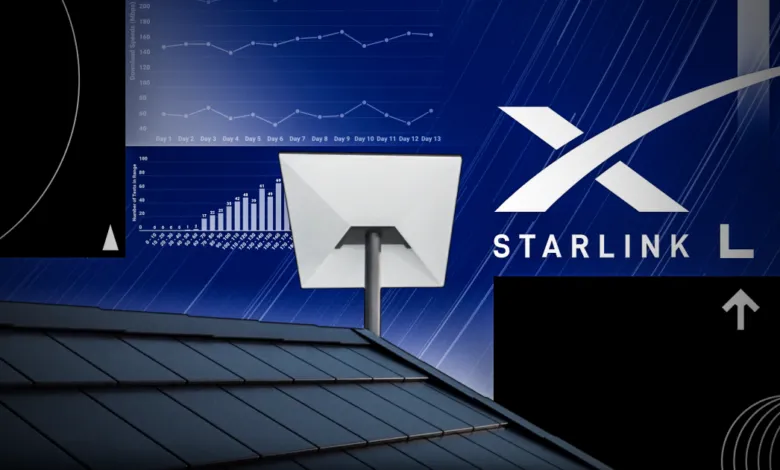
My year-over-year testing reveals a clear trend. In 2022, download speeds averaged 89Mbps, uploads struggled above 20Mbps, and latency was 60ms. By 2025, those numbers had improved dramatically: downloads hit 177Mbps, uploads approached 30Mbps, and latency dropped to 22.36ms. But in 2026, download speeds actually declined slightly to 160Mbps on average, while uploads jumped 43% and latency fell to 21.5ms. The camel hump distribution of speeds suggests either hardware limitations or growing subscriber congestion. I wouldn’t be surprised to see a hardware update in the next year or two, and rumors point to one coming.
The latency improvements are particularly impressive. More than 67% of my 18,000 ping measurements fell below 20ms, and 96% fell below 30ms. That’s on par with many broadband connections and far better than the 600ms latencies of traditional satellite ISPs. The physical constraints of low Earth orbit satellites,sitting about 340 miles above the dish,limit latency to around 7-10ms, but Starlink engineers have whittled it down remarkably close to that floor.
So what does the extra $45 per month for Residential Max buy you? My data suggests it’s not about raw download speed. Instead, you’re paying for service priority during peak hours. When the local ground station gets crowded, your connection stays steady while lower-tier users may see slowdowns. That consistency is a genuine benefit, but it changes the value equation. If stability and better-than-DSL speeds are all you need, the Residential 100 or 200 plans may offer better value.
Starlink is no longer SpaceX’s experimental wing. The company’s S-1 filing shows Starlink now accounts for more than 60% of total revenue. As the service matures into a utility, users can expect more stability and support, but also a greater focus on profits. That could mean further segmentation or stricter data deprioritization for lower tiers. Meanwhile, competition is looming: Amazon’s LEO service (formerly Kuiper) is expected to launch soon, and I anticipate running side-by-side tests by next year.
For now, I still recommend Starlink to anyone without access to cable or fiber. It delivers a high-quality connection at a reasonable price, especially in areas where DSL would severely limit your connectivity. But my advice comes with an asterisk: the best deal may not be the top-tier plan. If you’re just looking for reliable, fast-enough internet, the lower tiers could be the smarter choice.
(Source: PCMag.com)