AI slashes GM development from 15 hours to 1 minute
▼ Summary
– Sterling Anderson left his role as chief product officer at Aurora to take the same position at General Motors in 2024.
– Anderson describes the first epoch of engineering as a slow, empirical “guess-and-check” process based on imitating nature.
– The second epoch began with computers enabling virtual development tools like CFD and FEA to improve specific engineering tasks.
– In the second epoch, the development process remained a sequential “relay race” where different teams passed work back and forth.
– Anderson now has a firsthand view of how GM is entering what he calls the “third epoch” of engineering and design.
General Motors is rewriting the rulebook on automotive development, and according to its new chief product officer, the most transformative shift is already underway. Sterling Anderson, who joined GM just over a year ago after co-founding autonomous driving startup Aurora, describes the moment as the dawn of a third epoch in engineering and design , one where artificial intelligence compresses decades of iterative work into minutes.
Reflecting on the earliest days of invention, Anderson recalled a time when humans looked to nature for inspiration. “There was a time when humans looked at birds and were like, ‘OK, those wings seem to work pretty well. Let’s go and design something that looks like them,’” he said. That first age, spanning hundreds of years, was defined by a painstakingly slow process of trial and error. “It was this era of highly empirical iterative design development and engineering,” Anderson explained. “Humans largely started with what we know or had seen, built prototypes of something that kind of looked like it and maybe tweaked some things, hoping to make it perform better, tested it, iterated, and kind of went through this slow guess-and-check process until we got to something that marginally worked.”
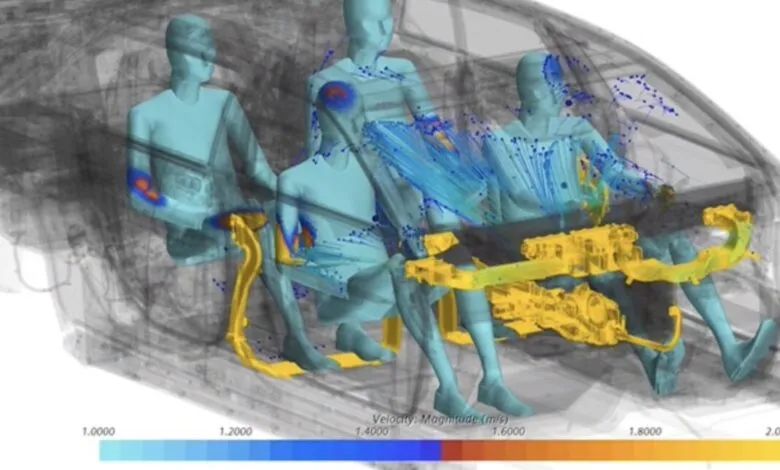
The second age arrived with the rise of powerful computers, which introduced specialized virtual tools that accelerated certain tasks. “We started to see virtual development tools, in functionally specific ways, improve the work that people did so they didn’t have to go to empirical prototypical development,” Anderson said. He pointed to examples like computational fluid dynamics (CFD) informing aerodynamics engineers and finite element analysis (FEA) guiding structural teams. But even with these advances, the fundamental workflow remained unchanged. “The relay race that was development remained the same, which is to say design passed the baton to aero which passed the baton to structures, just always passed the baton back when they found something that the other guys had to fix.”
Now, GM is entering a new era where AI doesn’t just assist individual disciplines but transforms the entire development pipeline. The result is staggering: what once required 15 hours of manual, cross-departmental iteration can now be accomplished in under one minute. This leap in efficiency promises to reshape how quickly vehicles move from concept to production, allowing engineers to explore far more design permutations and optimize performance in ways that were previously impractical. For an automaker of GM’s scale, that speed could become a decisive competitive advantage.
(Source: Ars Technica)