AI-Designed Car Prototype Takes Shape
▼ Summary
– New cars typically take five or more years to develop, starting as hand-drawn sketches that are iterated and refined into 3D models.
– GM uses AI tools like Vizcom to turn hand-drawn sketches into 3D models and animations in hours, a process that previously took months.
– AI-powered computational fluid dynamics (CFD) by companies like Neural Concept reduces aerodynamic simulation time from hours to minutes.
– AI is also used to automate menial software development tasks, such as unit tests, at Nissan to improve speed and quality.
– While companies claim AI boosts productivity without cutting jobs, some experts warn it will inevitably reduce headcount in design studios.
The automotive design industry has long relied on high-tech 3D visualization and virtual reality sculpting, yet most new vehicles still begin their journey as nothing more than a hand-drawn sketch. Those sketches undergo countless rounds of refinement, shifting between 2D and 3D forms, with some models destined for the digital graveyard while others are physically sculpted in clay to perfect every contour. This marks just the first step in a design and development cycle that can stretch five years or longer.
As a result, many cars arriving at dealerships this summer were first imagined back in 2020 or 2021. At that time, alternative fuel incentives were thriving, EV charging infrastructure was expanding rapidly, and the internal combustion engine appeared to be on its last legs. Fast forward to today, and the landscape has shifted dramatically. The current administration has rolled back EV incentives and imposed sweeping tariffs and trade restrictions. Automakers that once committed to all-electric lineups are now scrambling to put engines back into their vehicles, while factories race to reconfigure operations to sidestep the worst of the import penalties.
Amid this upheaval, the agentic AI boom is reshaping how manufacturers approach the lengthy new-car development timeline. Many are now using AI to shrink that 60-month window. As with most AI applications, the potential is enormous, but so are some unsettling consequences.
Design by Prompt
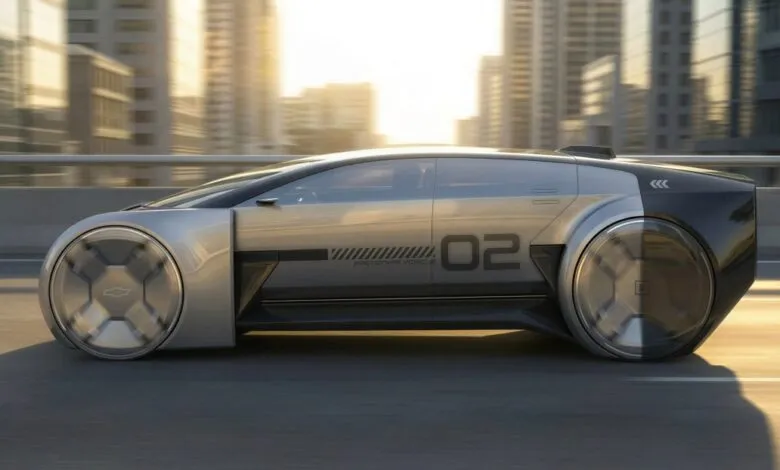
At General Motors, the design phase is getting a major AI upgrade. Dan Shapiro, a creative designer at GM, explained that the process always begins with human input. “That’s what the sketches are for,” he said, “and AI helps us see it sooner.” By feeding hand-drawn sketches into a tool called Vizcom, Shapiro generated a fully realized 3D model and animation in just hours, a task he noted previously “took multiple teams multiple months.” The example he shared was a concept car with sharp, futuristic lines that could have been plucked straight from a cyberpunk cityscape. Using prompts like “Create a dynamic view action shot of this Chevy concept vehicle… Empty elevated streets. Modern city,” he produced a simple animation of the car gliding along perpetually wet roads. When the vertical wheel covers vanished in one iteration, a few quick prompt tweaks and re-renders fixed the issue.
For now, these animations serve as internal “rolling mood boards” to help GM’s teams visualize concepts. Shapiro emphasized that humans remain firmly in control: “We’re still the monks deciding what feels like a Buick, a GMC, a Cadillac, and in this case, a Chevy.” Still, AI is subtly influencing those decisions.
Agents in the Wind
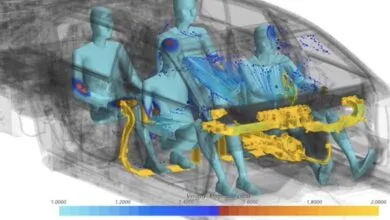
Computational fluid dynamics (CFD) is the science of understanding how air flows around a shape, helping EVs extend their range and trucks reduce drag. Since 2018, a Swiss company called Neural Concept has applied neural networks to CFD, slashing simulation times from hours on supercomputers to minutes on GPUs. Their technology is used everywhere from family sedans to Formula One cars, with Williams Racing among the clients. While most keep their tools under wraps, Jaguar Land Rover (JLR) recently praised the tech. At Nvidia’s GTC, Chris Johnston, a senior technical specialist at JLR, noted that aerodynamic tasks once requiring 4 hours now take just 1 minute.
GM is following suit, developing what it calls an “AI-powered virtual wind tunnel.” Scott Parrish, technical fellow and lab manager at GM R&D, demonstrated the system. “We’ve developed an AI model to provide a near-instantaneous prediction of drag,” he said. Designers and engineers can now tweak surfaces and get instant feedback, transforming a process that previously involved handing models off to CFD engineers for days or weeks of testing. Now, iteration happens faster, and CFD work begins earlier.
These automated systems are not flawless, however. “We’re building autonomous systems that design cars with strong human oversight,” said Pierre Baqué, CEO and co-founder of Neural Concept. “The value comes from the combination of AI speed and human judgment, not from removing the human from the equation.”
Coding and Complexity
Design and aerodynamics are only part of the five-year development puzzle. Software-defined vehicles require increasingly complex integration, causing delays and costing billions. AI is seen as a solution here, too. At Nissan, the focus is on automating menial software tasks like unit tests. Takashi Yoshizawa, a corporate executive overseeing software-defined vehicles, said these code-generation tools “improve both development speed as well as quality.”
Streamlining Headcount?
A common promise from companies adopting AI is that it will boost productivity by eliminating tedious tasks, not by cutting jobs. GM executives were firm on this point. “That hits on something that is a concern for a number of people, but the way that we’re really leveraging is allowing people to do what they really came to GM to do,” said Bryan Styles, director of design innovation and technology operations at GM Global Design. Neural Concept’s Baqué echoed this: “Our platform is designed to amplify engineering teams, not reduce them.”
Matteo Licata, a former automobile designer now teaching at IAAD in Turin, disagrees. “Jobs in design studios may not disappear right away, but the way I see it, only a fool will believe that such a massive productivity boost isn’t going to affect a studio’s headcount one way or the other,” he said. For his students, the outlook is grim. “Getting into car design was already very difficult before AI, and now it’s only going to get harder.”
Agentic Agility
Whether AI proves a blessing or a curse depends on how wisely manufacturers wield it. Some have shown poor judgment, like Dodge’s recent debacle with AI-generated “old family photos” that barely resembled the real vehicles. Marketing missteps aside, the driving force today is speed. GM’s AI-enhanced design process is already shaping its next-generation cars, though the company declined to share release timelines. Nissan, meanwhile, is targeting a 30-month development cycle as it fights to regain traction in the U. S. market.
Is that fast enough? The answer will come in 2029.
(Source: The Verge)