Anti-Jam Software Enhances Robotic Joint Control
▼ Summary
– Switching smartphones is smooth due to cloud syncing, but swapping robotic arms currently requires setting up everything from scratch.
– EPFL researchers developed “Kinematic Intelligence,” a framework to make switching robots as easy as switching smartphones.
– Robots can learn skills from human demonstration, but these skills are typically tied to the specific robot used during training.
– New robot designs with different sizes or joint orientations cause learned behaviors to fail, as the robot may flail or crash.
– Adapting skills to a different robot body usually requires completely retraining the system from scratch.
Switching smartphones is a seamless experience. Log into your accounts, and your apps, contacts, and preferences sync effortlessly to the new device. But in robotics, upgrading an old robotic arm to a newer model has traditionally meant rebuilding everything from the ground up.
To solve this, researchers at the Swiss École Polytechnique Fédérale de Lausanne (EPFL) have introduced Kinematic Intelligence, a framework designed to make swapping robots as intuitive as switching phones. Their findings are detailed in a recent Science Robotics paper.
Teaching by demonstration
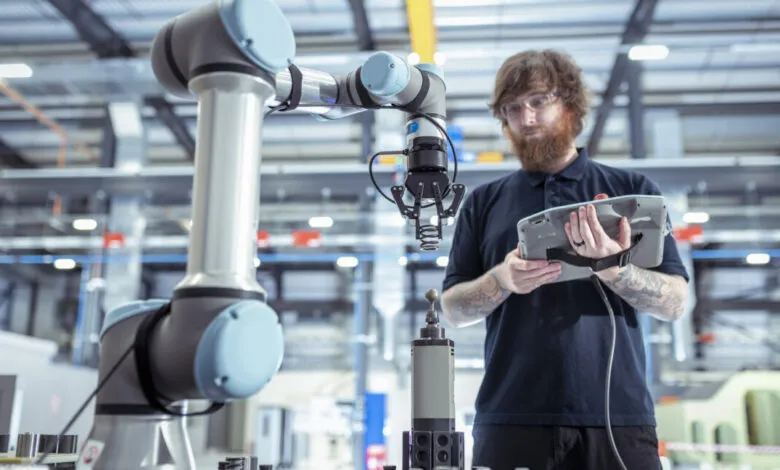
For years, roboticists have focused on teaching robots through demonstration,guiding an arm physically or remotely to perform tasks like wiping a table, stacking boxes, or welding car components, instead of writing code line by line. The catch? Most learned skills are locked to the specific robot used during training.
As robotics evolves rapidly, this limitation grows more acute. “The robots have different designs, and nowadays there are new designs being proposed,that brings its own set of challenges,” said Sthithpragya Gupta, an EPFL roboticist and lead author of the study. If a new robot has longer links, a different joint orientation, or a more complex configuration, the learned behavior fails instantly. The robot may flail, freeze, or crash when attempting the task.
“With new designs come different capabilities and constraints,” added Durgesh Haribhau Salunkhe, an EPFL roboticist and co-author. “The problem is to adapt to these constraints and capabilities,to faithfully replicate the actions demonstrated by a human.” Today, moving from one robot body to another typically requires starting over and retraining the entire system.
(Source: Ars Technica)