Transition Ventures closes $150M Fund II backed by Olix, Applied Atomics, Seneca
▼ Summary
– Transition Ventures, led by Unity co-founder David Helgason, has closed a $150m second fund, bringing total assets under management to over $300m.
– The fund focuses on companies at the intersection of AI and the physical world, including power, robotics, materials, and hardware-software systems.
– Portfolio companies include Olix (photonics computing), Applied Atomics (nuclear microreactors), Seneca (wildfire-suppression drones), and Upway (refurbished e-bikes).
– The team, composed of investors from Index Ventures, Atomico, Balderton, and others, has founded companies worth over $15bn cumulatively.
– The fundraise contrasts with a broader European venture slowdown, highlighting Transition’s ability to raise capital for deep-tech and physical AI investments.
Transition Ventures has officially closed a $150 million second fund (Fund II), bringing the firm’s total assets under management past the $300 million mark. The London-based early-stage investor, led by Unity co-founder David Helgason, is doubling down on a thesis that the most transformative companies of the next decade will emerge where artificial intelligence meets the physical world , spanning power, robotics, materials, refining, and the hardware-software boundary.
Helgason has been sharpening this argument since launching Transition in 2021, after stepping down as Unity’s CEO in 2014. His core conviction: the classic venture playbook of backing software-only incremental improvements has run its course. The next wave of generational technology companies, he argues, will require investors who can credibly evaluate both deep-tech hardware and AI software in tandem.
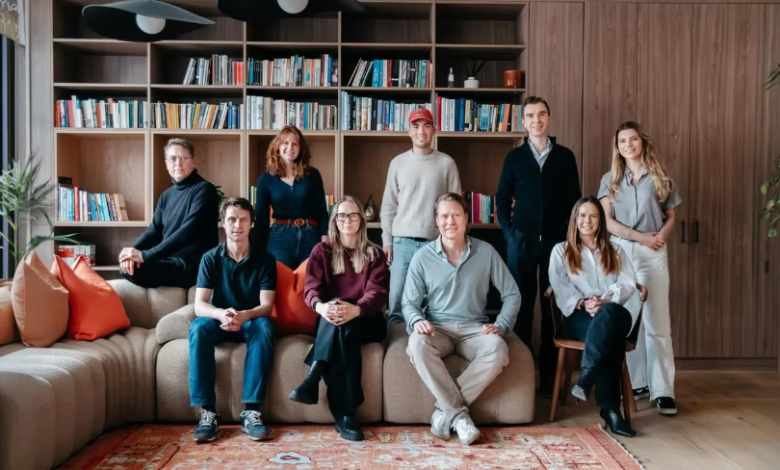
The firm’s compact team is built around that premise. Alongside Helgason are his brother Ari (formerly of Index Ventures), Kristian Branaes (ex-Atomico), Clara Ricard (ex-Balderton), and David Pacák (ex-Earlybird and Picus Capital). Transition claims its team members have collectively founded companies worth more than $15 billion; including more recent Unity equity, that figure rises to roughly $20 billion, though the headline number is anchored on Helgason’s tenure at Unity, which saw peak annual revenue above $2 billion.
The portfolio itself tells the story. Olix, the Bristol-based photonics computing company developing Optical Tensor Processing Units, is the most prominent name. Originally founded as Flux Computing and rebranded in January, Olix has raised roughly $220 million at a $1 billion valuation in a round led by Hummingbird Ventures, with Plural and LocalGlobe also on the cap table. Founder James Dacombe, a 25-year-old Thiel Fellow, was mentored by Helgason while building his first venture, CoMind. Transition invested at the first round.
Applied Atomics, founded by former SpaceX engineers Ben Kellie and Paul Keutelian, is building small modular nuclear plants designed to supply electricity directly to data centers and large industrial users. Keutelian previously served as COO of nuclear microreactor unicorn Radiant; both founders worked on SpaceX launch sites and landing barges before moving into nuclear. The company uses light-water reactor technology, the proven architecture behind most existing commercial plants, with U. S. Nuclear Regulatory Commission licensing timelines potentially as short as 36 to 48 months for its design class. Co-located nuclear power for hyperscalers is one of the most-discussed solutions to the AI data center energy bottleneck, and Applied Atomics sits squarely inside that thesis.
Seneca, the wildfire-suppression drone company that launched publicly with $60 million last October, can deploy autonomous drones to a fire within 10 minutes of detection. The round was led by Caffeinated Capital and Convective Capital, with Transition participating at the first venture round; later backers include DCVC, First Round Capital, and Slow Ventures. The drones carry 100 pounds of suppressant and shoot at 100 PSI; Seneca says it is preparing to roll out its first systems for the 2026 fire season.
Upway, the Paris-based refurbished e-bike platform, has grown roughly 30 times in revenue since Transition’s 2022 investment and is now the European and U. S. market leader in pre-owned e-bikes. The company has raised over $125 million to date across rounds led by Sequoia, Exor, and AP Moller Holding, with the Series C closing at a $400 million valuation in late 2025.
A handful of unannounced portfolio companies sit beneath the named ones, including a Paris-based space company founded by ex-SpaceX engineers, a semiconductor-metrology startup spun out of ASML in Eindhoven, and a New York photonics-materials-discovery platform run by senior AI researchers. The composition reflects what Transition is willing to underwrite: hardware-and-software businesses, often at the deeper end of the technology-readiness scale than most early-stage funds are comfortable with.
The fundraise itself arrives at a moment when European venture capital is visibly squeezed. Transition’s ability to close $150 million for a focused deep-tech and physical-AI thesis is a useful counterpoint to the broader European VC fundraising slowdown of the past 18 months.
Whether Fund II compounds the Fund I track record is the multi-year question. The portfolio so far suggests Helgason’s team is choosing risk-on rather than fashion-driven categories , the harder bet to make, but the one with longer-duration optionality.
(Source: The Next Web)