Corsair Galleon 100 SD Review: Stream Deck Included
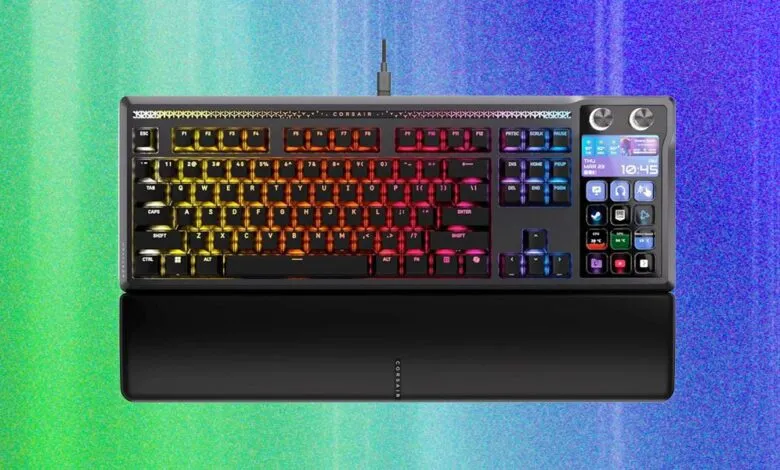
▼ Summary
– The keyboard uses standard mechanical switches instead of Hall Effect switches, so the actuation point cannot be changed and performance features like Rapid Trigger are unavailable.
– It features hot-swap sockets for MX-style switches, allowing physical customization of typing feel but not objectively increasing gaming performance.
– The gasket mount assembly suspends the internal assembly with rubberized gaskets, creating a softer, trampoline-like typing feel.
– The integrated Stream Deck has four rows of three buttons, two knobs, and a customizable screen for macros or live data, but its display can be partially cut off when viewed from a horizontal angle.
– The keyboard separates the PCB of the keyboard area from the Stream Deck area, providing consistent rigidity over the alphabet keys similar to a Tenkeyless (TKL) keyboard.
Instead of equipping this keyboard with cutting-edge Hall Effect switches that offer adjustable actuation and features like Rapid Trigger, Corsair has chosen standard mechanical switches. That means the actuation point is fixed, and some performance and customization potential is left on the table.
The upside of mechanical switches is greater physical customization. Under each key is a hot-swap socket, so you can replace any switch with an MX-style alternative. While this allows for extensive fine-tuning of the typing feel, it won’t objectively boost gaming performance.
Given the switch choice and the keyboard’s size, this isn’t really a fully performance-focused gaming keyboard. Instead, it strikes a middle ground: solid performance paired with open-ended customization options.
Shipshape Typing Experience
The Galleon uses a gasket mount assembly, meaning the entire internal structure is suspended inside the case with rubberized gaskets instead of screws. This produces a softer typing feel, which I found very comfortable. When you bottom out on a key press, it feels like landing on a trampoline rather than a hard surface.
A small bonus of the integrated Stream Deck, compared to a normal number pad, is the resulting internal packaging. In this design, the keyboard’s PCB is separated from the Stream Deck’s area, delivering consistent rigidity across the alphabet keys for typing. This provides the same feel as a Tenkeyless (TKL) keyboard when typing.
The gasket mount offers cushioning without being overly flexible, finding a comfortable middle ground between gaming and typing that maintains accuracy. Beyond that, I’m impressed by the stabilizers. Instead of the typical plate-mount stabilizers that can rattle, Corsair opted for PCB-mount stabilizers that are exceptionally well-tuned straight from the factory.
All Fingers on Deck
The integrated Stream Deck is nearly identical to a standalone version, featuring four rows of three buttons, two knobs, and a customizable screen. Each button can be freely programmed, remapped to display any feature or macro, or used to show live data.
I’ve seen people integrate their Stream Deck directly into games. One of my favorite uses is setting up macros for different Stratagems in Helldivers 2, where the button displays show the icon for each ability. Another obvious example is setting up an auto-buy for Counter-Strike 2, or programming dedicated commands like Alt+Tab, Ctrl+Alt+Del, or muting the microphone.
There are a few small issues. My biggest gripe is that the buttons are designed around a direct viewing angle. Since the keyboard is far more horizontal, viewing them from this non-ideal angle results in the outer edge of the display being cut off. If there is any text at the top or bottom of a button, you might not be able to see it during regular use.
(Source: Wired)