Pope Leo teaches tech bros a lesson on Tolkien
▼ Summary
– Pope Leo XIV’s first encyclical, “Magnifica humanitas,” cites J.R.R. Tolkien, surprising readers.
– The letter focuses on “safeguarding the human person in the time of artificial intelligence,” warning against a “technocratic paradigm.”
– Leo compares the rise of AI to the Industrial Revolution, echoing Pope Leo XIII’s defense of workers’ rights.
– The pope uses a quote from Tolkien’s Gandalf to advocate for personal responsibility against “dark forces” like tech oligarchs.
– The encyclical implicitly critiques right-wing billionaires Peter Thiel and Elon Musk for misinterpreting Tolkien’s themes of power and corruption.
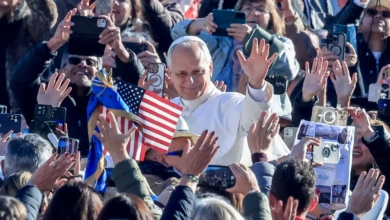
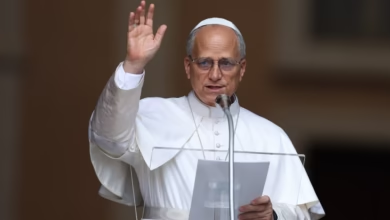
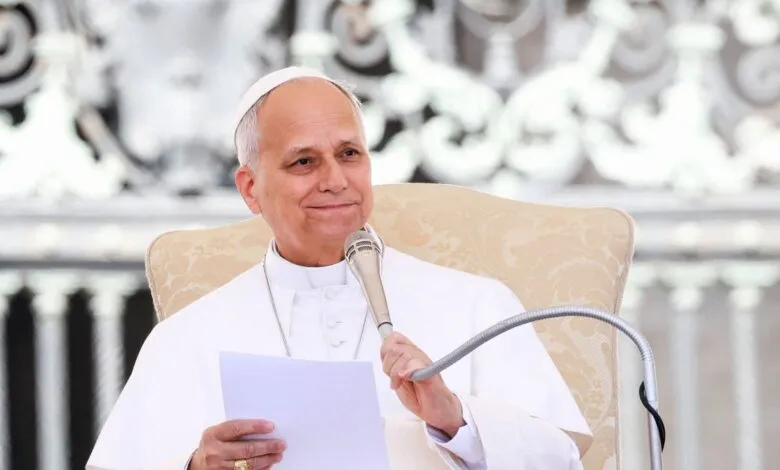
No one was surprised that Pope Leo XIV drew on well-known saints and his papal predecessors in his first encyclical, “Magnifica humanitas,” released Monday. But the name that immediately caught readers off guard belongs to a master of high fantasy: J.R.R. Tolkien, the Catholic author of The Lord of the Rings.
The pope’s letter focuses on safeguarding human dignity in the age of artificial intelligence, a defining theme of his early papacy. Building on the work of Pope Francis, Leo warns of “the growing dominance of a technocratic paradigm” that risks “reducing creation to an object of exploitation and human beings to mere cogs in a system driven toward ever greater efficiency.” He draws a parallel between the rise of AI and the Industrial Revolution, echoing the teachings of his namesake, Pope Leo XIII, whose 1891 encyclical defended workers’ rights during an era of technological and capitalist upheaval.
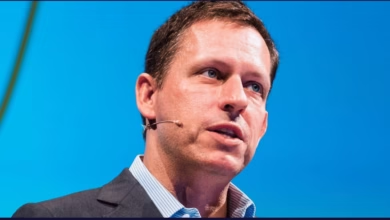
The document solidifies Leo’s reputation as an AI skeptic. Yet the Tolkien reference stands out, especially given how some right-wing billionaires have twisted Middle-earth’s mythology. Figures like Peter Thiel and Elon Musk have long been mocked by Tolkien fans for their backward interpretations. One might suspect the pope is trolling them. (The Vatican did not respond to a request for comment.)
Leo clearly worries about the motives of tech oligarchs racing to build artificial general intelligence that surpasses human capabilities. Are they truly aiming to cure diseases and solve climate change, or are they constructing engines of limitless profit and cultural dominance? When addressing our personal duty to resist such dark forces, the pope borrows from Gandalf: “It is not our part to master all the tides of the world, but to do what is in us for the succour of those years wherein we are set, uprooting the evil in the fields that we know, so that those who live after may have clean earth to till.”
That lesson is far removed from what Musk and Thiel appear to take from Tolkien’s work. Thiel named his data analytics firm Palantir after the crystal ball used as a spying device by the traitorous wizard Saruman. He reportedly calls his venture capital firm, the Founders Fund, “the precious,” the same term the twisted Gollum uses for the One Ring, a symbol of totalitarian power. Almost any reader of Tolkien sees that he was writing about power’s corrupting influence; in the novels, the temptation to rule inevitably destroys anyone who gives in. Yet Thiel seems to embrace the very possibilities of authoritarian control and omniscience that the villains pursue.
Musk, meanwhile, has suggested that Tolkien’s epic can be read as an anti-immigration, build-the-wall parable. “When Tolkien wrote about the hobbits, he was referring to the gentlefolk of the English shires, who don’t realize the horrors that take place far away,” he posted on X in October. “They were able to live their lives in peace and tranquility, but only because they were protected by the hard men of Gondor.” He offered this inaccurate reading of Lord of the Rings as a defense of Islamophobic far-right UK agitator Tommy Robinson.
(Source: Wired)