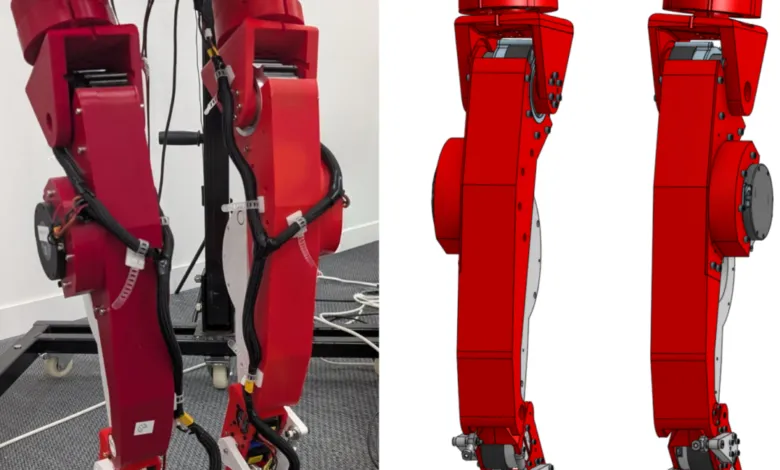
3D-printed humanoid legs accelerate robotics research
▼ Summary
– Hugging Face released the LeRobot Humanoid project, a $2,500 robot built from 3D-printed parts and off-the-shelf components, designed for research and experimentation.
– The project provides a complete open-source package, including hardware assembly instructions, 3D-printable files, and software for both physical and simulated control.
– The robot is not intended to be the most advanced humanoid, but rather one that is easy to build, understand, repair, and use for learning experiments.
– The design prioritizes affordability, mechanical performance, and ease of assembly, enabling rapid modification and experimentation instead of being a one-off prototype.
– This approach supports a reproducible “full-robot design loop,” where simulation designs are tested in physical bodies and real-world data improves the simulations.
A new open-source humanoid robot leg design, priced at just $2,500 and built from 3D-printed parts and off-the-shelf components, won’t be breaking any speed records. However, this affordable platform represents a significant step forward for robotics researchers who need a physical body to test and train AI-powered control software in real-world conditions.
The LeRobot Humanoid project, launched by the machine learning and AI platform Hugging Face, offers a complete full-stack release. Researchers and robot builders receive a detailed bill of materials, files for 3D-printable components, wiring guides, and physical assembly instructions. Critically, the package also includes software tools for calibrating and controlling the robot in both its physical form and within a simulated environment.
“If you are looking for the most advanced humanoid robot, this is not it,” wrote Virgile Batto, a robotics engineer at Hugging Face, in a blog post coauthored with colleagues. “If you are looking for a humanoid you can build, understand, repair, instrument, simulate, and use for learning experiments, this is the robot we are trying to make.”
The Hugging Face team deliberately aimed for a “practical balance between affordability, mechanical performance, and ease of assembly.” By relying on printable parts, readily available hardware, and cost-effective actuators and electronics, the bipedal platform is designed to be easily repaired and modified. This approach encourages rapid experimentation and iterative development, rather than producing a “one-off prototype useful for a demo.”
This design philosophy also supports a more reproducible “full-robot design loop.” Batto and his colleagues explain that robots designed in simulation can now be tested and validated through physical body experiments. Data gathered from these real-world trials can then directly inform and improve the simulations used to train more sophisticated robot behaviors.
(Source: Ars Technica)