Elon Musk Abandons Solar Power on Earth
▼ Summary
– Elon Musk’s xAI is using unregulated natural gas turbines to power its data centers, contradicting Tesla’s core mission of transitioning to a solar electric economy.
– SpaceX’s filing shows it spent $131 million on Cybertrucks and xAI bought $697 million in Tesla Megapacks, but xAI has not purchased a significant number of solar panels from Tesla.
– SpaceX promotes space-based solar power as superior to terrestrial solar, claiming it generates over five times the energy due to 24/7 illumination, and is considering powering AI data centers in orbit.
– Space-based data centers face major challenges, including high energy costs, difficulty protecting chips from space conditions, and uncertainty about distributing AI training across satellites.
– Musk believes AI computing demand could grow to terawatt-scale annually, far exceeding current global data center power usage of about 40 gigawatts, driving his space-based solar plans.
Has Elon Musk quietly abandoned his long-standing vision for a solar-powered Earth economy? Based on the SpaceX IPO filing released this week, the evidence is mounting that the billionaire’s priorities have shifted dramatically.
For those not deeply immersed in the Musk universe, a quick recap: Tesla has published four Master Plans over the years, each varying in specifics but united by a single goal , electrifying the global economy. Musk himself summed it up best in the original plan: “the overarching purpose of Tesla Motors… is to help expedite the move from a mine-and-burn hydrocarbon economy towards a solar electric economy.”
Yet today, one of Musk’s ventures, xAI, is actively embracing the very hydrocarbon economy he once pledged to dismantle. The company is powering its data centers with dozens of unregulated natural gas turbines and has plans to purchase an additional $2.8 billion worth of gas-powered equipment, effectively locking fossil fuels into its AI operations for the foreseeable future.
This represents a curious pivot for a businessman who built his reputation , and fortune , on clean energy. Musk has never hesitated to direct his companies to buy from one another. SpaceX has spent $131 million on 1,279 Cybertrucks. xAI has poured $697 million into Tesla Megapacks, the grid-scale battery storage systems designed to manage peak loads. But notably, xAI has not purchased a materially significant number of solar panels from Tesla.
Solar power does appear in the SpaceX filing, but almost exclusively in the context of space-based applications. The company touts orbital arrays as the future of data center energy, while terrestrial solar gets only a few mentions , not as a viable power source for xAI’s facilities, but as a benchmark to show how much better SpaceX believes its space-based solution will be.
It’s no secret that Musk and other Silicon Valley leaders have become fixated on space-based solar power. SpaceX argues that arrays in orbit can generate “more than five-times the energy” of ground-based panels thanks to continuous, 24/7 sunlight. As AI data centers face growing opposition from local communities , the dreaded NIMBYs , CEOs like Musk have begun floating the idea of massive server racks in space, powered by that uninterrupted sunshine.
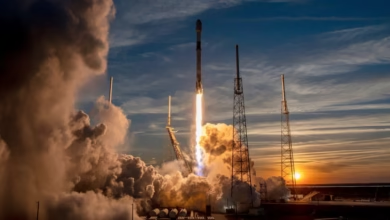
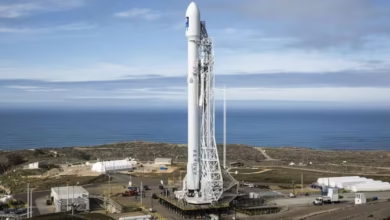
The economics, however, are daunting. Even if SpaceX can drastically reduce the cost of launching a data center into orbit, power prices for Starlink satellites remain multiples higher than what a terrestrial data center typically pays. Protecting sensitive chips from the harsh conditions of space is neither easy nor cheap. And it remains unclear whether AI training workloads can be effectively distributed across multiple satellites, leaving a significant portion of AI computation earthbound. SpaceX isn’t facing one problem , it’s facing many.
It’s plausible that Musk views xAI’s current data centers as temporary stopgaps. In his mind, once SpaceX can loft gigawatts worth of servers into orbit , perhaps just a few years away , he’ll scrap the ground-based infrastructure, natural gas turbines included, and never have to worry about NIMBYs again. The risk, of course, is that he’s wrong.
But Musk’s concerns extend beyond local opposition. He appears genuinely worried that AI computing demands will soon outstrip what Earth can provide. The SpaceX filing is sprinkled with references to “terawatt-scale annual AI compute growth,” a staggering figure when you consider that all the world’s data centers today use roughly 40 gigawatts. This is classic Musk first-principles thinking: assume the world will need an additional terawatt of compute every year, then work backward from there. “We believe that third-party estimates on data center demand are constrained by the practical supply limitations that exist in a terrestrial context and the power shortage may be far greater than what research estimates suggest,” the company argues.
Possible? Sure. But consider this: humanity today uses about 35,000 terawatt-hours of energy annually, or roughly 4 terawatts on a continuous basis. Energy demand has been rising, and AI is likely in a phase of exponential growth , but whether that continues or levels off is anyone’s guess. If there’s one thing Musk is good at, it’s spotting a trend at its inflection point and extrapolating wildly.
Here’s where the problems settle back down to Earth. I’m no rocket scientist, but shipping solar panels on a flatbed truck almost certainly uses less energy than launching them into orbit. And space-ready solar panels will need to be manufactured at an unprecedented scale. These aren’t insurmountable challenges, but they may also be a distraction. We’ve barely scratched the potential of terrestrial solar power.
The perfect doesn’t have to be the enemy of the good. There’s plenty of room to improve things here on Earth, even while we chase our dreams among the stars. Just three years ago, Musk and his team at Tesla released “Master Plan Part 3,” which thoughtfully outlined a strategy to “eliminate fossil fuels.” A good starting point might be xAI’s own data centers.
(Source: TechCrunch)