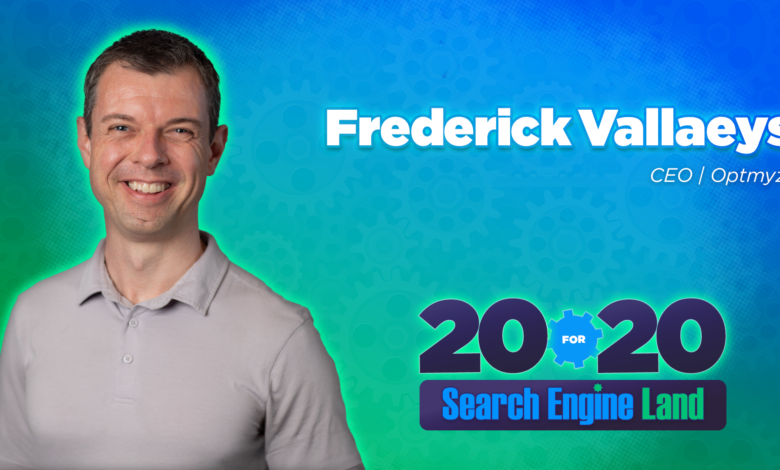
From VHS Tapes to AI: Paid Search Evolution with Frederick Vallaeys
▼ Summary
– Frederick Vallaeys entered PPC after using GoTo, an early search engine, to buy keywords for selling used Blockbuster video cassettes as a student in 1998.
– At Google in 2002, he helped launch Google Ads in Dutch, and the development of conversion tracking gave advertisers proof that paid search worked.
– Optmyzr was founded after Vallaeys shared a quality score script in a Search Engine Land article, which led to a connection with his future co-founders.
– The rise of Smart Bidding shifted Optmyzr’s role from bid adjustment to providing “PPC insurance” by monitoring automation and setting guardrails.
– Vallaeys advises marketers to give AI the broader goal, not just a narrow question, as search moves from keywords to understanding user context and intent.
Frederick Vallaeys never set out to become a defining voice in PPC. It happened almost by accident. In 1998, as a Stanford student, he spotted a niche resale market in used Blockbuster VHS tapes. To find buyers, he turned to GoTo, an early search engine where advertisers could bid on keywords. That small experiment gave him his first taste of the power behind paid search.
Fast forward over two decades, and Vallaeys is now a former Googler, a key architect in the early Google Ads ecosystem, and the founder of Optmyzr. In a recent interview, he reflected on the raw beginnings of search advertising, the sweeping impact of automation, and the critical mindset shift marketers need as search evolves from typed keywords to conversational prompts.
The Simple Spark of Paid Search
Vallaeys’ first breakthrough came before Google Ads dominated the landscape. GoTo proved that you didn’t need a massive budget to reach people. You could simply buy a keyword, drive traffic, and immediately test if an idea worked. This was a radical departure from traditional advertising, which demanded bigger budgets and offered far less clarity. Paid search democratized access to audiences.
Google Ads Made Proof Possible
When Vallaeys joined Google in 2002, his first task was launching Google Ads in Dutch , only the sixth language supported. Back then, a top advertiser might spend $30,000 a month. It sounds small now, but it was a milestone. What truly set Google apart wasn’t just the volume of traffic; it was the proof of performance. The acquisition of Urchin (which became Google Analytics) and the development of conversion tracking gave advertisers a clear view of what happened after the click. This transformed paid search from something that seemed to work into something advertisers could prove worked.
How Search Engine Land Shaped an Industry
By the time Search Engine Land launched in 2006, paid search was already a serious channel. For Vallaeys, it became more than a news source. It was a community where ideas were shared and connections were made. In fact, Optmyzr was born directly from a Search Engine Land article. Vallaeys wrote about Quality Score and shared a script for calculating it at the account level. His future co-founders commented on that article, they connected, and within thirty minutes of conversation, they decided to build the company.
Quality Score: Always About Relevance
Quality Score has always been a defining feature of Google Ads. In the earliest days, Vallaeys explained, it was essentially click-through rate. Google needed a mechanism to ensure ads were relevant, not just high-bidding. That balance between bid and quality became the foundation of the auction. Before machine learning took over, humans were deeply involved. Vallaeys himself reviewed keywords and could disapprove them for lack of relevance.
The Cyclical Nature of Search
Vallaeys sees the history of paid search as a repeating cycle. Advertisers started with very little data. Then Google gave them visibility through analytics, conversion tracking, and search query reports. Later, privacy changes pulled some of that visibility back. Performance Max followed a similar arc: it launched with limited controls, and Google gradually added more as advertisers demanded them. The industry often treats each “black box” moment as something new, but Vallaeys argues that paid search has always oscillated between simplicity, control, automation, and transparency.
Smart Bending Changed the Game
One of the biggest turning points, according to Vallaeys, was when Smart Bidding became genuinely effective. That forced tool providers like Optmyzr to rethink their value proposition. If Google could automate bidding well, advertisers no longer needed tools just to adjust bids. They needed PPC insurance , ways to monitor automation, set guardrails, and understand when the system went wrong. That became a core part of Optmyzr’s role in an increasingly automated world.
AI: The Next Existential Shift
For Vallaeys, the next major disruption began when ChatGPT launched publicly. It pushed Google to accelerate Gemini and forced the entire industry to think beyond keyword-based advertising. Google Ads was built on keywords. But users are now searching through prompts, conversations, and AI assistants. That raises a fundamental question: should the old Google Ads system be rebuilt for prompts, or should something entirely new replace it? AI search is no longer just search , it’s becoming an action engine.
Beyond Searching: Doing
Vallaeys believes AI is blurring the line between searching and doing. People no longer just ask for information. They ask AI tools to create spreadsheets, draft social posts, build slides, and solve problems. That changes what advertisers are trying to interrupt or support. The opportunity is no longer about matching one keyword to one ad. It’s about understanding the user’s broader goal and finding the right moment to be useful.
Give AI Better Context
One mistake Vallaeys frequently sees is people using AI like old search. They ask a narrow question, get a weak answer, and decide the tool is bad. His advice: give AI the real goal. If you want to be healthier, don’t just ask for the best mattress. Explain the broader problem and let AI help work through the options. The same applies to marketing. If you want a LinkedIn post, explain whether the goal is leads, hiring, education, or brand building.
The Next 20 Years Reward Problem Solvers
Vallaeys believes marketers need to stop defining themselves by old mechanics. If your job was “keyword manager,” the future may feel threatening. But if your job is to find customers and solve business problems, the tools are simply changing. The next phase of search will reward people who understand customers, communicate value, and adapt to new ways people discover information.
What He Would Tell His Younger Self
His first answer was simple: buy more Google stock. But beyond that, Vallaeys is happy with the path he took. His advice is to be purposeful, think in systems, and join communities that give you meaningful insight. For him, Search Engine Land, SMX, and Silicon Valley communities helped surface problems worth solving.
What He’s Proudest Of
Vallaeys is proud of joining Google early and contributing to the infrastructure that helped shape modern digital life. While he is also proud of Optmyzr, he sees Google’s impact on a much larger scale , from Google Ads to Maps, Docs, and Drive. His work in monetization helped fund products that changed how people access information and manage everyday life.
One Thing PPC Marketers Won’t Admit
Vallaeys joked that PPC experts never admit they don’t know the answer. Instead, they say: “It depends.” And in fairness, that is often true. Paid search has always been full of caveats, context, and changing systems. That is what makes the industry challenging , and why people who keep learning tend to last.
(Source: Search Engine Land)