Forza Horizon 6 PC Review: Stunning Ray Tracing Hints at Project Helix Port
▼ Summary
– Forza Horizon 6 is a true current-generation release, recreating a condensed, open-world version of Tokyo and rural Japan.
– The PC version introduces advanced ray-traced global illumination and reflections, significantly improving visual realism.
– A live preview feature on PC allows players to adjust graphical settings in real-time without restarting the game.
– On Xbox Series X/S, performance mode targets 60fps flawlessly, while quality mode adds limited ray-traced car reflections at 30fps.
– The game retains the series’ strong atmosphere and festival vibes, with a Japan-specific music track like YMO’s Rydeen.
Subscribe to Digital Foundry on YouTube1.5m
Playground Games has taken the beloved racing franchise to new heights with Forza Horizon 6, a title that reconstructs the Tokyo cityscape alongside rural Japan. This entry marks a definitive break from the Xbox One generation, arriving as a true current-gen release. The shift brings immense expectations, placing significant pressure on the game’s underlying technology to deliver a proper next-gen experience across PC and Xbox Series X/S.
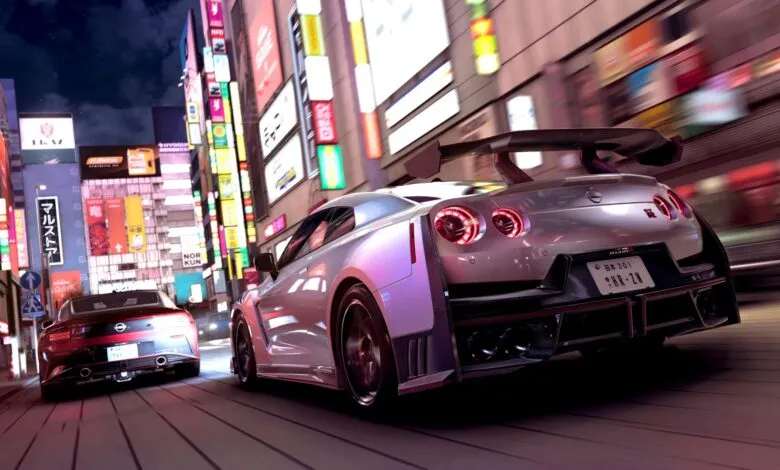
While series like Gran Turismo, Ridge Racer, Tokyo Xtreme Racer, and Project Gotham Racing have all drawn from Tokyo and its surrounding regions, Horizon 6 sets itself apart with a large-scale, open-world interpretation of the metropolis. In classic Horizon fashion, the map is a heavily condensed version of the actual city rather than a one-to-one recreation. Wider roads and far less vehicle and pedestrian traffic than the real thing create a “28 Days Later” vibe, but this distillation compresses the Japanese driving experience into a dense, varied world that feels like the largest aggregate urban space in series history.
The demands of rendering this new environment bring fresh complexities to the engine, which must handle dense urban spaces, significant elevation changes, and thick forests. Despite the lack of typical hustle and bustle, the choice of colours and materials is top notch, making FH6 one of the best-looking racing titles available.
The PC version is where the game’s graphical capabilities truly shine, offering a glimpse into the future with advanced ray tracing features. Unlike its predecessor, which only featured limited self-reflections on player cars, Horizon 6 introduces a new ray-traced global illumination (RTGI) system. This system works alongside traditional rasterised lighting to add nuance and realism, allowing objects and cars to feel significantly more grounded in their environments through realistic light propagation and subtle shadows.
Are you going to play Forza Horizon 6 at launch? (238 votes) Yes, I’ll be playing on day one 53 % Yes, I’ll check it out soon after launch 11 % Maybe, I’ll wait for reviews 9 % No, I’ll wait for the PS5 release 21 % No, I’m not really interested 5 %
Ray-traced reflections make an even more profound impact on the overall visual presentation. On PC, the city’s buildings now reflect like a mirror back onto the player, replacing the dynamically generated cube-maps and easily broken screen-space reflections (SSR) typically used. This robust reflection system extends to vehicles, allowing cars to reflect within one another, and provides much more coherent reflections on bodies of water in the countryside.
Naturally, these advanced graphical features require substantial computing power. Reaching high frame rates with maximum settings demands top-tier hardware, though upscaling and frame generation are available to help manage the load. A highly welcome addition to the PC version is a live preview feature that lets players adjust major graphical settings and watch the changes occur in real-time, without needing to reboot the game as was required in Forza Horizon 5.
Shifting focus to the Xbox consoles, the performance mode delivers a beautiful and highly stable experience. The game targets a 4K resolution on the Series X and 1080p on the Series S, using dynamic resolution scaling to maintain a flawless 60fps without a single recorded dip in our testing. While the Series S understandably loses some clarity and distant detail compared to its more powerful sibling, both consoles manage to present a visually impressive experience.
The Xbox quality mode holds a pleasant surprise too, granting console players a small taste of ray tracing. In this 30fps mode, Xbox consoles activate self-reflections on cars, similar to the feature seen in the previous game on PC. However, the consoles miss out on the large-scale environmental RT reflections, relying instead on an effective but sometimes inconsistent mix of cube maps and SSR to reflect the world and other vehicles.
Beyond the technical achievements, Horizon 6 maintains the strong atmosphere, robust music selection, and festival vibes the series is known for. While it does not introduce a major shift in the underlying game design,returning to the wristband progression system from the first game and retaining immediate access to various cars,it remains an incredibly fun experience. Bolstered by a fantastic audio presentation featuring Japan-specific music tracks like YMO’s Rydeen, it stands as a fast, beautifully optimised title that cements Playground Games as one of Microsoft’s most reliable studios.
(Source: Digitalfoundry.net)