Salesforce to spend $300M on Anthropic tokens, Benioff eyes coding in Slack
▼ Summary
– Salesforce CEO Marc Benioff projects the company will spend $300 million on Anthropic tokens in 2026, almost entirely for coding, which he says will lower development costs.
– Benioff stated that AI agents have driven “unprecedented” efficiency at Salesforce, including reducing the support workforce from 9,000 to 5,000 and now accelerating engineering output.
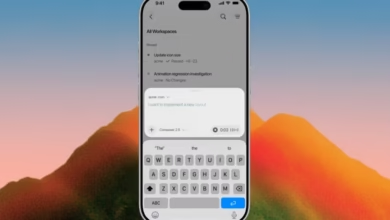
– Salesforce is developing new technology to simplify coding within Slack, which recently added over 30 AI capabilities powered by Anthropic’s Claude.
– Benioff called for an “intermediary layer” to route simple tasks to cheaper, smaller models and complex reasoning to frontier models like Claude, to optimize token spending.
– Salesforce has invested over $300 million in Anthropic since 2023, giving it roughly a 1% stake in the company, now valued at $380 billion.
Marc Benioff expects Salesforce to spend $300 million on Anthropic tokens in 2026, with the vast majority going toward coding. The Salesforce CEO shared the projection on the All-In podcast, calling AI coding agents “awesome” and Anthropic “awesome” in the same breath before noting the investment would make everything at Salesforce cheaper to build.
Tokens represent the text units that large language models process to generate output, and AI companies charge enterprise customers based on how many they consume. A $300 million annual token bill from one client would make Salesforce one of Anthropic’s largest commercial accounts, though neither company has confirmed the figure in official filings. Anthropic’s annualized revenue run rate has climbed from about $9 billion at the end of 2025 to roughly $30 billion by March 2026, fueled by enterprise adoption of Claude for coding, legal work, financial services, and general-purpose reasoning.
Benioff said AI agents have delivered “unprecedented” efficiency gains across Salesforce’s service, support, distribution, and marketing operations. Last August, he announced that agent-driven productivity allowed the company to cut its support workforce from 9,000 to 5,000. The coding use case, he argued, is now creating a similar effect on the engineering side: faster product iteration, lower development costs, and a pace of output previously impossible.
The CEO also revealed that Salesforce is developing technology to simplify coding inside Slack, the workplace communications platform Salesforce bought for $27.7 billion in 2021. “You’re going to see some cool stuff with Slack and code I’m not ready to talk about yet,” he said. “But there’s no question that we are in a new moment in coding.”
Salesforce overhauled Slack in March, introducing more than 30 new AI capabilities for Slackbot that turn it from a conversational assistant into an agentic system. It can now transcribe meetings, monitor desktop activity, execute tasks through third-party tools via the Model Context Protocol, and serve as a lightweight CRM. All these features run on Anthropic’s Claude. Benioff has called Slack “the interface to AI” and noted that AI companies including OpenAI and Anthropic run their own operations on the platform.
Slack revenue is expected to reach $3 billion this year, and Salesforce’s Agentforce business, its dedicated AI agent product line, hit $800 million in annual recurring revenue as of the most recent earnings, up 169% year-on-year with 29,000 deals closed. Starting this summer, every new Salesforce customer will have Slack automatically provisioned and AI-enabled from day one.
Benioff’s token projection comes with a caveat more interesting than the headline figure. He told the podcast that not every token a company employee generates needs to go to a frontier model like Anthropic’s Claude. He called for an intermediary layer that could route inputs intelligently, sending complex reasoning tasks to Claude and simpler ones to smaller, cheaper models.
The idea is not new, but its endorsement by the CEO of the world’s largest enterprise applications vendor carries weight. Claude Opus 4.7, released this month, costs $5 per million input tokens and $25 per million output tokens. Smaller models from Anthropic’s own Haiku line, or from open-weight competitors like Meta’s Llama and DeepSeek, cost a fraction of that. At $300 million in annual spend, even modest routing optimization could save Salesforce tens of millions of dollars. Benioff appears to be signaling that Salesforce will build that optimization rather than wait for Anthropic to offer it.
The broader context is an enterprise AI market where token consumption is becoming a major operational expense. Anthropic recently finalized a $1.5 billion joint venture with Blackstone, Hellman & Friedman, and Goldman Sachs to embed Claude inside the portfolio companies of the world’s largest private equity firms. This distribution mechanism turns token revenue from individual enterprise contracts into a structural feature of how large organizations operate. Salesforce’s projected $300 million spend is one data point in a pattern: frontier AI is no longer a line item in an innovation budget. It is becoming a cost of doing business at scale.
Salesforce has also invested more than $300 million in Anthropic as a company, starting with its Series C round in early 2023, giving it roughly a 1% stake in a company now valued at $380 billion. Benioff has said Microsoft blocked Salesforce from investing in OpenAI, which redirected the company toward Anthropic. That investment has produced a paper return of more than ten times the original outlay. Whether the $300 million in tokens produces a comparable return in engineering productivity is the question Benioff is betting on.
(Source: The Next Web)