War Memes Transform Conflict Into Viral Content
▼ Summary
– Recent ceasefire announcements prompted an analysis of how war spread online through memes, with distinct viral jokes emerging from the US and the Gulf region.
– Dark humor is a long-standing psychological response to fear, serving as a way to reclaim a sense of control during uncontrollable events.
– Social media algorithms drastically accelerate and amplify this instinct by rewarding simple, engaging, and easily remixed content over depth or accuracy.
– The article notes a geographical divide in meme creation, where proximity to conflict leads to fatalistic humor, while distance allows for safer ridicule.
– For many, especially in the West, the perception of war is heavily mediated through cinematic tropes, lacking a realistic understanding of its consequences.
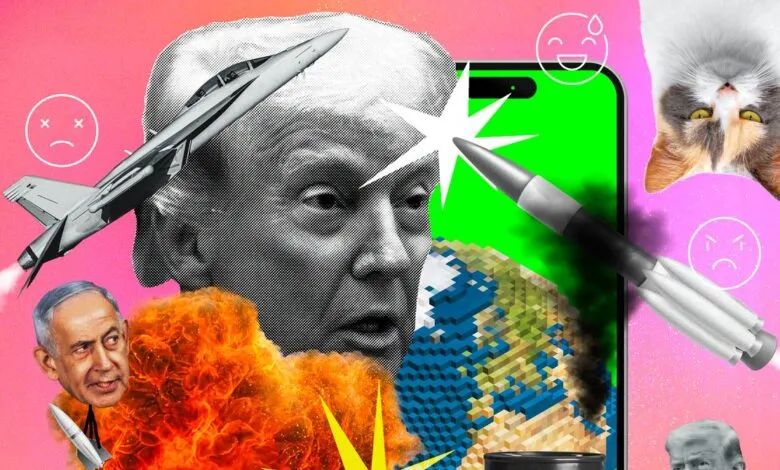
Recent ceasefire announcements between the US and Iran, and separately between Israel and Lebanon, have shifted focus to a powerful digital phenomenon: the transformation of conflict into viral content. The online response to these geopolitical tensions was not dominated by policy analysis, but by a flood of memes. This reflects a broader trend where social media platforms accelerate and amplify our most primal reactions to fear and uncertainty.
In the United States, humor fixated on conscription, with jokes about being drafted while clutching a Bluetooth device. A song titled “Bazooka” surged in popularity, its morbid lyrics about a grandmother hit by the weapon becoming a soundtrack for lip-sync videos. Military-themed filters proliferated, alongside satirical posts about Americans wanting deployment to Dubai. Across the Gulf, the content carried a different tone but stemmed from the same instinct. Memes quipped that Iran’s response time to Israel outpaced a romantic interest’s reply. Images showed delivery drivers evading missiles, and traditional “Eid fits” were reimagined as hazmat suits and tactical vests.
This dark humor is a timeless psychological defense, a fleeting mechanism to reclaim a sense of control amid chaos. Theories from Freud onward have framed comedy as a release valve for tension. The digital age, however, has fundamentally altered the equation of scale and speed. A joke once confined to a barracks or neighborhood can now become a global template in minutes. Platform algorithms, engineered for engagement rather than depth, favor content that is stripped of context, instantly recognizable, and easy to remix.
The tradition of satire during hardship is ancient, notes media analyst Adel Iskandar, tracing it from banned papyri in Egypt to revolutionary cartoons. “Where there is hardship, there is satire,” he observes. “Where there is loss of hope, there is hope in comedy.” That enduring impulse now merges with recommendation engines designed to perpetually capture attention. In this environment, memes spread faster than facts, evolving under their own Darwinian logic. As Iskandar puts it, “A meme is like a virus. If it doesn’t travel, it’ll die.” Its fitness depends on generality and emotional shorthand, not accuracy.
This dynamic creates a critical tension shaped by geography. For those distant from the immediate threat, memes can ridicule events from a position of safety. For those in proximity, the humor often tilts toward fatalism. This divide underscores how conflict is experienced online. For many, war becomes a mediated spectacle of clips, graphics, and reaction posts. For others, it is the stark reality of sirens, economic strain, and frantic safety checks.
The same piece of content can thus function as entertainment in one context and a tool for emotional survival in another. Sut Jhally, a communications professor, points out that for many Americans, the experience of political violence remains highly mediated, with the September 11 attacks as a rare, visceral exception. Much of the consumed narrative has been what critic George Gerbner termed “happy violence,” spectacular and detached from real consequence. Popular culture, from zombie films to superhero apocalypses, provides the reference points for jokes about a new draft. “There is almost no discussion about what an actual Third World War would look like,” Jhally states. “People do not have a perception of what that really looks like.” The memes fill that void with familiar, shareable tropes, making the unimaginable momentarily manageable, and the terrifying absurdly viral.
(Source: Wired)