Korg Handytraxx Play Helps Beginners Learn Scratching
▼ Summary
– The author purchased the Korg Handytraxx Play, a portable, battery-powered turntable, which finally enabled them to start learning to scratch after a 20-year goal.
– Its compact, suitcase-like design with a built-in speaker and fader makes it easy to store and quickly set up for practice or sampling in a small living space.
– The device has unique features like a reversible control panel for left/right-handed use and built-in effects, though its looper is criticized for an unintuitive and poorly designed control scheme.
– Several practical flaws are noted, including problematic latches, a gap that can eject the slipmat, and mediocre performance as a standard record player for its $500 price.
– The author recommends it for its portability but suggests cheaper alternatives for beginners, as the Handytraxx is better suited for those already familiar with scratching basics.
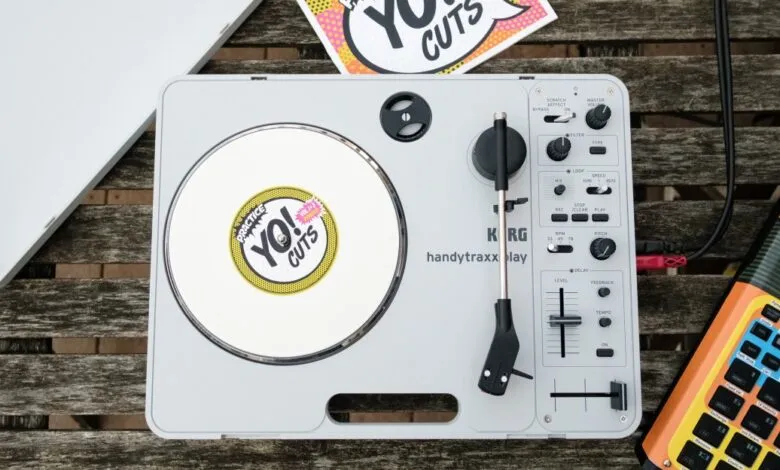
For over two decades, the goal of learning to scratch remained just out of reach, a dream deferred by the complexity of traditional turntable setups. That changed with the Korg Handytraxx Play, a portable, all-in-one unit that finally made the process approachable. This self-contained suitcase turntable, complete with a built-in speaker and fader, allowed me to finally start practicing a skill I had long admired from afar.
The Handytraxx Play’s portability is its greatest strength. As a battery-powered device that runs for up to 11 hours on six AAs, it can move from an office desk to a kitchen table without a second thought. When not in use, it closes up neatly like a piece of luggage, a crucial feature for anyone living in a tight space where it must serve multiple roles. The design encourages spontaneous practice sessions, removing the friction of setting up a full DJ rig.
Several thoughtful features enhance the user experience. The entire control panel is removable and reversible, accommodating both left- and right-handed operators. The crossfader can also be reversed to suit personal preference. While the built-in DJ-style filter and dub-style delay are interesting additions, they feel somewhat undercooked in practice. The delay sounds pleasant but lacks tempo tap, and the filter’s implementation for transitioning between loops is clunky.
However, the unit is not without its frustrations, particularly concerning build quality for a $500 device. The latches on the suitcase are problematic, often getting stuck or popping off entirely, and require perfect alignment to secure the lid. A small gap at the bottom can allow the slipmat to slide out if the case is picked up at an angle. While these are minor annoyances for home use, they would be significant flaws for someone planning to take it out for crate digging.
The built-in looper, which seemed like a potential killer feature for capturing drum breaks, is perhaps the most poorly designed element. Its operation is counterintuitive: you arm it by holding a button, it only begins recording once you release, and you must press the button again to stop. This bizarre logic makes capturing a clean, timed loop needlessly difficult until you decipher its unusual workflow.
As a dedicated record player, the Handytraxx is merely adequate. The ceramic cartridge is serviceable but can be swapped for a moving magnet type, and the built-in speakers are unremarkable. Where it truly shines is in its core function: providing a simple, dedicated platform for scratching. Connecting the RCA outputs to a proper audio interface or sampler and firing up a loop in a DAW like Ableton transforms the experience. The fader feels responsive, and the overall setup is refreshingly straightforward for a beginner.
For practice, using a dedicated scratch record like a 7-inch is highly recommended. While the platter can play standard 12-inch vinyl, the smaller format provides more stability. This also preserves any prized vinyl from a collection, as learning inevitably involves some wear and tear.
My initial approach years ago, buying a standard turntable, was a mistake due to the additional cost and complexity of a required mixer. For a novice, a portable all-in-one turntable is undoubtedly the better path to start. The Korg Handytraxx Play served my specific needs well, but its $499.99 price tag and numerous quirks make it a hard general recommendation. More affordable options like the Reloop Spin, Stanton STX, or Numark PT01 are likely better for absolute beginners testing the waters. The Handytraxx finds its niche with those seeking a more polished portablism experience after mastering the fundamentals.
(Source: The Verge)