Record-breaking Chinese PCIe 5.0 SSD uses hardware compression for speed
▼ Summary
– DapuStor’s new Roealsen6 R6101C SSD uses a hardware compression engine to compress data before writing, which reduces physical storage access and boosts performance.
– In testing, this drive achieved record-breaking sequential read/write speeds and random write IOPS when compression was enabled, making it exceptionally fast.
– The drive’s effective performance and usable capacity are directly tied to how compressible the data is, with ideal conditions allowing a 4:1 compression ratio.
– It is an enterprise-grade SSD with a PCIe 5.0 interface, a U.2 form factor, and a power draw of roughly 18W under load.
– While praised for its extreme benchmark results, real-world performance will vary as not all data types compress equally well.
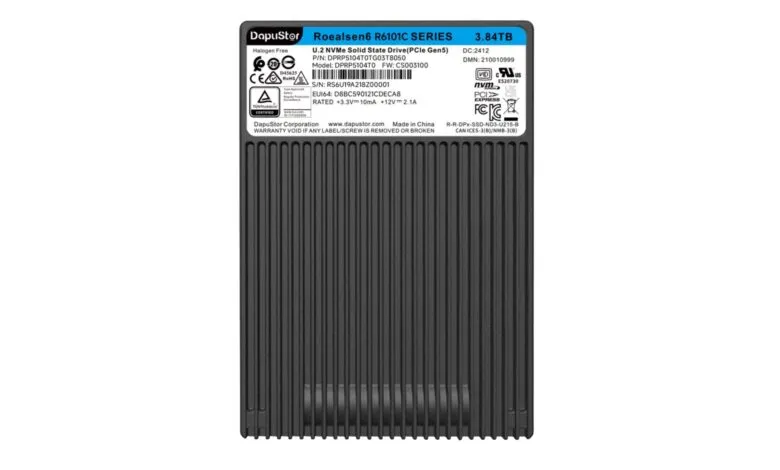
A new solid-state drive from a Chinese manufacturer is pushing the boundaries of performance by integrating hardware compression directly into its design. The Roealsen6 R6101C 7.68TB SSD leverages this technology to achieve record-breaking speeds that surpass conventional flash storage limits, though its impressive benchmarks are highly dependent on the type of data being processed. By compressing information before writing it to the NAND flash, the drive effectively reduces the physical storage accessed, which translates to faster throughput and the potential for greater effective capacity.
This enterprise-grade drive is part of DapuStor’s Roealsen6 series and utilizes the company’s proprietary DP800 controller alongside a PCIe 5.0 interface and 3D eTLC NAND flash. Its unique architecture pairs an application processor with a transparent hardware compression engine. This setup allows the drive to present a much larger logical capacity to the host system; under ideal conditions with highly compressible data, the system can achieve up to a 4:1 compression ratio. This means the 7.68TB physical drive could theoretically offer several times that amount in usable space, a concept familiar from tape storage systems that list both native and compressed capacities.
In performance testing reviewed by TweakTown, the drive delivered extraordinary results. With compression enabled at a 2:1 ratio, sequential write speeds hit 14,200MB/s and sequential reads reached 15,050MB/s, figures that exceeded the manufacturer’s own specifications. The drive also set a record in random write performance, achieving approximately 1.27 million IOPS in 4K workloads. It’s important to understand that these results are tied directly to how well the data compresses. The drive allows users to prioritize either raw speed or effective capacity, but both metrics fluctuate based on the compressibility of the workload.
The SSD operates within a 18W power envelope under load and comes in a U.2 form factor, making it suitable for standard enterprise server platforms. It carries an endurance rating of 1 Drive Writes Per Day (DWPD). While the concept of compression-based SSDs isn’t novel, with companies like ScaleFlux offering similar products, the Roealsen6 R6101C provides a new high-performance option. TweakTown awarded the drive a near-perfect score of 99 out of 100, with the caveat that real-world performance will vary since not all data types compress equally well. The publication’s senior editor noted it delivered the highest sequential and mixed workload throughput they had ever measured from any flash-based SSD.
(Source: TechRadar)