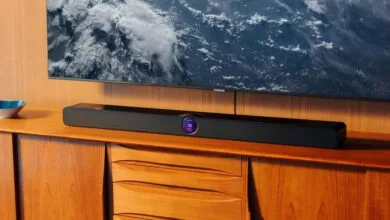
Bluesound Pulse Cinema Review: A Serious Sonos Rival

▼ Summary
– The Sonos Arc Ultra is a leading Dolby Atmos soundbar, but Sonos has lost customers due to a 2024 software issue, with many turning to competitor Bluesound.
– Bluesound is a premium, audiophile-focused audio ecosystem known for supporting lossless, hi-res audio formats, though its products are typically 30-50% more expensive than Sonos.
– Bluesound has launched its first Dolby Atmos soundbar, the $1,499 Pulse Cinema, which features dedicated up-firing drivers and a center channel to address its previous lag in home theater audio.
– The Pulse Cinema offers extensive connectivity options, including HDMI-ARC/eARC, analog/digital inputs, and a wired subwoofer output, surpassing the Sonos Arc Ultra in versatility despite lacking HDMI inputs.
– The soundbar delivers detailed audio for both movies and music, with exceptional dialog clarity for TV, and its design features a fabric grille and soft curves for a less high-tech aesthetic.
Finding a premium Dolby Atmos soundbar that excels with both movies and music is a challenge, but a new contender from Canada is making a strong case. Bluesound’s Pulse Cinema enters the market as the brand’s first soundbar with dedicated up-firing drivers for true height-channel effects, positioning it as a direct rival to established leaders. This move is timely, as it offers an alternative for those seeking high-fidelity audio without compromise.
The system presents a familiar, sleek profile. Measuring 47 inches wide, it fits comfortably beneath most modern televisions. Its design features a continuous fabric grille and gentle curves, offering a more organic aesthetic compared to some tech-heavy looks. A wall-mount bracket is included in the box, adding to its value. Where it truly distinguishes itself is in its connectivity. The rear panel hosts a generous selection: an HDMI eARC port, analog and digital audio inputs, a USB port for media playback, Bluetooth with aptX Adaptive, and both Ethernet and Wi-Fi. A dedicated wired subwoofer output is also included, a feature often absent on competing bars, though it lacks HDMI inputs.
Powering the experience is a substantial 500-watt, 3.0.2-channel array with twelve individual drivers. This configuration delivers a detailed and immersive soundscape. A key strength is its balanced performance; it is engineered to be as rewarding for critical music listening as it is for cinematic immersion. For home theater use, dialog clarity is exceptionally precise, ensuring voices remain intelligible and centered even during complex, noisy action sequences. This makes it a compelling option for audiophiles who demand support for high-resolution audio formats and are willing to invest in a premium, multiroom-capable ecosystem.
(Source: Wired)