DapuStor Unveils 245TB SSD for AI-Driven Hyperscale Storage
▼ Summary
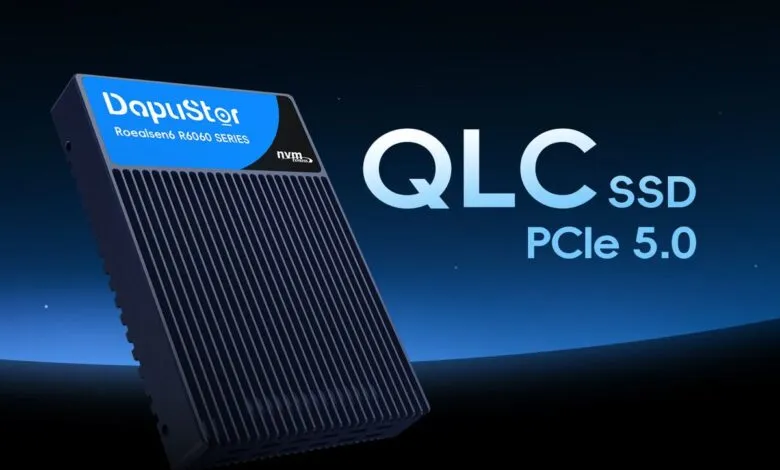
– DapuStor has announced a 245TB PCIe Gen5 QLC SSD designed for AI workloads in hyperscale data centers.
– The drive’s high capacity targets AI data lakes and vector databases where data is frequently accessed online, not archived.
– The SSD uses QLC NAND technology, which improves storage density and cost efficiency by storing four bits per cell.
– DapuStor is now the eighth vendor to reveal an SSD around 245TB, joining others like Kioxia, Sandisk, and SK Hynix.
– These ultra-capacity SSDs are intended exclusively for hyperscale environments due to their platform requirements and scale, not for consumers or typical enterprises.
The demand for massive, high-performance storage is surging as artificial intelligence reshapes data center infrastructure. DapuStor has responded to this trend by introducing a groundbreaking 245TB PCIe Gen5 QLC SSD, specifically engineered for the intense demands of AI workloads in hyperscale environments. This ultra-dense solid-state drive is designed for applications like AI data lakes and vector databases, where enormous datasets must remain instantly accessible for repeated training and inference cycles, rather than being archived away.
These advanced AI processes generate vast quantities of data, including embeddings, detailed logs, and video files. Because this information is accessed frequently and randomly, dense flash storage offers significant advantages over traditional hard disk drives in terms of speed, physical footprint, and power efficiency. DapuStor’s solution leverages QLC NAND technology, which stores four bits of data per memory cell. This approach maximizes capacity per silicon wafer, delivering greater storage density and improved cost efficiency for large-scale deployments.
The company has tackled historical concerns about QLC endurance and performance through sophisticated controller design, intelligent firmware management, and advanced data placement strategies. With this launch, DapuStor enters a competitive field of storage specialists targeting the same high-capacity tier. It becomes the eighth vendor to announce an SSD approaching the 245TB mark, joining others who see flash as critical for AI infrastructure.
The market for these drives is rapidly evolving. Kioxia has demonstrated a 246TB model, while Sandisk has unveiled a 256TB SSD tailored for AI. Solidigm has confirmed its roadmap includes 245TB drives, and Micron is promoting 122TB PCIe Gen5 SSDs as part of a broader shift away from hard disks. Samsung and SK Hynix are also pushing boundaries, with the latter teasing its own 245TB PCIe Gen5 enterprise drive. Meanwhile, companies like Huawei are exploring how high-capacity SSDs, combined with innovative controller techniques, can reduce dependency on costly High Bandwidth Memory in AI systems.
This industry-wide pivot toward ultra-high-capacity SSDs underscores a fundamental change in data storage patterns driven by AI. The nature of the workloads, where training datasets, inference results, and operational logs are constantly queried, heavily favors the random input/output performance of flash. This technology delivers the necessary speed while consuming less physical rack space and energy compared to alternative storage media.
It is important to note that these monumental drives are not intended for consumer use or even standard corporate data centers. The platform requirements, substantial pricing, and necessary scale firmly place these SSDs in the domain of hyperscalers and large cloud providers. In these environments, where AI is a core business function, flash storage capacity is transitioning from a convenience to a critical, strategic resource.
(Source: TechRadar)