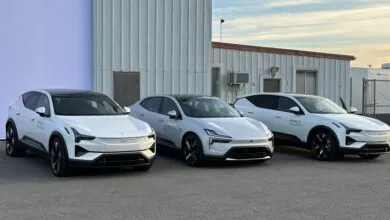
Polestar CEO: ‘Pump anxiety’ boosts EV demand amid fuel price surge
▼ Summary
– Polestar CEO Michael Lohscheller said “pump anxiety” over rising fuel prices from the Iran war and Strait of Hormuz closure has replaced range anxiety as the main consumer concern, driving a shift toward EV demand.
– EU EV registrations jumped 51% in March, with Italy, France, and Germany seeing significant increases, while US new EV sales have not shown a similar spike due to disappearing tax incentives.
– Polestar reported a widening Q1 net loss of $383 million on flat revenue of $633 million despite record deliveries of 13,126 vehicles, with gross margins swinging negative due to pricing pressure, tariffs, and currency effects.
– Lohscheller stated range anxiety is over, noting the cheapest Polestar 2 offers 344 miles of range and can be charged overnight for about £15, but acknowledged EV residual values remain a pain point.
– The fuel-price shock is reshaping markets, with BYD exporting over 120,000 EVs in March and Renault calling it a “seismic shift,” though higher energy costs and tariffs punish companies like Polestar.
For years, the electric vehicle industry wrestled with one primary consumer fear: range anxiety. Now, Polestar CEO Michael Lohscheller argues the anxiety has shifted from the battery to the pump. “People are concerned, ‘how much do I pay at the gas station?’” Lohscheller told CNBC’s Squawk Box Europe, coining a new term,“pump anxiety”,to describe a market shift the entire automotive sector is now racing to understand.
The catalyst is unmistakable. Following U. S. and Israeli strikes against Iran on February 28, the Strait of Hormuz,a narrow waterway handling roughly a fifth of global oil supply,has been effectively closed to commercial shipping. Brent crude has surged past $100 a barrel. In the United Kingdom, average petrol prices have climbed more than 25 pence per litre since early March, with diesel nearly 45 pence higher, according to RAC Fuel Watch. Across the European Union, petrol has breached €2 per litre in several countries. The result is a continent-wide recalculation of driving costs.
The economics have flipped
Lohscheller contends the cost equation has inverted. “In the past, people considered EVs for idealistic reasons, and now the decision is all about money,” he said. The data supports his claim. EU electric vehicle registrations surged 51% in March compared to the same month last year. Italy recorded a 65.7% increase in battery-electric registrations in the first quarter, France followed at 50.4%, and Germany at 41.3%, according to European Automobile Manufacturers’ Association data. In the United Kingdom, both Chinese EV makers and European incumbents report spikes in online inquiries and test-drive bookings.
The trend is not universal. In the United States, where petrol has topped $4 per gallon for the first time in four years, the effect has been more subdued. Used EV sales rose 12% year-on-year in the first quarter and 17% over the previous quarter, but new EV sales have not shown the same surge. Lohscheller pointed to disappearing federal tax incentives and broader consumer uncertainty as factors dampening American demand.
A company under pressure
The pump-anxiety thesis arrives at a critical moment for Polestar. The Geely-controlled, Sweden-headquartered company reported a widening net loss of $383 million in the first quarter, more than double the $166 million loss from the same period last year. Revenue remained flat at $633 million, despite a 7% increase in deliveries to a record 13,126 vehicles. Gross margins swung to negative 3.2%, down from positive 10.3% a year earlier. The company attributed the deterioration to pricing pressure, EU and U. S. tariffs, lower carbon-credit sales, and unfavourable foreign-exchange movements driven by the weakening Chinese yuan.
The financial results highlight a paradox at the heart of the EV industry in 2026. Demand is rising, but so is the cost of competing. Polestar manufactures primarily in China, making its vehicles subject to both American and European tariff regimes designed to counter Chinese production advantages. The company described China’s domestic market as “hyper competitive” and suggested Europe needed to “speed up” its own response.
Range anxiety is over. What comes next is harder.
Lohscheller, who previously ran Opel and Vauxhall, was blunt about the range question. “Range anxiety, I think this has gone,” he said at the Financial Times Future of the Car conference, also held on Wednesday. The cheapest Polestar 2 now offers 344 miles of official range on the WLTP test cycle. The dual-motor Polestar 3 SUV manages 402 miles. An 82-kilowatt-hour Polestar 2 can be fully charged overnight on a domestic EV tariff in the UK for roughly £15, a fraction of what a comparable petrol car costs to refuel at current prices.
But lower running costs have not yet translated into lower purchase anxiety. Lohscheller acknowledged that EV residual values remain a pain point, lagging behind equivalent combustion cars. New-car pricing pressure, driven by manufacturers scrambling to meet the UK’s zero-emission vehicle mandate quotas or face fines, has led to aggressive discounting that further erodes used-EV values. “I’m asking for stability,” he said of the regulatory environment. “Every three months to have a new debate about these rules changing is not helping anybody.”
The bigger picture
The fuel-price shock is reshaping automotive markets well beyond Polestar’s niche. BYD exported more than 120,000 electric and hybrid vehicles in March alone, a 65% increase year-on-year. Renault has described the Middle East conflict as having triggered a “seismic shift” in EV adoption. International Energy Agency chief Fatih Birol has said countries are likely to pivot to renewables to mitigate geopolitical risk, calling the Hormuz disruption the largest supply disruption in the history of the global oil market.
The irony is that the crisis most likely to accelerate the transition to electric vehicles is also the crisis most likely to punish the companies trying to lead it. Higher energy costs raise manufacturing expenses. Tariff walls make cross-border competition more expensive. Currency volatility erodes margins on vehicles built in one country and sold in another. Polestar’s first-quarter results are a case study in all three dynamics operating simultaneously.
Lohscheller’s framing,that the conversation has moved from range to price, from ideology to arithmetic,is probably correct. The question is whether Polestar, a company losing money on every percentage point of margin while navigating tariffs, competition, and a war-driven energy shock, is positioned to benefit from the shift it is describing. Pump anxiety may be good for EVs in the aggregate. Whether it is good for Polestar depends on whether the company can turn rising demand into something its balance sheet has not yet demonstrated: a sustainable business.
(Source: The Next Web)