Musk-Altman Trial Opens With $150B OpenAI Conversion at Stake
▼ Summary
– Jury selection begins Monday in the federal trial over whether OpenAI’s conversion from nonprofit to for-profit constitutes unjust enrichment and breach of charitable trust, with Musk dropping fraud claims to sharpen focus on these two counts.
– The most damaging evidence is Greg Brockman’s 2017 diary entry calling the nonprofit commitment “a lie,” and Judge Gonzalez Rogers found “ample evidence” supporting Musk’s claims, rejecting nearly all dismissal attempts.
– The advisory jury will hear testimony from Musk, Altman, Nadella, Murati, and Sutskever, but the judge alone decides remedies, which could include $150 billion in damages and unwinding the conversion.
– OpenAI defends the conversion as legal, reviewed by attorneys general, and argues Musk’s lawsuit is a competitive harassment campaign driven by his own AI venture, xAI.
– The trial tests the legal sustainability of nonprofit-to-profit conversions in AI, with Musk arguing the conversion enriched insiders at the expense of the charitable mission.
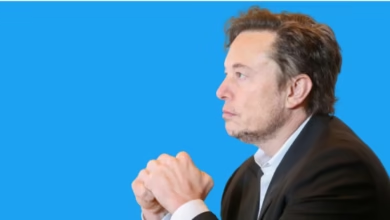
Jury selection is set to begin Monday in a federal courtroom in Oakland, California, for a trial that could reshape the future of artificial intelligence. At the heart of the dispute is OpenAI’s transformation from a nonprofit research lab into a for-profit giant valued at $852 billion. Elon Musk, who co-founded the organization in 2015 and contributed at least $38 million, is suing CEO Sam Altman, President Greg Brockman, and the company itself. The two remaining claims focus on unjust enrichment and breach of charitable trust. Musk is seeking up to $150 billion in damages directed back to the nonprofit arm, the removal of Altman and Brockman from leadership, and a court order to reverse the for-profit conversion. On Friday, Musk voluntarily dropped fraud and constructive fraud claims, paring the case down from 26 counts but sharpening the legal battle on a single, defining question: Did OpenAI’s leadership promise a nonprofit mission while building a corporate empire?
The most damaging evidence may come from a surprising source. A 2017 diary entry written by Greg Brockman reads: “I cannot believe that we committed to non-profit if three months later we’re doing b-corp then it was a lie.” Judge Yvonne Gonzalez Rogers, who is overseeing the trial and will ultimately decide remedies, cited this entry directly in her January 15 ruling that allowed the case to proceed. She found “ample evidence” supporting Musk’s claims and rejected “nearly every attempt by OpenAI and Microsoft to make the lawsuit disappear.” That 28-page ruling signaled the court considers the allegations serious enough for a jury to hear, a significant validation of the underlying arguments. Additional evidence includes a 2017 email in which Altman professed enthusiasm for the nonprofit structure after Musk threatened to cut funding, a statement Musk’s team frames as a deliberate misrepresentation.
Hundreds of pages of discovery materials unsealed in late 2025 contain emails, texts, and Slack messages that Musk’s attorneys say show leadership “said one thing publicly and planned something completely different privately.” A February 2023 text from Altman to Musk, sent after Musk publicly criticized OpenAI, read: “You’re my hero and that’s what it feels like when you attack OpenAI.” The witness list reads like a Silicon Valley who’s who: Musk, Altman, Microsoft CEO Satya Nadella, former OpenAI CTO Mira Murati, co-founder Ilya Sutskever, and Shivon Zilis.
OpenAI has called the lawsuit “baseless” and described it as a “harassment campaign that’s driven by ego, jealousy and a desire to slow down a competitor.” The competitor is xAI, Musk’s AI company founded in 2023 and recently merged with SpaceX in an all-stock deal valuing the combined entity at $1.25 trillion. OpenAI’s defense team will use this to argue that Musk’s motivations are competitive rather than charitable. They contend that Musk left the board in February 2018, reneged on a larger planned donation, and has no standing to dictate the organization’s structure years later. Judge Rogers herself noted that “this country likes competition,” acknowledging the potential self-interest in Musk’s claims. The structural defense rests on the fact that OpenAI’s conversion was reviewed by attorneys general in California and Delaware. The nonprofit entity now operates as the OpenAI Foundation, holding roughly 26% of the company’s valuation (about $130 billion), and retains oversight of mission alignment and the ability to appoint members of the for-profit board.
The foundation’s $25 billion commitment when OpenAI completed its recapitalization makes it one of the most well-endowed philanthropic organizations in the world. OpenAI argues this structure preserves the charitable mission while enabling the scale of investment needed to pursue artificial general intelligence. Altman, Brockman, and Microsoft have all denied wrongdoing.
The trial structure is unusual. The nine-member jury’s verdict on liability will be advisory only. Judge Rogers will make the final determination on both liability and remedies. Opening arguments are expected Tuesday. The liability phase runs through mid-May. If OpenAI is found liable, the remedies phase begins May 18, where the court will consider Musk’s requests for damages, leadership removal, and the unwinding of the conversion. Even a unanimous jury verdict does not bind the judge, but a strong consensus would carry significant moral authority in her deliberations.
Musk’s decision to drop the fraud claims on Friday was strategic, not a concession. Fraud requires proving intentional deception, a higher evidentiary bar that would have diverted the trial into debates about Altman’s state of mind. Unjust enrichment and breach of charitable trust focus on outcomes rather than intent: Did the conversion enrich insiders at the expense of the charitable mission? Did it violate the trust under which the nonprofit’s assets were held? These claims are easier to prove because the facts are largely undisputed. OpenAI was founded as a nonprofit. It converted to a for-profit. Its leaders hold equity in the for-profit entity. The question is whether that sequence constitutes a legal violation, not whether anyone intended it to be one. In his April 2026 amendment, Musk asked that Altman and Brockman be required to hand over “all equity and other personal financial benefits they obtained as a result of OpenAI’s for-profit operations” to the OpenAI charity.
The stakes are enormous. OpenAI’s $852 billion valuation is already facing scrutiny from its own investors over questions about its enterprise pivot and strategy shifts. The company raised $122 billion in its most recent round, is laying groundwork for a 2026 or 2027 IPO at a potential valuation of $1 trillion, and is projecting $14 billion in losses this year. The trial arrives at the worst possible moment for a company seeking public market credibility. At least 12 senior executives have left OpenAI since its conversion, with only two original co-founders remaining. This departure rate includes the dismantling of OpenAI for Science and the shutdown of Sora, decisions that reinforce the argument that the conversion prioritized commercial revenue over the original research mission. OpenAI quickly stepped in to fill Anthropic’s Pentagon contract with no usage restrictions after Anthropic refused the military work on principled grounds, a contrast that has become part of the broader governance debate about whether OpenAI’s “benefit all of humanity” charter survived the conversion.
Eyes on OpenAI, a coalition of more than 60 California nonprofits, has separately argued that the restructuring deal is “full of holes” and could establish a precedent for startups to use nonprofit status for tax advantages before converting to for-profit. Public Citizen and the San Francisco Foundation have urged the California attorney general to ensure that conversion payments go to a new, independent charitable enterprise rather than one controlled by the same leadership that approved the conversion.
This trial is not only about OpenAI. It is about whether the nonprofit-to-profit conversion model is legally sustainable in AI. OpenAI was not the first technology organization to start as a nonprofit and accumulate enormous value. Mozilla did. Wikipedia resisted. The question the Oakland courtroom will address over the next month is whether the people who built OpenAI with charitable donations and a stated commitment to benefit humanity can legally convert that work into an $852 billion for-profit enterprise and keep the equity. Musk says they cannot. Altman says the conversion serves the mission better than the original structure ever could. Brockman’s diary says it was a lie. The jury will hear all of it, and the judge will decide what it means.
(Source: The Next Web)