Topic: archaeological research
-

Easter Island Statues Built by Small Clans, 3D Model Reveals
New 3D modeling of the Rano Raraku quarry suggests the moai were carved by decentralized family groups, not a single unified society, around 800 years ago. This digital reconstruction provides a comprehensive, shareable record of the site, allowing detailed virtual study of carving styles and ina...
Read More » -

AI Rivals Decode Ancient Roman Board Game's Secrets
AI simulations identified a mysterious Roman-era stone as a rare board game, reconstructing its probable rules and marking a new method in archaeological analysis. The artifact, found in the Netherlands, showed unique wear patterns consistent with game pieces, which AI matched to a strategic "blo...
Read More » -

How Easter Island's Giant Statues Walked to Their Platforms
The moai statues of Easter Island, some weighing up to 92 tons, were carved around 800 years ago, and a theory by archaeologist Carl Lipo suggests they were transported upright by "walking" them with ropes. Recent studies, including 3D modeling and field tests, support this walking hypothesis, wi...
Read More » -

How Seabird Guano Powered the Rise of Peru's Chincha Kingdom
The pre-Inca Chincha Kingdom's prosperity was built on seabird guano, a potent fertilizer that fueled agricultural surpluses, driving trade, population growth, and political power. Research shows guano dramatically increased maize production, creating an economic surplus that could be traded or s...
Read More » -
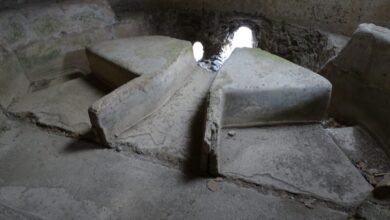
Pompeii's Public Baths: How a Water Switch Boosted Hygiene
The catastrophic eruption of Mount Vesuvius in 79 CE preserved Pompeii, including its water infrastructure, allowing modern study of its advanced urban systems. A recent scientific analysis of mineral deposits in the water system revealed a major shift from reliance on deep wells to a sophisticat...
Read More » -

Dogs Were Diverse in Size and Shape Long Before Modern Breeds
Ancient dogs exhibited significant physical diversity in size and shape long before modern breeding practices, with Ice Age dogs already showing about half the variation of contemporary breeds. A study comparing 643 canine and wolf skulls from the past 50,000 years revealed that Mesolithic and Ne...
Read More » -

Ancient Treasure Reveals Extraterrestrial Metal
Two corroded artifacts from Spain's Bronze Age Treasure of Villena, a bracelet and a hemisphere, have been identified as being made from meteoritic iron, not terrestrial metal. This discovery resolves a dating puzzle, as the objects' high nickel content confirms a celestial origin, placing them i...
Read More » -

South America's Ancient Hunters Targeted Giant Prey
Ancient human hunters in South America showed a strong preference for hunting giant Ice Age creatures like sloths, armadillos, and elephant-like mammals, which may have driven them to extinction. Analysis of bones from 20 archaeological sites revealed that over 80% of butchered remains at most lo...
Read More »