Germany Tests 30 AI Military Tools, Prototype Due in 2027

▼ Summary
– The Bundeswehr is evaluating 30 artificial intelligence tools to enhance battlefield decision-making, with a prototype expected by mid-2027 and full deployment in 2028.
– Vice Admiral Thomas Daum confirmed that the selection process favors mostly German companies, excluding US firm Palantir despite its widespread NATO usage.
– Germany faces a trade-off between adopting existing foreign systems like Palantir’s Maven and developing sovereign software, which delays capability but reduces foreign dependency.
– Instead of a single European champion, Berlin is pursuing a strategy of multiple domestic options to build a competitive field of defense technologies.
– Integrating these disparate systems presents significant technical challenges, contrasting with Palantir’s unified platform approach.
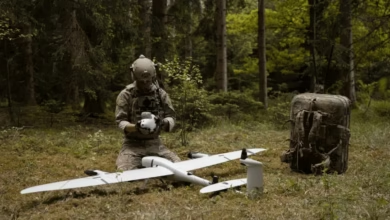
The Bundeswehr is currently evaluating a portfolio of 30 artificial intelligence tools designed to accelerate battlefield decision-making by analyzing data streams from drones and satellites. This ambitious initiative aims to deliver a functional prototype by the second quarter of 2027, with plans for full operational deployment following in 2028.
Vice Admiral Thomas Daum, who leads the military’s cyber command, outlined this schedule in remarks reported by Reuters on Thursday. He emphasized that while the assessment process remains ongoing, he maintains a positive outlook regarding its potential success. The majority of the companies participating in this evaluation are German, though French firm ChapsVision stands out as one of the few international contenders still in contention.
The absence of certain major players from this list defines the strategic narrative. In April, Germany explicitly rejected Palantir, declining to adopt the Maven Smart System already utilized by the Pentagon and several NATO allies. This rejection posed a direct question for Berlin: if the American system was off the table, what would serve as its replacement? That answer now has a concrete timeline attached to it.
However, the schedule presents significant challenges. While Maven is already active, Germany’s domestic alternative requires approximately 18 months to reach the prototype phase, followed by another year for full deployment, assuming no delays occur. Defense projects rarely adhere to such precise schedules. Developing sovereign military software reduces reliance on foreign vendors but demands extensive time for development, testing, and integration. During this interim period, other armies continue to operate with systems that Germany is still conceptualizing.
The conflict in Ukraine highlights the difficulty of this trade-off. The volume of imagery generated by drones and satellites has surged beyond the capacity of manual analysis, creating a compelling argument for deploying the most effective tools available immediately. Simultaneously, the war has demonstrated the strategic leverage gained by controlling the software layer, especially when that software influences military intelligence and targeting decisions.
Berlin has navigated this tension for some time. France and Germany initially pledged to create a European alternative to Palantir, but German officials later expressed concerns that a French-led project might simply shift dependencies rather than eliminate them. By evaluating 30 mostly German systems, Berlin appears to be pursuing a different strategy. Instead of betting on a single European champion, it is cultivating a diverse field of domestic options.
Whether this fragmented approach is superior remains debatable. Having thirty tools compete for the same decision-support role indicates an unsettled market. The true challenge will arise during the integration phase, where these disparate systems must function cohesively. Military software programs frequently struggle at this stage, and one of Palantir’s key advantages is its ability to house various capabilities within a unified platform.
Germany seeks to achieve similar interoperability by assembling multiple components. This method offers greater technological control but significantly increases project complexity, helping to explain why the prototype is not expected for another 18 months. Placing the program under Daum’s cyber command is also noteworthy. Although battlefield decision support extends beyond pure cyber issues, assigning it to this command suggests Berlin views AI as part of the broader military data and network infrastructure before treating it as a targeted operational system.
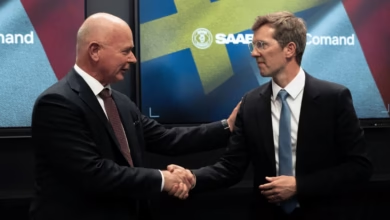
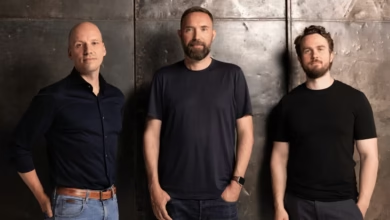
This perspective clarifies why the initial focus is on identifying tools capable of processing data rather than selecting a specific system for field commanders. Germany secured 90% of Europe’s record defense technology funding last year, and the domestic supplier base has expanded considerably since 2022. Startups like Comand AI have attracted investment to develop command software for European forces. A procurement program of this scale serves as a critical mechanism for converting those investments into tangible military utility.
The pivotal milestone will not be the prototype itself, but the subsequent consolidation of the 30 candidates. Germany must rapidly narrow the field and ensure that surviving systems can integrate with each other and with NATO infrastructure. Failure to do so could result in 2028 bringing forth a collection of capable yet disconnected tools. In such a scenario, the argument for reverting to the American solution would become straightforward, driven primarily by the pressure of the calendar.
(Source: The Next Web)