Comand AI secures €32M for military command software
▼ Summary
– Comand AI, a Paris-based startup, raised a €32mn Series A led by Blossom Capital with investment from Saab for its AI command-and-control software.
– Its platform, Prevail, uses a “digital command staff” of specialized AI agents to turn sensor and drone data into decisions, with a human making the final call.
– Unlike larger competitors like Helsing and Anduril, Comand AI focuses solely on the command layer and has deployed Prevail with operational units in multiple allied nations.
– Saab’s strategic investment signals a European alternative to US-led C2 systems like Palantir’s Maven, with plans to integrate Prevail into Saab’s GlobalEye aircraft.
– The funding will expand Prevail into NATO markets and new domains like air and maritime, aiming to control the decision layer in the defense-AI landscape.
The defence technology sector is experiencing a rapid land grab, but the most critical battleground isn’t the drones or sensors that dominate headlines. It is the software layer that sits above them, orchestrating the chaos into actionable decisions.
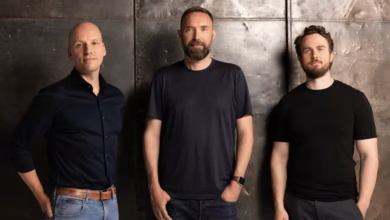
Comand AI, a Paris-based startup specializing in military command software, has secured a €32 million Series A funding round. The investment was led by Blossom Capital, with a strategic contribution from Sweden’s Saab and continued support from existing backer Expeditions. The announcement was made at Eurosatory, one of the globe’s premier defence exhibitions.
The company operates in the niche of C2, or command and control, the software that translates a deluge of data from sensors, drones, and weapon systems into coherent battlefield decisions. Its platform, Prevail, is built around what it calls a “digital command staff” of specialized AI agents. Each agent handles a distinct function, from mission analysis to after-action review, effectively turning a single laptop into a command node capable of coordinating both manned units and drone swarms. Crucially, a human operator retains the final call on every action.
Founder Loïc Mougeolle frames the shift succinctly: “We are moving from a battlefield governed by words to a battlefield governed by mathematics.”
This territory is already crowded with well-funded giants. Helsing, the German defence-AI firm, has reached an $18 billion valuation, while Anduril recently closed a round at a staggering $61 billion. Both operate in adjacent spaces, but neither has focused squarely on the command layer itself.
That is the precise gap Comand AI is targeting. And it holds a distinct advantage: Prevail has been deployed with operational units in France, Germany, Ukraine, and other allied nations over the past year. This provides the company with live battlefield feedback at the decision layer, a real-world testing ground its larger competitors cannot easily replicate. The company remains vague on the exact scale of these deployments.
Despite the competition from Anduril’s Lattice, Palantir’s Maven, Helsing’s Altra, and Shield AI’s Commander, a €32 million round is modest compared to the war chests of these rivals. But Comand AI’s strategy hinges on a different kind of leverage.
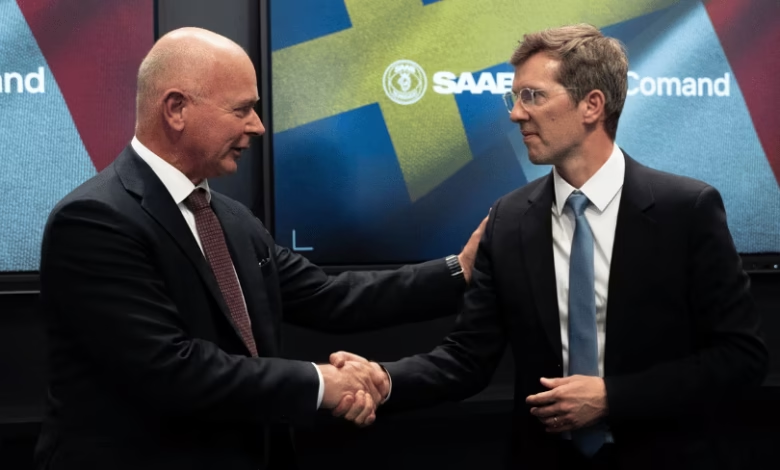
The involvement of Saab signals more than just capital. Rather than developing command software internally, the Swedish defence prime has chosen to back a startup. The two partners will develop new software for Saab’s GlobalEye airborne early-warning aircraft and work on a next-generation C2 ecosystem with Prevail integrated. This pairing of Swedish defence hardware with French AI is a deliberately European combination.
That framing is critical because Europe’s most prominent C2 deployment is currently American. NATO has rolled out Palantir’s Maven, and officials have openly acknowledged the lack of a homegrown alternative, even as Palantir’s standing in Europe wavers. Comand AI, with Saab, is positioning itself as precisely that alternative.
The fresh funding will push Prevail across NATO markets and into new domains. Air operations are already underway, and a maritime version is expected before the end of the year. The bet for the next three years is narrow and high-stakes: when the dust of the defence-AI rush settles, the question will be who controls the decision layer.
(Source: The Next Web)