Rocket Lab shows flexibility; Blue Origin plans two pads

▼ Summary
– Rocket Lab’s quarterly update shows strong progress as it expands beyond launching, but the article raises concerns about vague readiness updates for the Neutron vehicle, with Stage 2 shipping language unchanged for 12 months.
– The company introduced a new portable spaceport system called GHOST, enabling Electron and HASTE rockets to launch from anywhere at any time for multi-launch campaigns and national security missions.
– Rocket Lab currently operates launch sites in New Zealand and Virginia, and announced plans to add Alaska’s Pacific Spaceport Complex to its footprint.
– GHOST was developed in response to a HASTE customer’s request for Rocket Lab to be more mobile, expanding the company’s launch capabilities beyond fixed sites.
– The Rocket Report covers small-, medium-, and heavy-lift rockets and includes a preview of the next three launches on the calendar.
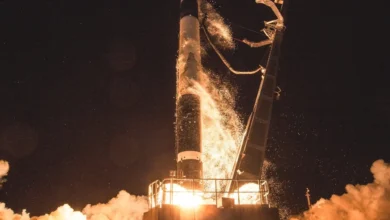
Rocket Lab is positioning itself for a major operational shift, unveiling a new portable launch platform designed to make its Electron rocket more agile than ever. The company, which has been aggressively expanding beyond its traditional launch business, announced the new system, dubbed GHOST, this week in a move that could significantly alter how and where it conducts missions. The development signals a broader strategy to capture more defense and national security work, where responsiveness and flexibility are increasingly prized.
The new system, which stands for “Global Hypersonic & Orbital Spaceport Technology,” is designed to transform the company’s Electron and HASTE vehicles into a true launch-anywhere capability. According to a company statement, GHOST will enable multi-launch campaigns from virtually any location, a feature that could prove decisive for time-sensitive national security payloads. The announcement came alongside Rocket Lab’s quarterly earnings update, where the company touted its growing financial health and expanding portfolio.
Rocket Lab currently operates from two established sites: one on the North Island of New Zealand, the home country of founder and CEO Peter Beck, and another at Wallops Island, Virginia. However, the company has already signaled plans to add a third location at Alaska’s Pacific Spaceport Complex. The GHOST system, Beck explained, was born out of a direct request from a customer using the HASTE platform, a suborbital hypersonic test vehicle. That client specifically asked for a launch solution that was, in Beck’s words, “a little bit more mobile than we are.”
While the expansion is ambitious, the company’s near-term outlook is not without its question marks. The quarterly update highlighted solid progress across the business, but it also left some analysts and observers wanting more clarity on the Neutron vehicle, the company’s next-generation rocket. Despite repeated inquiries, Rocket Lab’s language regarding the readiness of Neutron’s second stage has remained largely unchanged over the past year, a point that did not go unnoticed on social media. One user on X pointed out that the phrasing around the stage being “ready to ship to the launch site” has been essentially static for twelve months, raising concerns about potential delays in the program’s timeline.
That ambiguity is worth watching, given that much of Rocket Lab’s long-term valuation hinges on Neutron’s success. The vehicle is expected to compete in the medium-lift category, a segment that could open up new revenue streams and reduce the company’s reliance on the smaller Electron. Still, the immediate focus appears to be on operational flexibility. The GHOST system, combined with the planned Alaska site, suggests Rocket Lab is betting that mobility will be a key differentiator in a crowded launch market.
Looking ahead, the calendar is packed with upcoming flights across the small-, medium-, and heavy-lift categories. The next three launches on the docket will be closely watched, particularly as the industry heads into what is typically a busy autumn season. For Rocket Lab, the path forward involves balancing its near-term Electron cadence with the promise of Neutron, all while rolling out new infrastructure like GHOST to keep pace with evolving customer demands.
(Source: Ars Technica)