Hyundai and Kia’s UV System Kills Bacteria Inside Cars
▼ Summary
– Hyundai and Kia unveiled Plasma Care UVC, an in-vehicle far-ultraviolet sanitization system that kills bacteria and viruses while passengers are present.
– The system uses far-UVC light in the 200-230 nm range, which cannot penetrate human skin but is lethal to microbes.
– Independent tests showed nearly 97% reduction in airborne viruses in 30 minutes and 99% elimination of bacteria in 30 seconds to 40 minutes.
– The technology was miniaturized for automotive use, including a smaller plasma lamp and optical filter, and hardened against vibration and temperature changes.
– Plasma Care UVC also destroys odor-causing organisms and is intended as a supplement to regular cleaning, not a replacement.
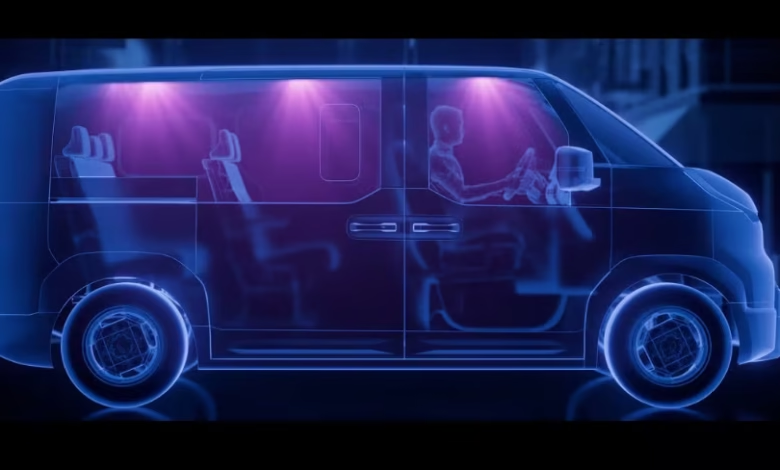
Hyundai and Kia have introduced a cabin sanitization system that uses far-ultraviolet light to eliminate bacteria and viruses inside a vehicle, and it operates safely even when people are inside. Dubbed Plasma Care UVC, the companies claim it is the first system of its kind designed for production cars.
Standard ultraviolet sterilization is dangerous to human skin and eyes, which is why it is typically confined to empty spaces like airplane lavatories between flights. Plasma Care UVC takes a different approach. It emits far-UVC light in the 200 to 230 nanometre range, a wavelength that cannot penetrate human skin but is lethal to bacteria and viruses. These microorganisms lack the protective outer layer that shields human cells, making them vulnerable to this specific light spectrum.
The companies conducted three separate rounds of independent testing. The Korea Testing Laboratory recorded a nearly 97 percent reduction in airborne viruses within 30 minutes inside a simulated cabin. Joint research with Seoul National University showed 99 percent eradication of pneumonia-causing bacteria in just 30 seconds. A final test with the Korea Automotive Technology Institute demonstrated 99 percent elimination of E. coli within 40 minutes inside an actual vehicle.
Shrinking this technology to fit inside a car was a major engineering hurdle. Far-UVC systems designed for hospitals and schools are too large and consume too much power for automotive use. Hyundai Motor Group’s R&D team miniaturized the plasma lamp and added an optical filter that restricts emitted wavelengths to the safe range, while also hardening the system against vibration and temperature fluctuations.
Beyond killing pathogens, the companies say the system also eliminates odors by destroying the organisms that cause them, rather than simply masking the smell. That could eventually make chemical air fresheners in cars unnecessary.
Plasma Care UVC is not yet installed in any production vehicle. Hyundai and Kia say tests are ongoing to meet international safety standards before the system reaches an assembly line. The companies have not announced which models will receive the technology first or when deliveries might begin.
The system does have clear limitations. UVC light only disinfects surfaces and air it can reach directly, so bacteria in shadowed areas or under seats would survive. Some pathogens can also repair themselves after UV exposure. That makes Plasma Care UVC best understood as a supplement to regular cleaning rather than a replacement. Hyundai and Kia will need to communicate this point carefully once the feature reaches showrooms.
(Source: The Next Web)