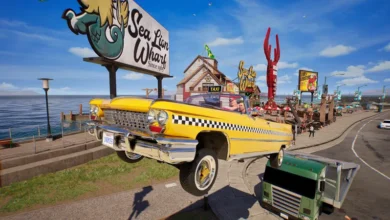
Crazy Taxi: World Tour Producer Addresses AI Use

▼ Summary
– Sega confirmed that generative AI was used as a support tool during development of “Crazy Taxi: World Tour” for background assets, with all generated assets reviewed by the development team.
– Series creator and lead producer Kenji Kanno clarified that AI was used only as a small part of the ideation process, serving as a hint for artists who created original designs based on real-world location references.
– The Steam page initially stated that no AI was used in reference to performers in the game, a point reiterated in both the spokesperson’s and Kanno’s statements.
– Kanno emphasized that the final product will contain only original work created by the team, aiming to deliver a great experience for customers.
– “Crazy Taxi: World Tour” is a faithful modernization of the franchise and is scheduled for release on PS5, Xbox Series X/S, Switch 2, and PC in 2027.
The Xbox Summer Showcase announcement of a new Crazy Taxi game generated a wave of excitement among longtime fans eager for a modern take on the arcade classic. However, that enthusiasm quickly collided with controversy when the game’s Steam page disclosed the use of generative AI during development. During a recent hands-off gameplay preview, I sat down with series creator and lead producer Kenji Kanno to get a clearer picture of what that actually means.
For context, the original Steam listing offered a brief, somewhat ambiguous statement: “At SEGA Corporation, we utilize generative AI as a support tool for developers, aiming to provide better content to our users and enable developers to focus more on creative tasks. We have used such generative AI support tools during development of Crazy Taxi: World Tour. No AI was used in reference to the performers in the game.”
When that explanation felt insufficient, a Sega spokesperson provided a slightly expanded version, clarifying that generative AI was used to support teams during the development of background assets. It added that all AI-generated assets were still subject to review by the development team and reiterated that no AI was used in relation to performers.
Still unsatisfied with the level of detail, I took the question directly to Kanno. His response was far more specific. “First, I think I can be a little bit more specific or clear on how we use the generative AI,” he said. “It’s like one small part of the creative process. To get a little bit more detailed about our design process, as mentioned earlier, it’s World Tour, and we have five different countries. I can’t say which countries there are today, but our artists, our designers, they actually went to the actual locations, and they took references, and based on that, they came up with the designs. And generally, AI is just one part of that, and is used as a hint or part of the ideation.”
Kanno acknowledged that the Steam statement was too vague. “To make things a bit more clear , and this is a sentiment that both me and our team of talented artists and designers back in Japan share , is that we want to create things ourselves and deliver that as a great experience for our customers. So rest assured, everything in the final product is going to be original.”
Despite the AI controversy, the game itself appears to be a faithful and energetic modernization of the beloved Dreamcast-era franchise. Crazy Taxi: World Tour is scheduled to launch on PS5, Xbox Series X/S, Switch 2, and PC in 2027.
(Source: Gameinformer.com)