Hue’s SpatialAware made me a color-changing light convert
▼ Summary
– The Philips Hue Bridge Pro offers MotionAware, which uses Zigbee signals to detect motion without separate sensors, but requires three to four powered, non-linear lights per room and is slower than dedicated motion sensors.
– SpatialAware, a feature exclusive to the Bridge Pro, uses AR to map lights in a room and intelligently distributes colors across scenes, making multicolored lighting more cohesive and natural.
– The Bridge Pro has a quad-core processor and 1GB of RAM for up to five times faster response times, supports over 150 lights and 50 accessories, and costs $140 in the US.
– For existing Hue users with many lights, SpatialAware is the primary reason to upgrade, as it transforms color scenes from a novelty into a daily-use feature, but the standard bridge remains a better value for new users.
– MotionAware worked best in a large living room but was unreliable in bedrooms (no weekend settings) and offices (no presence sensing), and it fails if lights are turned off at the switch.
I’ve been a Philips Hue enthusiast since the earliest generations of its smart lighting system, and it remains one of the few constants in my ever-evolving smart home. But when the Bridge Pro launched late last year, I wasn’t immediately convinced I needed it. Its headline feature, MotionAware , which effectively turns your Hue bulbs into motion sensors , is clever, but I already own dedicated motion sensors. I run two standard Hue bridges to handle all my lights and accessories, so the Pro’s higher device capacity isn’t a pressing need. Faster response times thanks to beefier processing power sounded nice, but not essential.
Then came SpatialAware in April. This feature maps the physical location of each light in a room and intelligently distributes the colors and tones of Hue’s lighting scenes across them. Suddenly, my existing smart lights felt brand new. While MotionAware was the big selling point at launch, it’s SpatialAware that finally made me want to upgrade.
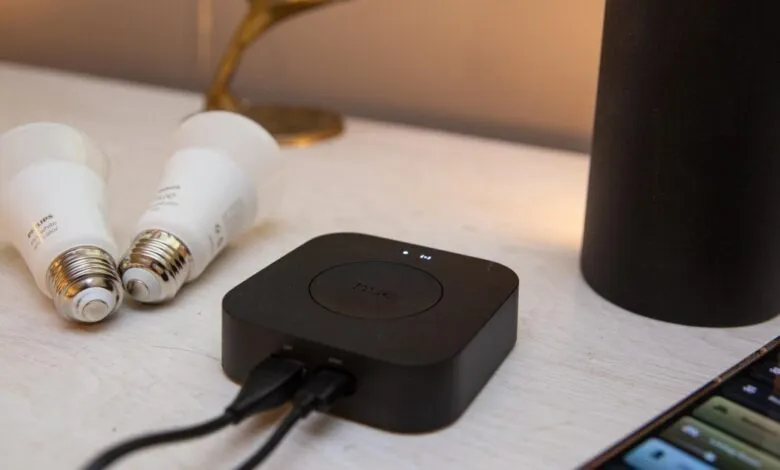
You don’t need a bridge to control a Hue light, but adding one unlocks advanced capabilities like dynamic lighting. The Bridge Pro, which debuted last September, packs a quad-core processor and 1GB of RAM, delivering faster response times and enabling both MotionAware and SpatialAware , features exclusive to the Pro.
For those already invested in Hue, upgrading to the $140 Bridge Pro can be a meaningful move. It supports up to four MotionAware zones, potentially eliminating the need for standalone motion sensors at $49 each. It can manage over 150 lights and 50 accessories , triple the standard bridge’s capacity , and promises response times up to five times faster. The catch is the price, especially in the US, where it costs roughly 40 percent more than in the UK or EU (where it’s £89.99).
Even as the Matter standard makes it easier to mix and match smart lighting brands, there are still strong reasons to stick with one ecosystem. Proprietary features like dynamic lighting, entertainment syncing, and now MotionAware and SpatialAware can’t be used when you combine products from different manufacturers.
Still, the standard bridge delivers most of the core experience for less. When the Pro was priced at $98, it was an easier sell , and you can still find it at that price for now , but at $140, the decision gets harder. Here’s how the Bridge Pro’s flagship features performed in my home.
MotionAware detects motion by sensing disruptions in Zigbee radio signals between Hue devices. In the app, it functions similarly to Hue’s standalone motion sensors, but it comes with specific requirements , and if you need to buy new hardware to meet them, you might be better off just buying a motion sensor.
The biggest requirement: three to four powered Hue lights in a room. My Hue Table lamp in the bedroom didn’t qualify because it’s unpowered, so I had to add an extra powered lamp to test it there. The bulbs also can’t be arranged in a straight line, which ruled out my bathroom with its single vanity light holding four Hue bulbs.
My mudroom and laundry room area, equipped with BR30 bulbs in the ceiling and adjoining space, worked with MotionAware , but it wasn’t as fast as the dedicated motion sensor by the entrance.
With the right lights in place, the app guides you through leaving the room for a few seconds to calibrate. You can then choose what happens when motion is detected: turn lights on or off, group with other sensors, or send alerts. The alert feature is part of Hue Secure, Hue’s security system, and costs $1 per month or $10 per year. For this review, I focused on the free light-control option.
Like Hue’s motion sensors, when a MotionAware zone detects motion, you can trigger different scenes or have the lights turn on to their last setting. You can also set them to turn off after a period of inactivity.
I set up MotionAware zones in my most-used areas: the bedroom, mudroom and laundry room, living room, and my daughter’s room. Within a day, I eliminated three of them.
The bedrooms were a nonstarter because the app lacks a weekend setting. The first Saturday, I rolled over in bed and the lights turned on at 6AM. Hue’s hardware motion sensors also lack weekend settings, but there are workarounds , like integrating them with other platforms that support weekend automations. Third-party support for MotionAware zones is currently limited but includes Home Assistant and the paid app iConnectHue.
In the mudroom and laundry room, I had more success. The lights turned on reliably, but only once I was halfway down the hall. That was too late for pass-through traffic but fine for tasks in the area. The layout was also problematic: although I have four lights, they’re all on the ceiling and not ideally positioned. A light nearer each entrance would have triggered faster, but that wasn’t possible.
I also tried MotionAware in my office with two lamps and one ceiling light. It worked well for turning on lights as I approached my desk, but because it’s motion-sensing rather than presence-sensing, it kept shutting them off while I was working. For an office, newer mmWave presence sensing would be a better solution, though Hue doesn’t offer it. I had to add an extra motion sensor to cover one corner of the room, which brought the benefit of the sensor’s physical light sensor but underscored that MotionAware isn’t always a standalone solution.
MotionAware worked best in my living room, a large open-plan space that’s always been tricky to light. I dislike overhead lighting, so I use a mix of ambient and task lights. In this room, I don’t need instant-on lights, and I actually like them to fade gently off when I’m sitting still. Paired with SpatialAware, the lighting now feels appropriate and welcoming throughout the day.
Aside from the living room, I see little reason to replace my motion sensors with MotionAware. It’s slower, less reliable, and shares a failure point familiar to Hue users: if someone turns off the light at the switch, the feature stops working.
But for new users, MotionAware makes more sense. It’s easy to set up , built right into your bulb and bridge combo , with no need for little white boxes to stick around the house that require periodic battery changes.
SpatialAware, the Bridge Pro’s other flagship feature, is what makes the upgrade worthwhile for existing Hue users. Using the Bridge Pro’s advanced processing power and your phone’s AR capabilities, the Hue app maps the lights in a room and determines the best way to distribute the scene’s colors and effects. I saw this at CES and was impressed. While I couldn’t replicate the hotel room demo exactly in my home, my lighting is noticeably better than before.
In the past, I rarely used Hue scenes beyond the core ones like read and energize, which use tunable white lighting (and for those, you only need Hue’s white ambient bulbs, not the pricier full-color ones). I’ve never found multicolored lighting compelling indoors , one bulb red or purple, another green or orange. But with SpatialAware, the scenes fit my space much better, as if they were designed for it. Many made my living room , where I have the most lights , a significantly prettier space.
For example, without SpatialAware, selecting a scene like Woodland Toadstool resulted in a weird display: one lamp glowing red, another yellow, and the light strip all orange. With SpatialAware, the color distribution across bulbs is subtler, and the gradient lighting in my setup (two Wall Washers) provides stronger pops of color in a more elegant way. The overall effect is more cohesive and natural. I suspect more gradient lights would make it even better.
Some scenes showed little difference, but most were noticeably improved , to the point where I added a couple to my MotionAware zones so they activate when motion is detected at certain times. My husband came home one night and commented on how nice the living room looked, and the only change was the lighting.
There’s room for improvement. Only some scenes have been updated to support SpatialAware, and the feature doesn’t work with zones , groups that can include lights in different rooms, like Downstairs or Night Lights. So if I want the same scene in my mudroom and living room, which are part of my downstairs zone, I have to set them individually. And as noted, the effect is best in rooms with many lights, especially gradient lights that can display multiple colors at once. All of this gets expensive quickly.
To test SpatialAware in my living room, I added Hue bulbs in lamps, Play Bars on the mantelpiece, Play Wall Washers by the TV, and a Solo light strip under the counter.
I’ve recommended Hue for years because of its high-quality lighting, rock-solid reliability, wide product range, and strong track record. Other brands offer cheaper bulbs and brighter colors, but most have less range, none dim as well, and Wi-Fi bulbs aren’t as reliable as a Zigbee mesh.
If you’re after super-bright colors and flashier RGB scenes, Govee, Nanoleaf, or Lifx may better suit your needs for less money. But for dependable everyday lighting, Hue remains the gold standard. The Bridge Pro is the first upgrade that’s truly changed how I use Hue lights , SpatialAware turned color-changing scenes from a novelty into a feature I prefer and use every day.
For me, that’s the reason to buy the Bridge Pro, and if you’re an existing Hue user with a house full of lights, I strongly recommend it. But if you’re just starting out with Hue, the standard bridge remains a better value, offering access to all core features for under $70. Unless you’re planning to buy a bunch of lights upfront, you won’t see enough benefit from the Pro’s headline features to justify the extra cost.
(Source: The Verge)