Silicon Valley bets $200M on floating AI data centers
▼ Summary
– Silicon Valley investors, including Peter Thiel, have invested hundreds of millions in AI data centers powered by ocean waves, as tech companies face land-based construction challenges.
– A $140 million investment round will help Panthalassa build a pilot facility near Portland, Oregon, and deploy floating “nodes” that generate power from waves.
– The floating nodes directly power onboard AI chips and transmit AI model outputs to customers worldwide via satellite, transforming energy transmission into data transmission.
– Each node is a steel sphere with a tube that uses wave motion to pressurize water, which spins a turbine to generate renewable energy for AI chips.
– The nodes use surrounding ocean water for cooling, offering a cooling advantage over land-based data centers that consume significant electricity and fresh water.
Silicon Valley is pouring hundreds of millions of dollars into a radical new vision: floating AI data centers powered by ocean waves. Backed by investors including Palantir co-founder Peter Thiel, the strategy emerges as tech companies face growing obstacles to building AI infrastructure on land.
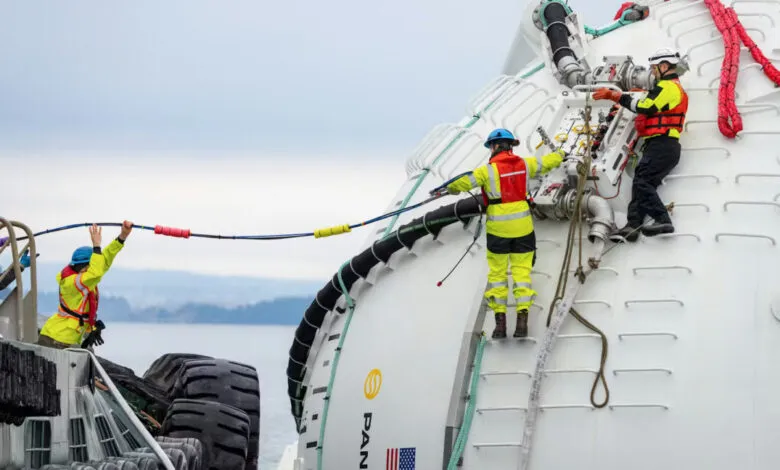
The latest funding round, totaling $140 million, will help the startup Panthalassa complete a pilot manufacturing facility near Portland, Oregon, and accelerate deployment of its wave-riding “nodes,” according to a May 4 press release. Rather than transmitting renewable energy to a land-based facility, these floating platforms would directly power onboard AI chips. The models’ outputs, known as inference tokens, would then be sent to customers worldwide via satellite link.
“Panthalassa’s idea transforms an energy transmission problem into a data transmission problem,” said Benjamin Lee, a computer architect and engineer at the University of Pennsylvania. “Performing AI computation on the ocean would require transferring models to the ocean-based nodes and then responding to prompts and queries.”
Each node is designed as a massive steel sphere that bobs on the water, with a tube-like structure extending vertically beneath the surface. Wave motion forces water upward through the tube into a pressurized reservoir. When released, the water spins a turbine generator, producing renewable energy for the AI chips onboard.
The surrounding seawater also provides a natural cooling solution, an advantage over conventional data centers. “Ocean-based compute might offer a massive cooling advantage because the ambient temperature is so low,” Lee added. “Land-based data centers use a lot of electricity and fresh water for cooling.”
This approach could sidestep many of the permitting, land-use, and grid-capacity issues that have stalled AI data center projects onshore. By moving computation to the open ocean, Panthalassa aims to bypass those bottlenecks entirely, converting a logistical hurdle into a technical opportunity.
(Source: Ars Technica)