Palantir Staff Question If They’re the Bad Guys
▼ Summary
– During Trump’s second term, Palantir employees began questioning the company’s civil liberties commitments as it became the technological backbone of immigration enforcement for DHS.
– Two former employees expressed concern over Palantir’s direction, with one asking if the company was “descending into fascism.”
– Palantir, cofounded by Peter Thiel with CIA investment post-9/11, sells data analysis software used by the US military and private businesses.
– Internal employee concerns grew over Palantir’s deepening role with an administration they feared was “wreaking havoc at home,” forcing a rethink of the company’s mission.
– Tensions boiled over in January after a nurse was killed by federal agents during an ICE protest, prompting employees to demand more information from CEO Alex Karp about the company’s relationship with ICE.
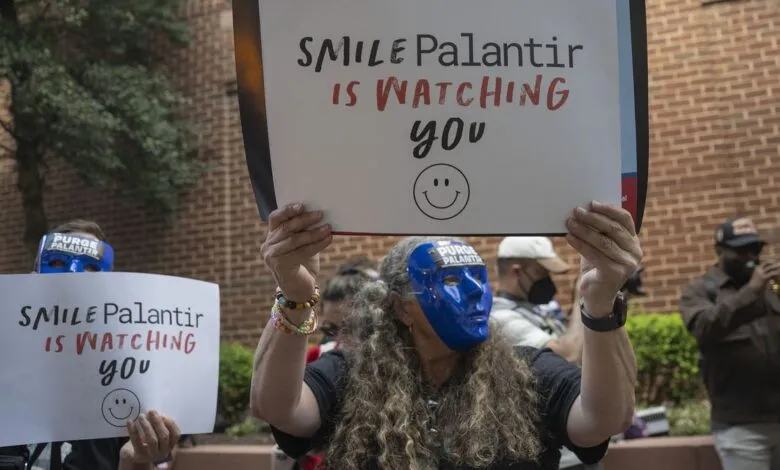
It took only a few months into President Donald Trump’s second term for Palantir employees to begin questioning whether their company had abandoned its stated commitment to civil liberties. By last fall, Palantir had essentially become the technological backbone of Trump’s immigration enforcement apparatus, supplying software to the Department of Homeland Security (DHS) that identifies, tracks, and helps deport immigrants. That’s when current and former staffers started sounding the alarm.
Around that time, two former employees reconnected by phone. As soon as one picked up, the other asked, “Are you tracking Palantir’s descent into fascism?”
“That was their greeting,” the second former employee recalls. “There’s this feeling not of ‘Oh, this is unpopular and hard,’ but, ‘This feels wrong.’”
Palantir was founded with initial venture capital from the CIA, at a moment of national unity after the September 11, 2001 attacks, when many Americans saw fighting terrorism abroad as the country’s most urgent mission. Co-founded by tech billionaire Peter Thiel, the company sells software that functions as a powerful data aggregation and analysis tool, serving everything from private businesses to the U. S. military’s targeting systems.
For two decades, employees could tolerate intense external criticism and awkward conversations with family and friends about working for a company named after J. R. R. Tolkien’s corrupting, all-seeing orb. But now, a year into Trump’s second term, as Palantir deepens its ties with an administration many workers believe is causing havoc at home, those concerns are finally being voiced internally. The U. S. war on immigrants, the ongoing conflict in Iran, and even company-released manifestos have forced staff to reconsider their role in it all.
“We hire the best and brightest talent to help defend America and its allies and to build and deploy our software to help governments and businesses around the world. Palantir is no monolith of belief, nor should we be,” a Palantir spokesperson said in a statement. “We all pride ourselves on a culture of fierce internal dialogue and even disagreement over the complex areas we work on. That has been true from our founding and remains true today.”
—
Got a Tip? Are you a current or former government employee who wants to talk about what’s happening? We’d like to hear from you. Using a nonwork phone or computer, contact the reporters securely on Signal at makenakelly.32.
—
“The broad story of Palantir as told to itself and to employees was that coming out of 9/11 we knew that there was going to be this big push for safety, and we were worried that that safety might infringe on civil liberties,” one former employee tells WIRED. “And now the threat’s coming from within. I think there’s a bit of an identity crisis and a bit of a challenge. We were supposed to be the ones who were preventing a lot of these abuses. Now we’re not preventing them. We seem to be enabling them.”
Palantir has long maintained a secretive reputation, barring employees from speaking to the press and requiring alumni to sign non-disparagement agreements. But throughout the company’s history, management has at least appeared open to engagement and internal criticism, multiple employees say. Over the last year, however, much of that feedback has been met with philosophical soliloquies and redirection. “It’s never been really that people are afraid of speaking up against Karp. It’s more a question of what it would do, if anything,” one current employee tells WIRED.
While internal tensions at Palantir have grown over the last year, they reached a boiling point in January after the violent killing of Alex Pretti, a nurse who was shot and killed by federal agents during protests against Immigration and Customs Enforcement (ICE) in Minneapolis. Employees from across the company commented in a Slack thread dedicated to the news, demanding more information about the company’s relationship with ICE from management and CEO Alex Karp.
(Source: Wired)