Dyson’s Robot Vacuum Now Uses a Third-Party Motor
▼ Summary
– Dyson confirmed its newest robot vacuum, the Spot & Scrub Ai, does not use a Dyson motor; its lidar navigation and vacuum motor were developed by a third-party partner.
– The company outsourced these key components to quickly and cost-effectively enter the wet-and-dry robot vacuum market, where it lags behind competitors like Roborock and Ecovacs.
– Previous Dyson robot vacuums, such as the 360 Eye and Vis Nav, used powerful Dyson motors but had unreliable camera-based navigation.
– In The Verge’s testing, the Spot & Scrub’s vacuuming performance was significantly worse than Dyson’s previous robots, especially on carpet.
– Dyson’s senior design manager hinted the company may work toward a future robot combining its motor technology with mopping and machine learning advances, but the Spot & Scrub is a “balancing act” for competitiveness.
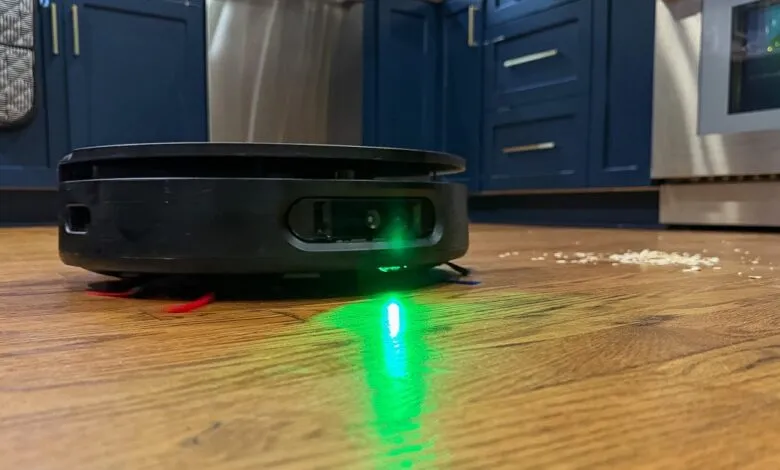
Dyson has long been synonymous with its own high-speed motor technology, but the company’s latest robot vacuum marks a notable departure from that tradition. The Verge has confirmed that the new Dyson Spot & Scrub Ai robot vacuum and mop does not use a Dyson motor. Instead, the device was “co-engineered,” according to Nathan Lawson McLean, senior design manager at Dyson.
Lawson McLean explained that the Spot & Scrub Ai blends “new and already existing Dyson technologies with other platforms.” In particular, the robot’s lidar-based navigation system and its vacuum motor were developed by a third-party partner. “It’s not one of our V10 motors; it’s one of our partner technologies,” he said.
The suspicion that Dyson had outside help with its newest robot vacuum emerged shortly after the product’s announcement late last year. The Spot & Scrub represents a radical shift from Dyson’s earlier models, bearing obvious similarities to many other robot vacuums already on the market. However, this is the first time Dyson has publicly acknowledged that it relied on external assistance to build its flagship robotic cleaner.
Outsourcing key components is common practice in the robot vacuum industry and manufacturing at large. Still, for a company that has built its reputation on proprietary high-speed motors and cyclonic vacuum technology, this move is unexpected. The Spot & Scrub is also Dyson’s first robot vacuum to include a multifunctional dock that empties the bin, washes the mop, and drains and refills the water tanks.
So why did Dyson abandon its signature motor for this model? According to Lawson McLean, the decision came down to speed and cost. “We really wanted to enter the market in this new space of wet and dry and self-emptying,” he said. “And how could we quickly do that?” The answer was to bring in a partner.
Though Dyson has been developing robotic floor cleaners since the early 2000s, it lags years behind Chinese competitors like Roborock and Ecovacs, as well as U. S.-based iRobot, maker of the Roomba. iRobot made a similar pivot last year, moving from vision-based navigation to lidar by working with Chinese original design manufacturer Shenzhen Picea Robotics to produce an entirely new line of Roombas.
Dyson has not confirmed which partner it collaborated with, but Reddit sleuths and industry analysts have identified Picea as the likely candidate. Picea also works with Xiaomi, Anker (Eufy), and Shark, and recently purchased iRobot following its bankruptcy.
Dyson’s earlier robot vacuums, such as the 360 Eye and the 360 Vis Nav, featured Dyson-designed high-speed motors. While those models excelled at suction, they struggled with autonomous navigation, relying on camera-based vSLAM technology that proved slow and unreliable.
For the Spot & Scrub, Dyson partnered with a third party to integrate more dependable lidar navigation. Reviews suggest this has been a significant upgrade. The shift was clearly necessary for Dyson to stay competitive. But in the process, the company also dropped its strongest selling point: its powerful motor.
Lawson McLean argues that this tradeoff tells only part of the story. “We never look at motors by themselves. The ducting, the inlet pressure, outlet pressure, etc. of the Spot & Scrub all have a huge amount of Dyson engineering wrapped around it,” he said.
He also noted that much of the robot incorporates “new and already existing Dyson technologies,” including the company’s AI stain detection, a 12-point hydration system for the self-cleaning wet rollers, and the Cyclonic bagless dock , a key part of Dyson’s first multifunction robotic dock.
The Dyson Vis Nav, the company’s previous robot vacuum, still features a Dyson-designed motor that outperforms the one in the Spot & Scrub. Yet the new model is a Dyson vacuum without a Dyson motor. In The Verge’s testing, the Spot & Scrub’s vacuuming performance was notably weaker than its predecessors, especially on carpet.
Lawson McLean declined to share future product roadmaps but hinted that Dyson may be working toward a robot that successfully combines its motor technology and vacuuming heritage with advances in mopping, machine learning, and essential robotic features. The Spot & Scrub, however, is not that device. Instead, he described it as a “balancing act” , a product designed to keep Dyson relevant in a market where it has yet to make a lasting impact.
(Source: The Verge)