SoftBank seeks $10B margin loan backed by OpenAI shares

▼ Summary
– SoftBank is seeking a $10 billion margin loan backed by its OpenAI shares with a two-year term and one-year extension at SOFR plus 425 basis points (~7.88%).
– This loan adds to a $40 billion bridge loan from March, bringing SoftBank’s total OpenAI commitment to ~$64.6 billion for a ~13% stake.
– At OpenAI’s $852 billion valuation, SoftBank’s stake is notionally worth ~$110 billion, but S&P downgraded its outlook to negative (BB+) and it faces a $32 billion funding gap.
– The loan’s high interest rate reflects the illiquidity of private OpenAI shares, unlike SoftBank’s 2018 Alibaba margin loan backed by publicly traded stock.
– Masayoshi Son is betting on AI dominance through “total offence mode,” but analysts warn the strategy risks failure if OpenAI’s valuation drops or debt service falters.
SoftBank is pursuing a $10 billion margin loan secured by its shares in OpenAI, a move that deepens the financial complexity of what is already the most leveraged bet in artificial intelligence history. The proposed financing, reported by Bloomberg, carries a two-year term with a possible one-year extension and an interest rate of roughly 425 basis points above the secured overnight financing rate, equating to approximately 7.88% at current levels. The deal remains unconfirmed, with no specific lending banks disclosed. What is clear is that SoftBank is borrowing against unrealized gains in a private company to fund further investment in the same entity, creating a recursive leverage structure that functions flawlessly until it does not.
This is neither SoftBank’s first margin loan nor its most intricate financing arrangement this year. In March, the company secured a $40 billion bridge loan underwritten by JPMorgan Chase, Goldman Sachs, Mizuho Bank, Sumitomo Mitsui Banking Corporation, and MUFG Bank. That facility was designated for a $30 billion follow-on investment in OpenAI and general corporate purposes. It entered a soft launch phase in mid-April, with additional lenders invited to join at roughly $5 billion commitments each. The $10 billion margin loan sits atop that. SoftBank’s total debt now stands at approximately 20.45 trillion yen, roughly $135 billion.
The OpenAI position represents SoftBank’s most concentrated wager. Once the $30 billion follow-on closes, cumulative investment will reach approximately $64.6 billion, securing roughly 13% of the company. The initial commitment, completed by late December 2025, totaled $40 to $41 billion: $7.5 billion in direct investment, $11 billion syndicated with co-investors, and a $22 to $22.5 billion final tranche. To fund that, Masayoshi Son sold SoftBank’s entire Nvidia stake for $5.83 billion and $12.73 billion in T-Mobile stock between June and December 2025. He then borrowed $40 billion more. Now, he is borrowing an additional $10 billion.
The collateral’s notional value has shifted dramatically. SoftBank’s initial $40 billion went in at OpenAI’s March 2025 valuation of $300 billion pre-money. By March 2026, OpenAI’s record funding round closed at an $852 billion post-money valuation, anchored by Amazon at $50 billion, Nvidia at $30 billion, and SoftBank’s own $30 billion follow-on. At that valuation, SoftBank’s 13% stake is notionally worth roughly $110 billion, making a $10 billion margin loan appear modest, about 9% of the collateral’s paper value. The critical question is what that paper is worth if the music stops.
The price of illiquidity is stark. When SoftBank borrowed $8 billion against its Alibaba stake in 2018, the rate was LIBOR plus 150 basis points. Ten banks participated. Alibaba was publicly traded on the New York Stock Exchange, with daily trading volume in the billions. If SoftBank defaulted, lenders could sell the shares the next morning. The rate reflected that liquidity. The OpenAI margin loan is priced at SOFR plus 425 basis points, nearly triple the spread. The difference is not just the macro environment. It is the nature of the collateral. OpenAI is a private company. Its shares do not trade on any exchange. Secondary market transactions are infrequent, opaque, and subject to company approval. OpenAI’s $852 billion valuation has come under scrutiny from its own investors, with secondary market data showing a five-to-one ratio of sellers to buyers. If SoftBank were to default, lenders would hold shares in a private company that they cannot easily sell, at a valuation the secondary market is already questioning, in a sector where sentiment can shift in a quarter. The 275 basis point spread premium over the Alibaba loan is the banks’ price for that risk.
Whether it is enough is another matter.
The leverage stack is tightening. SoftBank’s loan-to-value ratio stood at 20.6% as of December 2025, with management estimating current levels at roughly 19%. The company’s self-imposed ceiling is 25%, and it has acknowledged it could “temporarily” breach that limit. S&P Global Ratings downgraded SoftBank’s credit outlook from stable to negative in March 2026, affirming its BB+ rating and citing concerns about liquidity and asset credit quality. S&P noted that OpenAI is among the investments with the “weakest credit quality” in SoftBank’s portfolio and that the proportion of unlisted assets is expected to rise above 50%, up from 42% in December. Credit-default swaps on SoftBank debt widened roughly 10 basis points to approximately 360 basis points after the margin loan was reported, approaching a one-year high of 376.
Analysts estimate SoftBank faces a $32 billion funding gap over the next two years for bond redemptions and committed acquisitions. The company held 3.8 trillion yen in cash as of December and has issued 1.12 trillion yen in domestic bonds alongside $2.2 billion and 1.7 billion euros in foreign currency bonds. Undrawn credit lines totaled 945.2 billion yen. The financing is not yet stretched to breaking, but the margin for error is narrowing with each new facility.
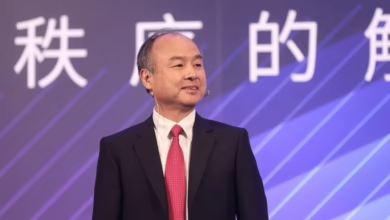
The Son thesis is bold. Masayoshi Son has described SoftBank’s current posture as “total offence mode” and is repositioning the company as an “AI-era industrial holding company.” He believes artificial superintelligence, AI 10,000 times smarter than humans, will arrive within 10 years. He has stopped investing in China entirely. Sixty percent of SoftBank’s assets are now classified as “ASI-oriented investments.” Son chairs the Stargate joint venture with OpenAI, Oracle, and MGX, the Abu Dhabi investment firm, which has committed an initial $100 billion with plans to invest up to $500 billion by 2029 in AI data centers across the United States. Ten facilities are under construction in Abilene, Texas, with expansion planned to the UK, Norway, Japan, and the UAE.
The thesis requires believing several things simultaneously: that OpenAI will maintain its position as the leading AI company; that its $852 billion valuation will hold or increase; that the Stargate infrastructure buildout will generate returns commensurate with its cost; and that SoftBank can service its debt stack while the returns materialize. Son has been right about this kind of bet before. His $20 million investment in Alibaba in 2000 returned more than $100 billion. He has also been wrong. The Vision Fund 1 returned 7% IRR on $100 billion in committed capital. Vision Fund 2 returned 0.2%, essentially flat, on $72 billion. The combined funds generated roughly $5 billion in gains from $172 billion in commitments. The question is which pattern the OpenAI bet follows.
The AI financing environment is intense. SoftBank’s margin loan sits within a venture capital environment deploying record capital into AI, with $297 billion in venture investment in the first quarter of 2026 alone, 2.5 times the previous quarter. The concentration is extreme. OpenAI’s $122 billion round, the largest private funding round in history, drew $50 billion from Amazon and $30 billion each from Nvidia and SoftBank. The capital is flowing to a handful of companies at valuations that assume the entire global economy will be reorganized around their technology within a decade.
The risk is not that AI fails to matter. It is that the returns are competed away, that open-source models erode pricing power, that the infrastructure buildout overshoots demand, or that a single company at an $852 billion private valuation is mispriced even if the sector as a whole delivers. OpenAI has already paused its Stargate UK data center project over energy costs and regulatory obstacles, a reminder that not every infrastructure plan proceeds on schedule. SoftBank is borrowing against a future that it is simultaneously helping to build and betting will arrive on time. The margin loan is a financial instrument. The margin for error is a strategic one. At $135 billion in total debt and $64.6 billion committed to a single private company, the distance between visionary and reckless is one down round.
(Source: The Next Web)