Open-Source Tool Reveals CI/CD Pipeline Attack Methods
▼ Summary
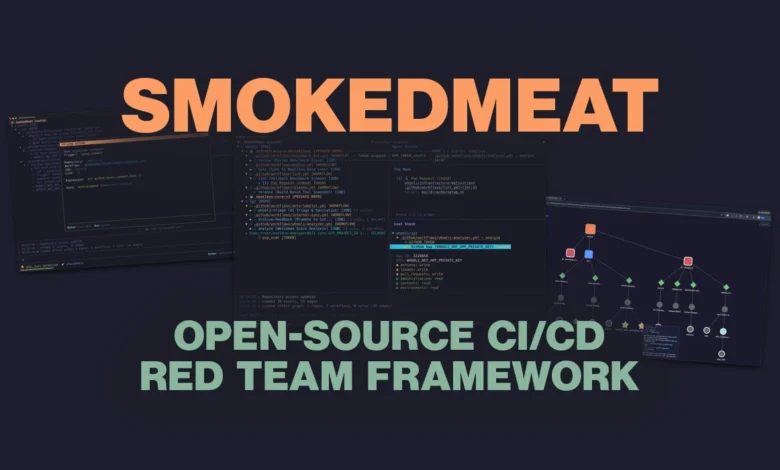
– Boost Security released SmokedMeat, an open-source framework that simulates attack chains against CI/CD infrastructure to demonstrate real-world risks.
– The tool exploits a flagged pipeline vulnerability to deploy a payload, compromise systems, steal credentials, and map the potential damage in a live environment.
– The 2026 TeamPCP attack, which compromised major tools like Trivy, exemplified the severe cascade supply chain threats that such simulations aim to prevent.
– Security findings often go unpatched because static vulnerability reports fail to convey the immediate, concrete impact an attacker could achieve.
– SmokedMeat is freely available on GitHub and is designed to prioritize remediation by showing exploitation scenarios on a team’s own infrastructure.
The release of an open-source framework is providing security and engineering teams with a powerful new way to visualize threats. Boost Security has launched SmokedMeat, a tool that actively simulates attack chains against an organization’s own CI/CD infrastructure. This allows teams to witness firsthand the exact steps an adversary would take after discovering a vulnerability, moving beyond theoretical warnings to see a live demonstration of potential compromise.
The tool operates by taking a known pipeline vulnerability and executing a full attack sequence. It begins by deploying an exploit payload, then proceeds to compromise the CI/CD runner. From there, it harvests credentials directly from process memory, uses those stolen credentials to gain access to cloud environments, and ultimately exposes private repositories to map the complete blast radius of the attack. This end-to-end simulation transforms an abstract security finding into a tangible, urgent problem.
Zaid Al Hamami, CEO of Boost Security, explained the tool’s purpose is to illustrate the attacker’s perspective. He noted that adversaries can find a vulnerability in an open-source repository, craft a specific exploit, steal credentials from that repo, and then pivot to other systems to insert malware or infect developers working on those projects.
The urgency for such a tool was underscored earlier this year by the massive TeamPCP attack. In March, this coordinated campaign successfully compromised tools including Trivy, Checkmarx, and LiteLLM, along with dozens of npm packages. Notably, the techniques used mirrored those Boost Labs had documented in prior research. Their open-source scanner, Poutine, had even flagged critical vulnerabilities in Trivy’s pipeline months before the breach, but those findings remained unpatched. Al Hamami described the event as the largest cascade supply chain attack seen to date.
This incident highlights a persistent challenge in application security, the backlog problem. For years, Boost Labs published research detailing how attackers navigate build pipelines, steal credentials, and pivot into cloud environments. However, a static scan result that merely states “workflow injection possible” fails to convey the rapid, devastating impact an attacker can achieve in seconds. Without a concrete, visual demonstration of the risk, remediation tasks are often deprioritized in favor of other development work.
SmokedMeat is specifically engineered to bridge this critical communication gap. By running a realistic attack scenario against live infrastructure, it provides security teams and engineering leaders with an unambiguous view of what exploitation looks like in their specific environment. This evidence-based approach is designed to shift security findings from being ignored tickets to becoming prioritized action items. The framework is available for free on GitHub.
(Source: Help Net Security)