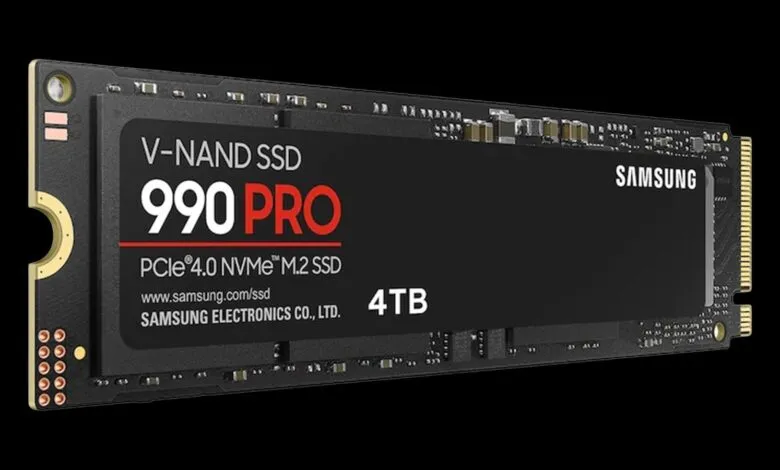
Samsung 990 Pro Fake SSD Clone Has Near-Identical Performance
▼ Summary
– Counterfeit Samsung 990 Pro SSDs are becoming highly convincing, with packaging that is nearly identical to the original, differing only in subtle details like an extra hanging tab.
– The fake drive uses a different, smaller Maxio MAP1602 SSD controller instead of Samsung’s proprietary Pascal controller, a key internal difference.
– It lacks the LPDDR4 DRAM of the genuine drive and likely uses cheaper QLC NAND flash instead of Samsung’s 176-Layer V-NAND TLC.
– While its sequential read/write speeds are close to the original, its random write performance is significantly slower, especially in sustained real-world file transfers.
– The recommended method to identify fakes is to use Samsung’s Magician software, which authenticates drives and restricts features on counterfeits.
The market for counterfeit storage devices has reached a new level of sophistication, with a recent analysis revealing a fake Samsung 990 Pro SSD that delivers alarmingly similar performance to the genuine flagship drive. This high-quality clone, examined by Japanese outlet Akiba PC Hotline, demonstrates how far counterfeiters will go to deceive consumers, making visual identification nearly impossible for the average buyer.
The deception begins with the packaging. Counterfeiters have invested significant effort into replicating the retail box, creating a package that is virtually identical to the authentic one. A minor tell, such as the inclusion of a header for display racks which the original lacks, might be the only visual clue. This attention to detail extends to the drive’s label, which is a near-perfect copy. The real differences are hidden beneath the surface, where the technical specifications diverge completely.
At the heart of the genuine 990 Pro is Samsung’s proprietary Pascal SSD controller. The counterfeit model substitutes this with a Maxio MAP1602 SSD controller, a smaller, DRAM-less design. This fundamental swap has cascading effects on the components. The authentic drive uses LPDDR4 memory and Samsung’s 176-Layer V-NAND TLC flash. The fake drive lacks dedicated DRAM and likely employs cheaper QLC NAND flash, a cost-cutting measure typical of forgery operations.
Where this particular clone stands out is in its benchmarked speed. Unlike many fakes that perform abysmally, this unit posted sequential read and write speeds of 7,255 MB/s and 6,090 MB/s. These figures are uncomfortably close to the real 990 Pro’s rated speeds of 7,450 MB/s and 6,900 MB/s. The Maxio controller is clearly capable in sequential tasks, which are the numbers most consumers check. However, a deeper look at random 4K performance exposes a significant gap. In a test using 32 queues and 16 threads, the fake drive managed only about half the write speed of the genuine Samsung controller.
Further testing confirmed the drive’s advertised 1TB capacity was real, but its sustained write performance told a different story. A large file transfer test proved devastating for the clone. While the real 990 Pro moved a 397GB file in under four minutes, the counterfeit drive took over 25 minutes. Once its SLC cache was exhausted, the fake drive’s write speed plummeted to a sluggish 100 MB/s, a stark contrast to the consistent high speed maintained by the authentic product.
This incident underscores a persistent trend with Samsung SSD clones, which have plagued previous generations like the 980 Pro. The most reliable method for verification is to use the official Samsung Magician software, which will fail to authenticate or run diagnostics on a counterfeit drive. The ultimate safeguard is to purchase storage only from authorized and reputable retailers. Even if a drive looks perfect, running it through Samsung’s validation tool is an essential final step, as these sophisticated fakes are becoming more convincing with each passing day.
(Source: Tom’s Hardware UK)