Theban Tomb Reveals Shift in Ancient Egyptian Burial Practices
▼ Summary
– A new study in Frontiers in Environmental Archaeology shows Theban burial practices shifted from individual elaborate coffin burials to reusing older sites, increasing density and body superposition.
– The research focused on Theban tomb 209 in the western necropolis, active from the early 25th Dynasty to the Ptolemaic period, and originally owned by a high official named Nisemro.
– The tomb’s location in an active drainage channel caused repeated flash flooding, making it a complex archaeological site.
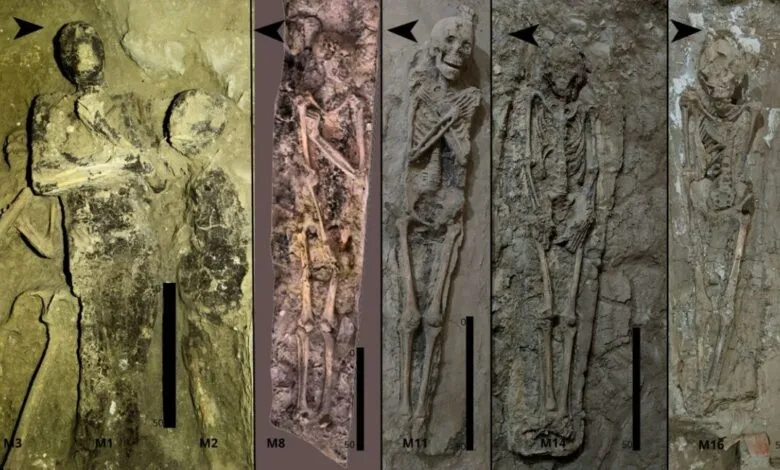
– Using an integrated archaeothanatological approach, the team analyzed body positions, coffin use, superpositions, and stratigraphy to reconstruct burial sequences in Side Chamber 3.
– Excavations uncovered 16 mummified individuals, a mummified dog, and disarticulated remains of at least four others, indicating deliberate spatial adaptation to prior burials rather than chaotic accumulation.
Archaeologists working in Egypt’s Theban necropolis have documented a fascinating evolution in how ancient communities handled their dead, with new findings suggesting a deliberate shift from individual, ornate burials to the systematic reuse of existing tomb spaces. The research, published in Frontiers in Environmental Archaeology, offers fresh insight into funerary practices that adapted over centuries, leading to densely packed burial chambers and even stacked remains.
While tomb reuse in Thebes has been studied before, this investigation zeroes in on a specific structure known as Tomb 209, situated in the western necropolis. Dating back to the early 25th Dynasty (754–656 BCE) and eventually abandoned during the Ptolemaic period (305–30 BCE), the tomb originally belonged to a high-ranking official of Nubian descent named Nisemro. Its location, however, proved problematic: the tomb sat directly within an active drainage channel of the Wadi Hatasun, making it vulnerable to repeated flash floods over the centuries. That combination of factors created a highly complex archaeological puzzle.
To untangle it, the team employed what they call an integrated archaeothanatological approach, combining detailed observations of body positioning, coffin usage, and stratigraphic layers with osteological analysis. This method allowed them to reconstruct the precise chronological sequence of burials within the site, focusing on a largely undisturbed secondary area known as Side Chamber 3.
What emerged from the excavation was striking: the remains of 16 mummified individuals (totaling 1,444 bones), a single mummified dog, and a separate chamber filled with the disarticulated fragments of at least four more people (1,775 bone fragments in all). Rather than signaling chaos or a breakdown in ritual tradition, the arrangement tells a more nuanced story. “The detailed study of the bodies indicates neither chaotic accumulation nor a loss of the original ritual over time,” explained co-author Jared Carballo-Perez of the University of La Laguna in Spain. “Rather, there was a spatial logic in which each new deposition was adapted to the presence of previous bodies, a kind of funerary memory in the processes of reuse.”
This evidence points to a deliberate, respectful approach to burial over many generations. Instead of clearing out older remains to make way for new ones, those managing the tomb carefully integrated each fresh interment around the existing occupants. That practice, the authors argue, reflects a cultural continuity in how Theban communities viewed death and the afterlife, even as their methods shifted from elaborate single burials to more communal, space-conscious arrangements. The findings add a valuable layer to our understanding of ancient Egyptian society, showing that even in death, there was a keen awareness of history and place.
(Source: Ars Technica)